

I researched this against current Healthdirect Australia guidance, DermNet, and peer-reviewed hair-fibre research, including 2025–2026 studies on friction and UV damage. (Healthdirect)
Hair can look dry, rough or frizzy for many reasons. Sometimes the problem is hair damage to the hair shaft. Other times, changes in your hair may come from the scalp, hair follicle or a health condition.
Knowing the difference matters. A conditioner may help rough, tangled hair feel smoother, but it will not treat a scalp infection or a type of alopecia.
This guide explains the main types of hair damage, how to judge how damaged your hair may be, and 10 common hair and scalp problems to know about.
What Are the Main Types of Hair Damage?
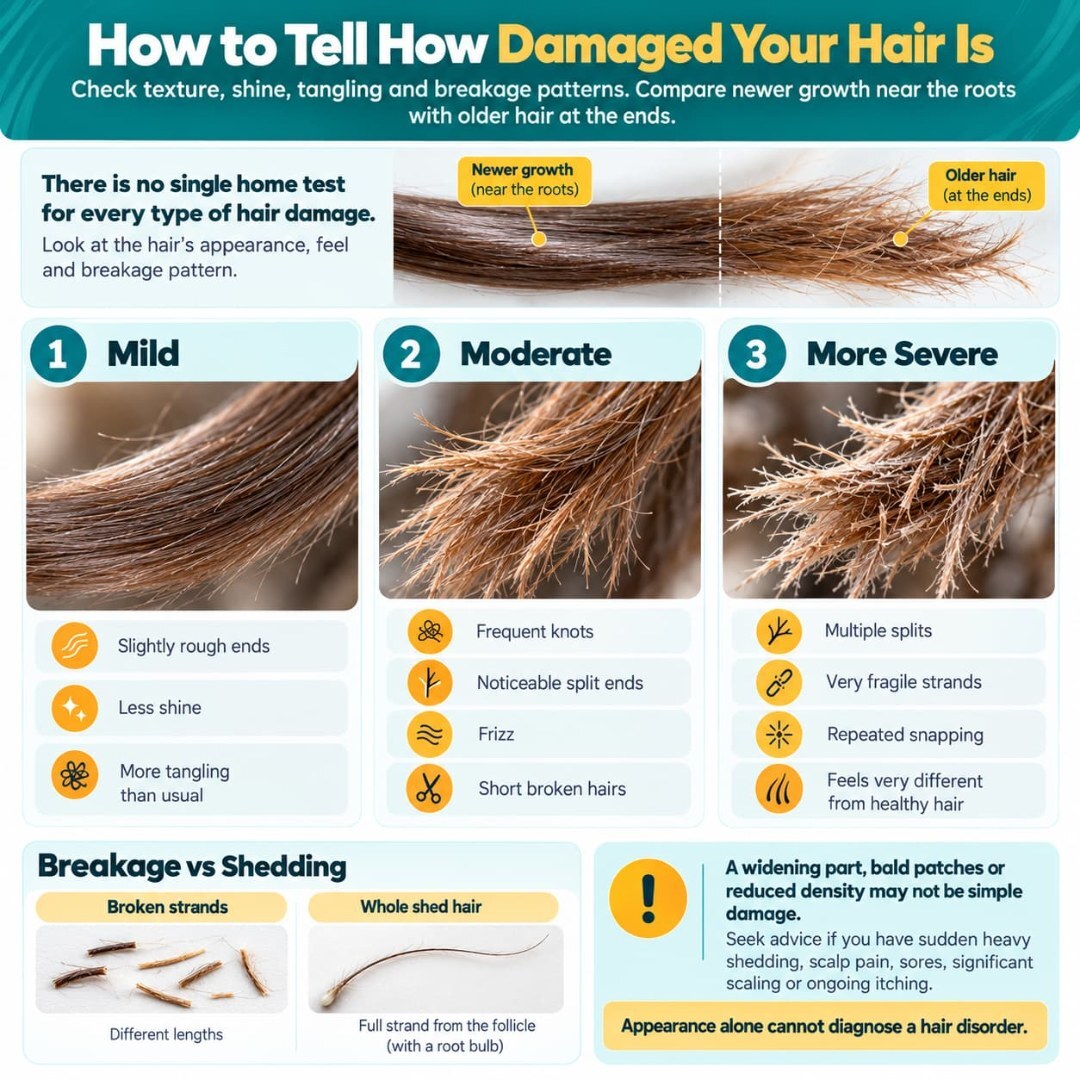
The visible hair above your scalp is made mainly from keratin. Its outer layer is called the cuticle. Under the cuticle is the cortex, which provides much of the hair fibre's strength.
Research published in Polymers explains that repeated stress can gradually wear away the protective surface of the hair. This process is sometimes called hair weathering. Hair farther from the scalp, especially the ends of long hair, has usually been exposed to more wear than newer growth near the roots. (PubMed)
Hair damage can be grouped into four main types:
A 2026 study from the University of São Paulo found measurable changes to the hair cuticle after simulated UV exposure. Research also shows that bleaching and other chemical treatments can increase structural damage. (PubMed)
Most people have more than one type of damage at the same time. For example, bleached hair that is also heat-styled and brushed frequently receives chemical, thermal and mechanical stress.
How Do I Tell How Damaged My Hair Is?
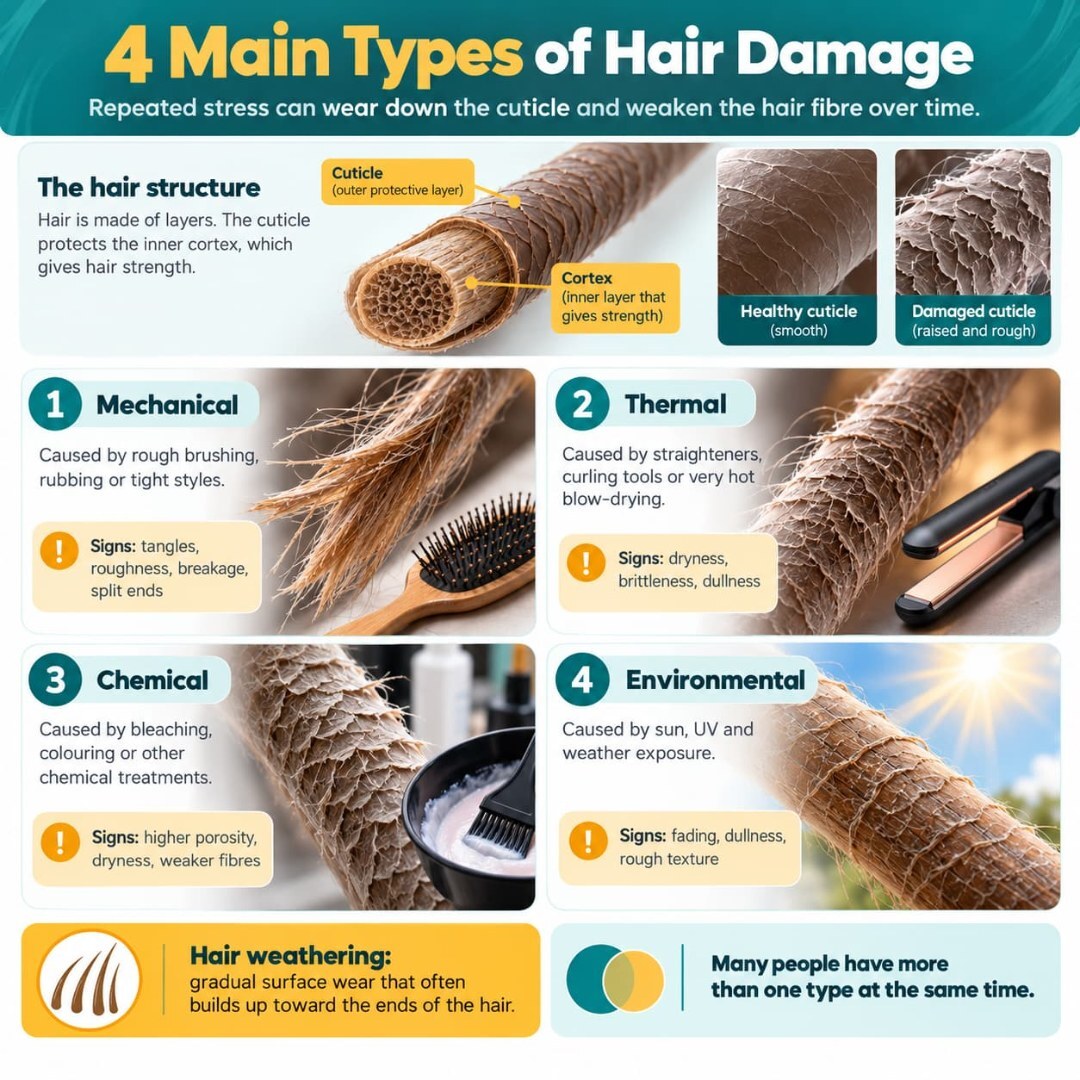
There is no single home test that can precisely measure every type of hair damage. However, you can look at your hair's texture, appearance and breakage pattern.
Start by comparing the newer hair near your roots with the older hair at the ends.
Mild damage may show as slightly rough or dry ends, less shine and more tangling than usual.
Moderate damage may include frequent knots, noticeable split ends, frizz that is difficult to manage and short broken hairs through the lengths.
More severe damage may involve widespread splitting, very fragile strands, repeated snapping or hair that feels very different from healthy new growth.
DermNet explains that damaged or abnormal hair shafts can become coarse, frizzy, difficult to comb or unusually fragile. Some structural problems need microscopic examination, so appearance alone cannot diagnose a hair disorder. (DermNet®)
Also look at where the hair is coming from. Breakage usually leaves strands of different lengths. Hair shedding involves whole strands coming from the follicle. A widening part, bald patches or a clear reduction in hair density should not automatically be blamed on damaged ends.
If you have sudden or heavy shedding, bald patches, scalp pain, sores, significant scaling or ongoing itching, Healthdirect recommends finding the cause rather than assuming it is cosmetic damage. (Healthdirect)
What Are 10 Common Hair Disorders or Problems?
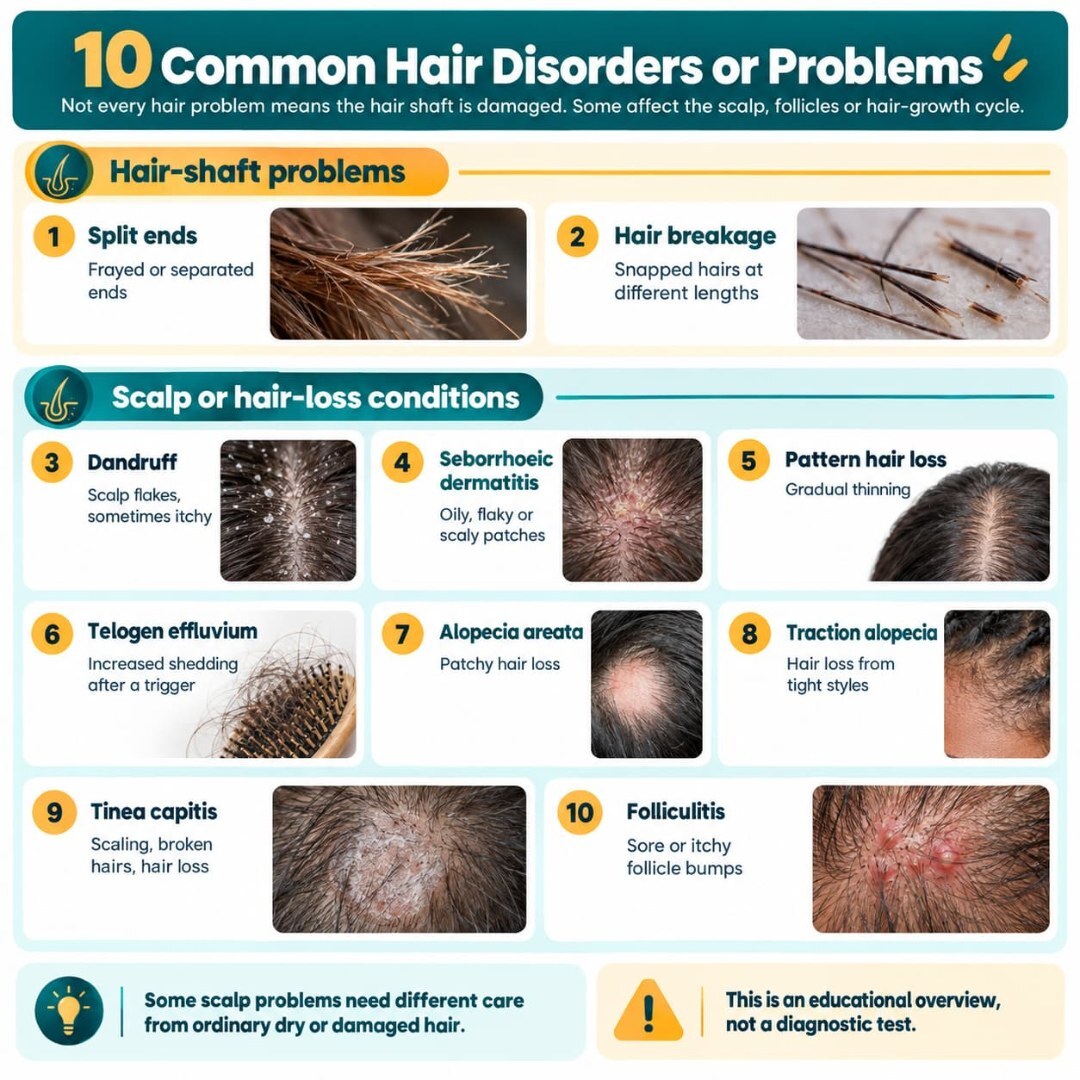
Not every hair problem means the hair shaft is damaged. Healthdirect lists several conditions that can affect the scalp, follicles or normal hair-growth cycle. (Healthdirect)
Here are 10 common or well-recognised hair and scalp problems:
Healthdirect notes that untreated scalp tinea can sometimes lead to scarring and permanent hair loss. Folliculitis can also occasionally cause scarring or bald patches when severe. These problems need different care from ordinary dry or damaged hair. (Healthdirect)
How Can You Reduce Further Hair Damage?
Damaged hair cannot biologically heal in the same way that living skin can. However, good hair care can reduce further wear and help damaged hair feel smoother and easier to manage.
A 2025 review led by researchers at Imperial College London found that chemical processing, heat and mechanical grooming can increase friction as the hair surface becomes weathered. Conditioning products can temporarily reduce friction between fibres, which may make hair easier to comb. (PubMed)
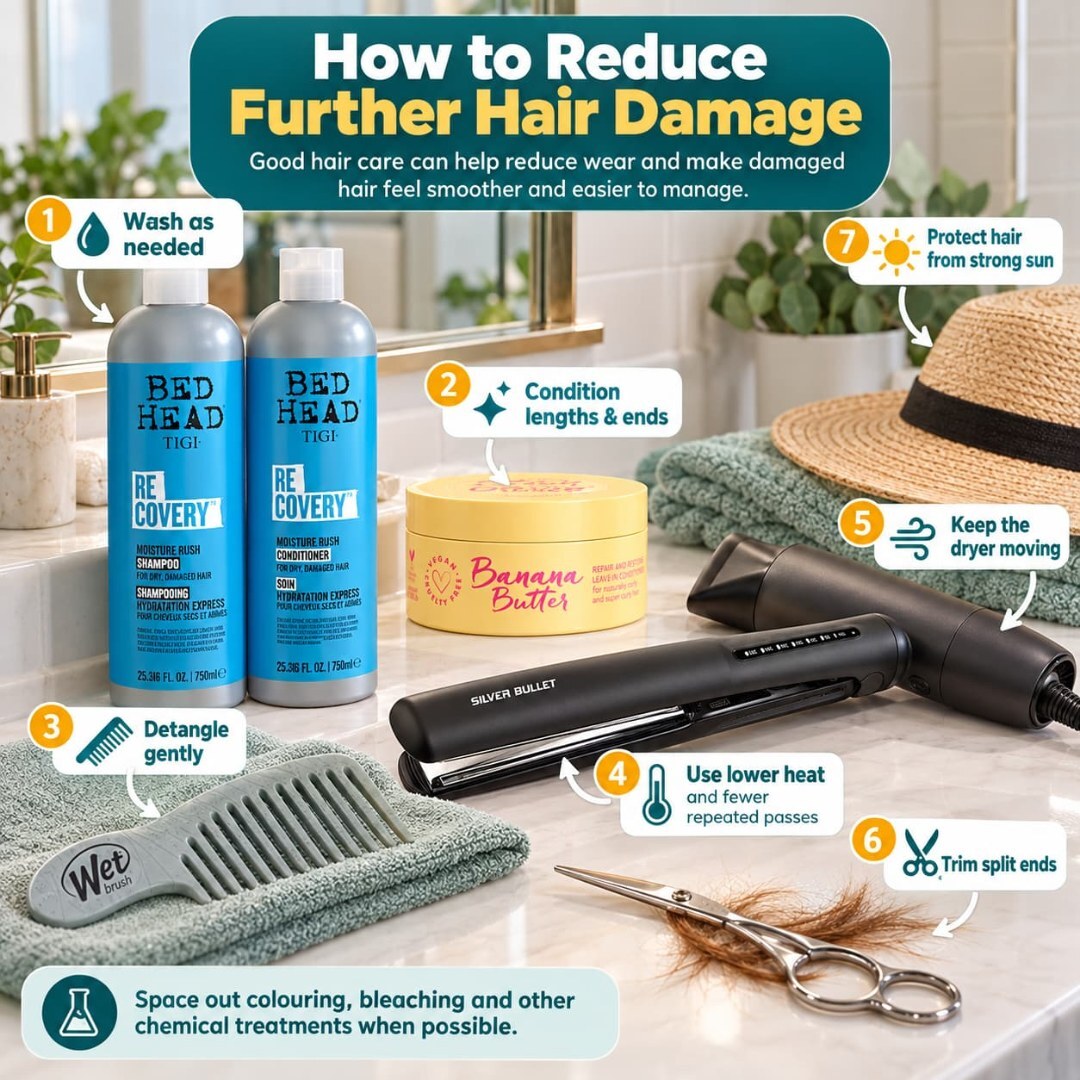
A simple routine can include:
- Wash your scalp and hair as often as needed for your hair and scalp type.
- Apply conditioner mainly through the lengths and ends.
- Detangle gently instead of pulling through knots.
- Limit very high heat and repeated passes with straighteners or curling irons.
- Keep a hair dryer moving rather than holding high heat close to one section.
- Space out bleaching, colouring, relaxing and other chemical treatments when possible.
- Avoid hairstyles that repeatedly pull tightly on the hairline.
- Trim badly split ends, as a split fibre cannot permanently join itself back together.
- Use a hat or other physical protection during long periods in strong sun.
Shampoos, conditioners, leave-in products, styling products and other options are available in MedCart's Hair Care & Styling range. Choose products for your actual hair and scalp needs rather than expecting one product to correct every type of damage.
FAQs
Is frizzy hair always damaged?
No. Natural hair texture, curls and humidity can all affect frizz. Damage can make the hair surface rougher and increase friction, but frizz alone does not prove that hair is damaged.
Can damaged hair grow back healthy?
New hair grows from follicles in the scalp, so new growth may be healthier if the source of external damage is reduced. Existing split or severely fractured sections do not biologically regenerate.
Is hair breakage the same as hair loss?
No. Breakage happens along the hair shaft. Hair loss or shedding involves hair leaving the follicle. If you notice increasing thinning, a widening part or bald patches, consider speaking with a GP or dermatologist.
Summary
Hair damage usually develops gradually through mechanical, thermal, chemical or environmental stress. Early signs can include roughness, tangling and dullness. More advanced damage may cause split ends and frequent breakage.
However, shedding, bald patches, scalp scaling, inflammation or pain may have another cause. Hair and scalp conditions need the correct diagnosis rather than simply more conditioning products.
Gentle handling, sensible heat use, conditioning and reducing repeated chemical processing can help limit further damage.
Where to Buy Hair Care Products
You can explore shampoos, conditioners, treatments, styling products and other Hair Care & Styling products at MedCart Australia.
Visit MedCart Australia to browse the wider beauty and wellness range.
References
- Healthdirect Australia. Alopecia (Hair loss). Last reviewed August 2024. https://www.healthdirect.gov.au/alopecia (Healthdirect)
- Healthdirect Australia. Dandruff. Last reviewed April 2025. https://www.healthdirect.gov.au/dandruff (Healthdirect)
- Healthdirect Australia. Seborrhoeic dermatitis – treatment and causes. Last reviewed December 2023. https://www.healthdirect.gov.au/seborrhoeic-dermatitis (Healthdirect)
- Healthdirect Australia. Folliculitis – causes and treatment. Last reviewed April 2025. https://www.healthdirect.gov.au/folliculitis (Healthdirect)
- Healthdirect Australia. Tinea – symptoms, types & treatment. Last reviewed October 2025. https://www.healthdirect.gov.au/tinea (Healthdirect)
- DermNet New Zealand. Defects of the hair shaft. Author information dated 2010; current online educational resource. https://dermnetnz.org/topics/defects-of-the-hair-shaft (DermNet®)
- Fernandes C, Medronho B, Alves L, Rasteiro MG. On Hair Care Physicochemistry: From Structure and Degradation to Novel Biobased Conditioning Agents. Polymers. Published 24 January 2023. https://pubmed.ncbi.nlm.nih.gov/36771909/ (PubMed)
- Weiand E, Rodriguez-Ropero F, Roiter Y, et al. Understanding and controlling the friction of human hair. Advances in Colloid and Interface Science. Epub 11 July 2025; Volume 345, November 2025. https://pubmed.ncbi.nlm.nih.gov/40782659/ (PubMed)
- Ramos NCBS, Dini AXP, Albarici VX, et al. Impact of ultraviolet radiation-induced damage to hair fiber integrity: A multi-technique physicochemical characterization of surface and cortex properties. International Journal of Cosmetic Science. Published 14 May 2026. https://pubmed.ncbi.nlm.nih.gov/42130407/ (PubMed)
The article keeps the focus on understanding hair damage while clearly separating cosmetic fibre damage from hair-loss and scalp conditions, which should also make the visual aids easier to interpret.