


Introduction
Perfume does not stay exactly the same from morning to night. Its ingredients slowly evaporate, and different fragrance notes disappear at different speeds.
Your skin can also affect how a fragrance behaves. A 2025 study published in the International Journal of Cosmetic Science found that skin properties can influence the evaporation of fragrance molecules.
There is another factor too: your nose. After smelling the same fragrance for some time, you may become less aware of it even when other people can still smell it.
So, how can you make perfume last all day? There is no trick that guarantees a full day of wear. However, choosing the right perfume or fragrance, applying it carefully, layering suitable products and storing the bottle correctly can all help.
Why Does My Perfume Smell Go Away So Quickly?
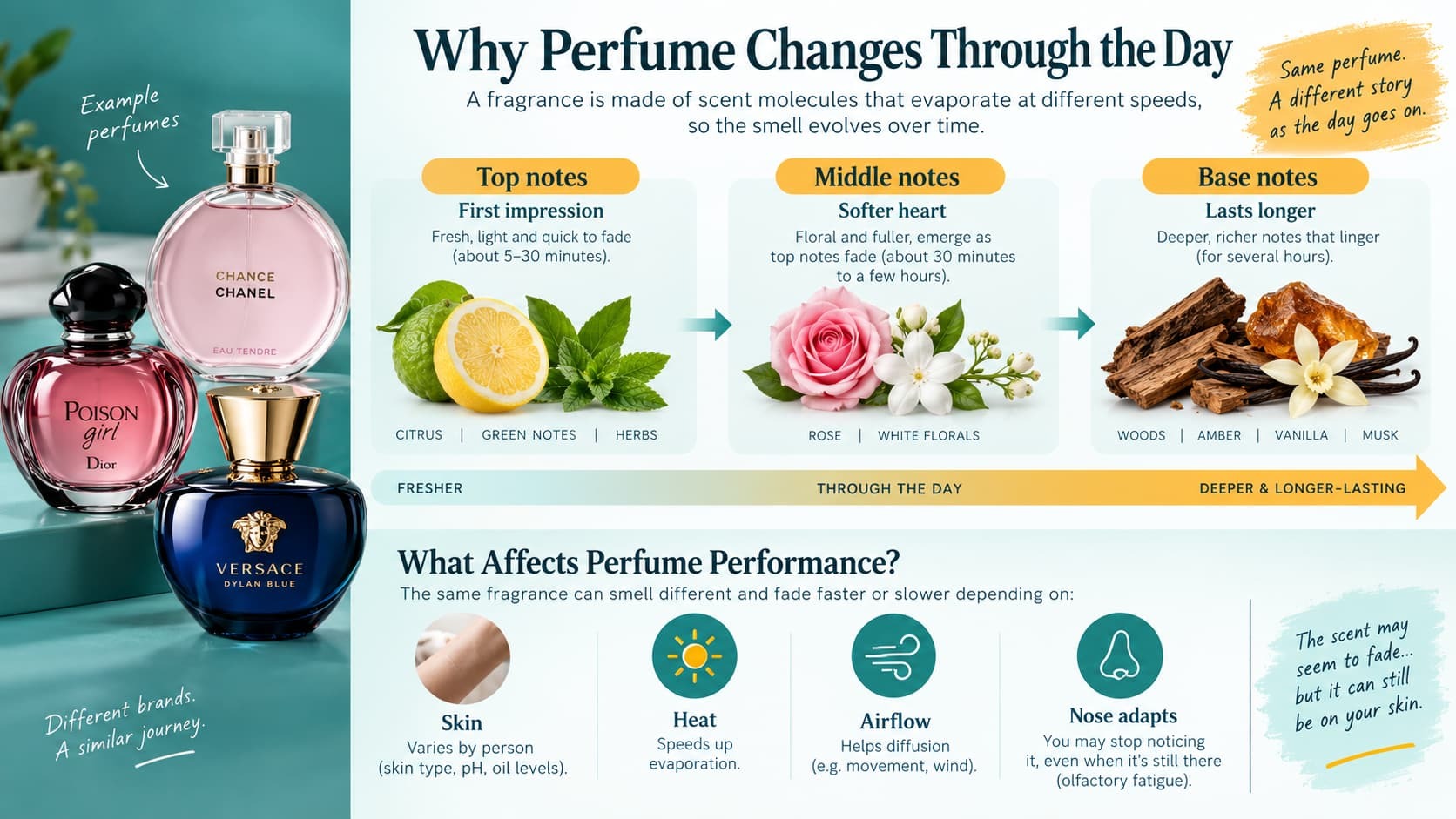
Perfume contains many different scent molecules. Some evaporate much faster than others.
The Open University explains that perfume is often described using top, middle and base notes. Top notes, including many fresh citrus and herbal scents, are more volatile. This means they evaporate quickly. Woody and musky base notes are generally less volatile and remain noticeable for longer.
This is why your perfume may smell bright and strong when first sprayed, then become softer or noticeably different after a few hours.
Your skin also matters. Recent research found that fragrance evaporation varies between people and that skin hydration, water loss and surface properties can affect different fragrance molecules in different ways.
Temperature and airflow can also affect evaporation. Research modelling perfume ingredients on skin found that temperature and air movement can change evaporation rates. This may help explain why fragrance sometimes seems to disappear faster on hot, active or windy days.
Finally, the perfume may not actually be gone. Repeated exposure to one smell can cause olfactory adaptation. Research shows that our response to an odour can become weaker after repeated or prolonged exposure.
If you stop noticing your perfume after an hour, ask someone else whether they can still smell it before adding several more sprays.
How to Make Perfume Last Longer on Your Skin
Start with the perfume itself. A formula with less volatile base notes may naturally remain noticeable longer than a fragrance built mainly around light, fresh top notes.
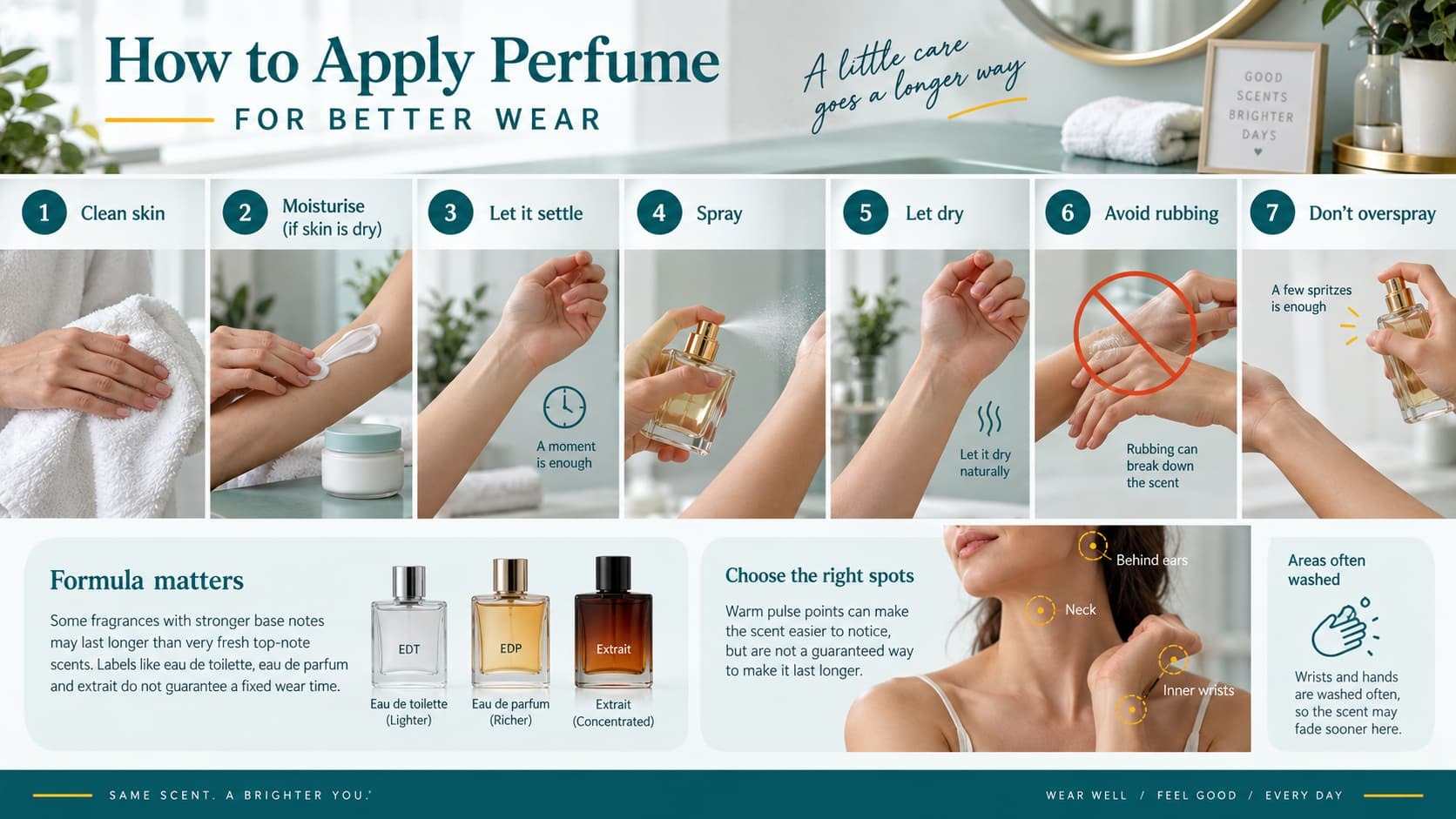
You may also see labels such as eau de toilette, eau de parfum and extrait. The International Fragrance Association says these terms are commonly linked with different fragrance concentrations, but there is no strict international standard that guarantees a particular concentration or number of hours. Formula matters as much as the label.
A simple application routine can help:
- Start with clean skin. Washing removes oils, sweat and previous scented products.
- Use a moisturiser first if your skin feels dry. Research suggests skin hydration can affect fragrance evaporation. A moisturiser may help create a more consistent skin surface, although it cannot guarantee extra hours of wear.
- Let the moisturiser settle before spraying. This avoids mixing a wet cream and perfume in your hands.
- Spray and allow the fragrance to dry naturally. There is no need to rub your wrists together.
- Choose areas that are not constantly washed or rubbed. Perfume on the hands or wrists may disappear sooner because these areas are washed frequently.
- Avoid over-spraying. If your nose has adapted to the fragrance, more perfume may simply make it stronger for everyone around you.
Warm pulse points can make perfume easier to notice, but warmth also encourages evaporation. They should not be treated as a guaranteed way to extend wear.
How to Maximise Perfume with Layering
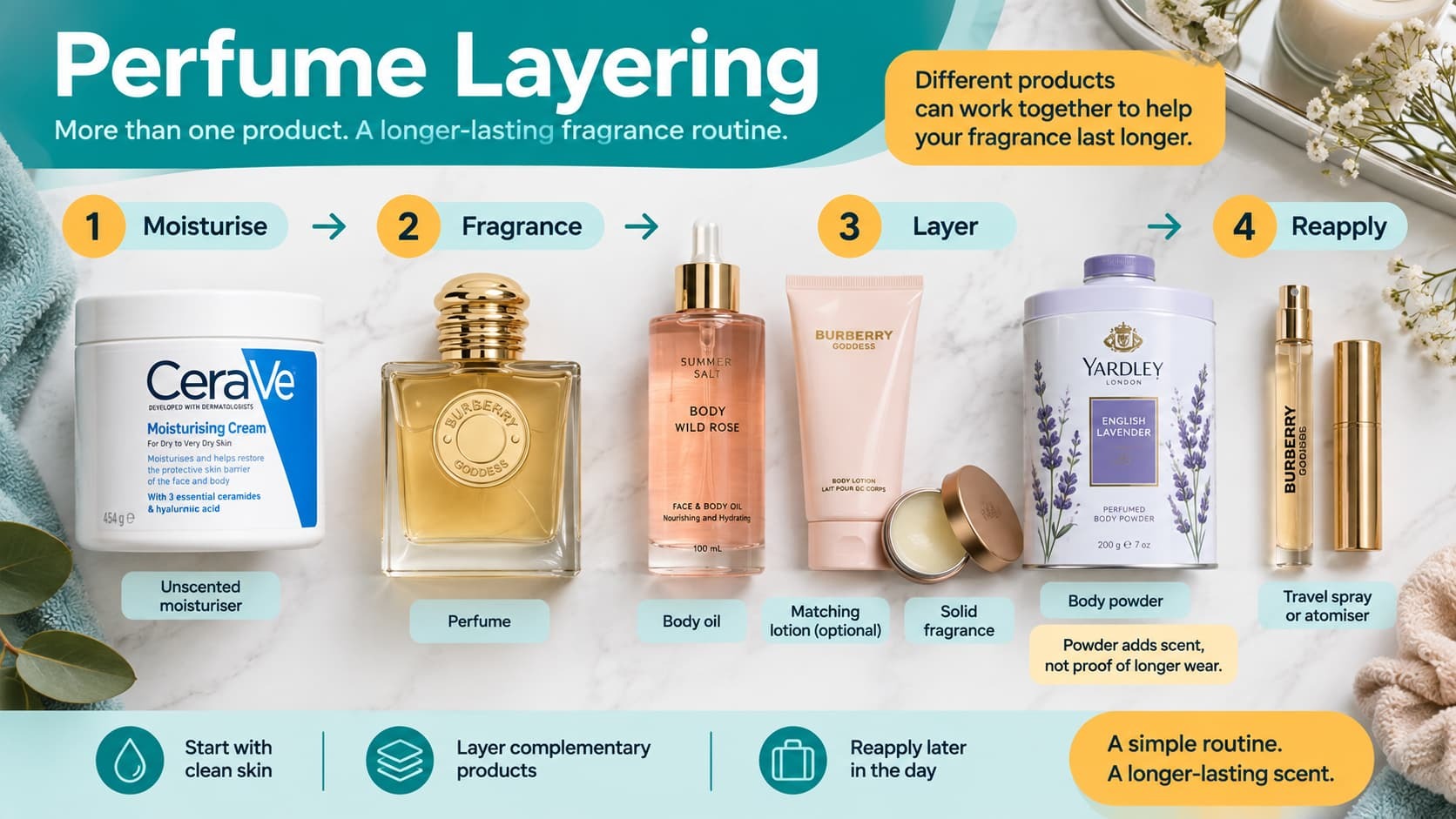
Perfume layering means using more than one scented or supportive product instead of relying on perfume alone.
A review in the International Journal of Cosmetic Science explains that the structure of creams and other cosmetic emulsions can affect how fragrance molecules are released. Oils, water and other ingredients can change the way fragrance behaves on the skin.
This makes leave-on products useful when building a fragrance routine.
What about powder and perfume?
Using body powder plus perfume is a popular layering trick, but there is little direct evidence that loose body powder placed over sprayed perfume actually “locks in” the fragrance.
If a body powder is scented, it can add another layer of fragrance. That is different from making the original perfume evaporate more slowly.
For a simple routine, moisturiser followed by perfume is a better starting point. You can then add a matching body lotion or oil or another leave-on fragrance if you enjoy layering.
Try not to mix many unrelated scents at once. Too many fragranced products can change the overall smell rather than simply making your perfume last longer.
What Kills the Smell of Perfume?
Several things can make perfume weaker or change its smell.
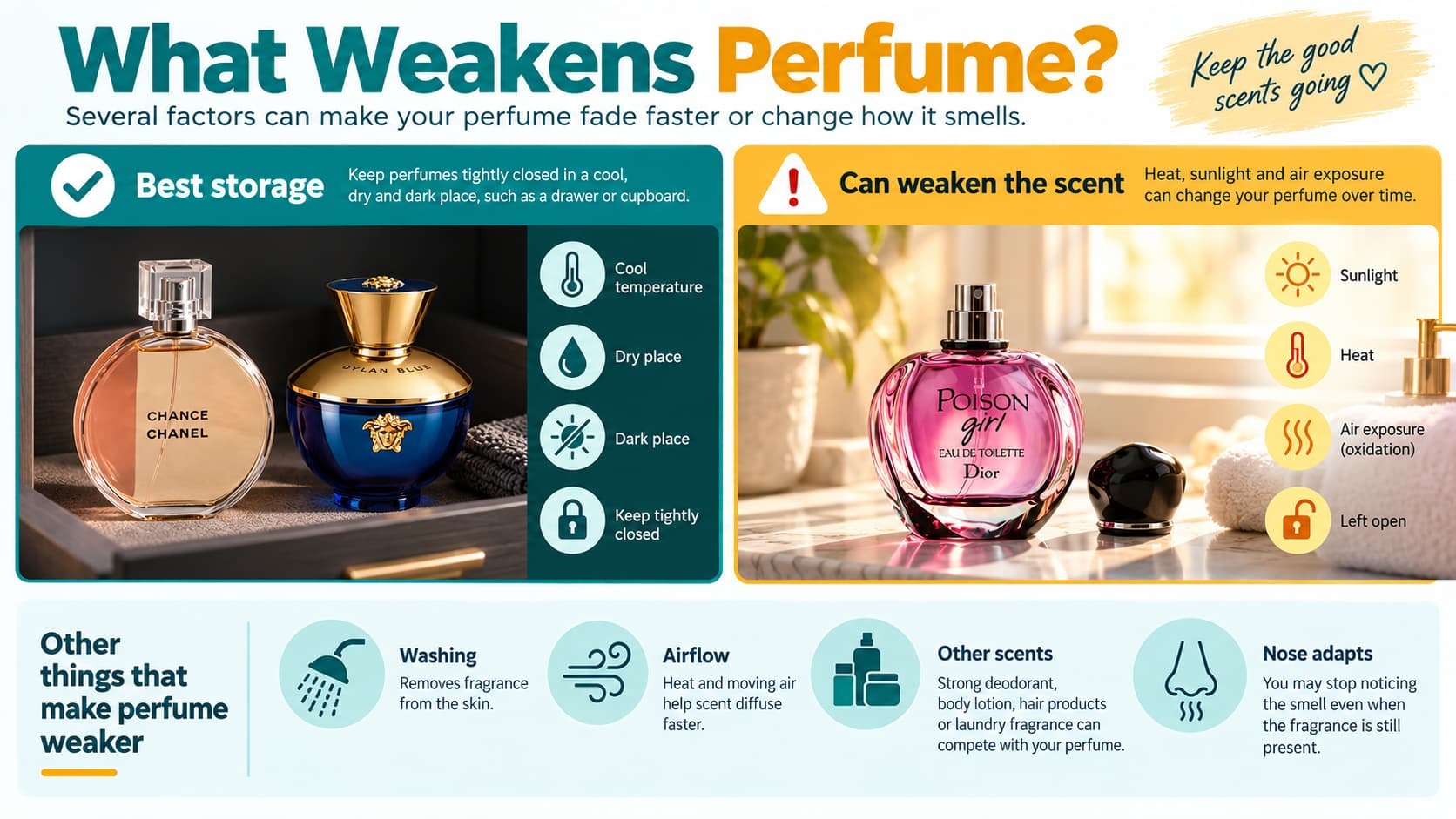
Evaporation is the main reason. Fragrance molecules leave the skin and move into the air. Heat and moving air can affect how quickly this happens.
Washing also removes fragrance from the skin. Research published in 2024 studied how much fragrance remained after body washing. Some longer-lasting base-note ingredients could still be detected, but washing clearly changes the fragrance left on skin.
Other scented products can cover or change the smell. Strong deodorant, body lotion, hair products or laundry fragrance may compete with your perfume.
Your perfume can also change while sitting in the bottle. ACCC Product Safety advises consumers not to leave cosmetics open or expose them to hot conditions or sunlight. Air exposure can also oxidise some fragrance ingredients. Studies on linalool, for example, show that it changes chemically after exposure to air.
For better storage, keep perfume tightly closed in a cool, dry and dark place. A cupboard or drawer is usually better than a sunny windowsill or hot bathroom.
Also remember that your nose adapting to the perfume can make the smell seem “dead” even when the fragrance is still present.
FAQs
Does moisturiser make perfume last longer?
It may help, especially if your skin is dry, because skin properties and hydration can affect fragrance evaporation. However, research does not support a universal claim that moisturiser adds a set number of hours to every perfume.
Does eau de parfum always last longer than eau de toilette?
Not always. Eau de parfum commonly contains more fragrance material, but the International Fragrance Association notes that these labels are not controlled by one strict international concentration standard. The exact ingredients and formula still matter.
Should I spray perfume on clothes?
Only if the fragrance product is suitable for fabric. Some products can stain, mark or affect certain materials. A product specifically designed as a fabric fragrance is the safer choice.
Can I spray normal perfume into my hair?
A hair fragrance or hair mist made for use on hair is a better option. Follow the product directions rather than assuming every alcohol-based perfume is suitable for hair.
What if perfume irritates my skin?
In Australia, ACCC Product Safety recommends checking cosmetic ingredient information and stopping use if you develop irritation or an allergic reaction. Seek medical advice if needed.
Summary
To make perfume last longer, focus on the basics rather than perfume hacks.
Choose a fragrance with a formula you enjoy after the first top notes fade. Apply it to clean, comfortable skin. Moisturise first if needed. Use matching leave-on products if you want to layer your scent, and reapply carefully when necessary.
Body powder can add fragrance if the powder itself is scented, but it should not be treated as a proven way to seal perfume onto the skin.
Most importantly, remember that perfume fading and your nose getting used to perfume are not the same thing.
Where to Buy Perfume and Fragrance Products
You can explore perfumes and fragrances, moisturisers, bath and body products, dusting powders and hair care products through MedCart Australia.
Always check the product description, ingredients and directions before use.
References
- Australian Industrial Chemicals Introduction Scheme (AICIS). Flavour and fragrance chemicals. Updated 24 April 2024. https://www.industrialchemicals.gov.au/cosmetics-and-soap/flavour-and-fragrance-chemicals
- Australian Competition and Consumer Commission Product Safety. Cosmetic ingredients labelling guide. Publication date not stated. https://www.productsafety.gov.au/consumers/use-cosmetic-and-fashion-products-safely/cosmetic-ingredients-labelling-guide
- Hadjiefstathiou E, Savary G, Malhiac C, Terescenco D, Picard C. International Journal of Cosmetic Science. Exploring the impact of fragrance molecular and skin properties on the evaporation profile of fragrances. First published 17 June 2025. https://doi.org/10.1111/ics.13085
- Dallay C, Malhiac C, Picard C, Savary G. International Journal of Cosmetic Science. Fragrance in dermocosmetic emulsions: From microstructure to skin application. Version of record published 14 September 2023; Volume 46 issue published February 2024. https://onlinelibrary.wiley.com/doi/full/10.1111/ics.12896
- Goh A, Im SH, Bae J-E, Choi Y, Jeon J, Im SH. International Journal of Cosmetic Science. Assessing residual fragrances on skin after body washing: Optimization of an analytical method using solid-phase microextraction coupled with gas chromatography-mass spectrometry. First published 25 July 2024. https://pubmed.ncbi.nlm.nih.gov/39054565/
- Mignot C, et al. European Archives of Oto-Rhino-Laryngology. Olfactory adaptation: recordings from the human olfactory epithelium. Published July 2022; first online 18 December 2021. https://pubmed.ncbi.nlm.nih.gov/34921612/
- Kasting GB, Saiyasombati P. International Journal of Cosmetic Science. A physico-chemical properties based model for estimating evaporation and absorption rates of perfumes from skin. Published February 2001. https://pubmed.ncbi.nlm.nih.gov/18503438/
- The Open University. The world around us – Perfume. Updated 21 March 2016. https://www.open.edu/openlearn/body-mind/the-world-around-us-perfume
- International Fragrance Association (IFRA). About the IFRA Transparency List. Current page includes the 2025 Transparency List and fragrance concentration guidance. https://ifrafragrance.org/transparency-list/about-the-ifra-transparency-list
- Bråred Christensson J, et al. Contact Dermatitis. Air-oxidized linalool: a frequent cause of fragrance contact allergy. Published November 2012; online 21 August 2012. https://pubmed.ncbi.nlm.nih.gov/22906042/