


Understanding the Difference Between Surgical Masks and N95 Respirators
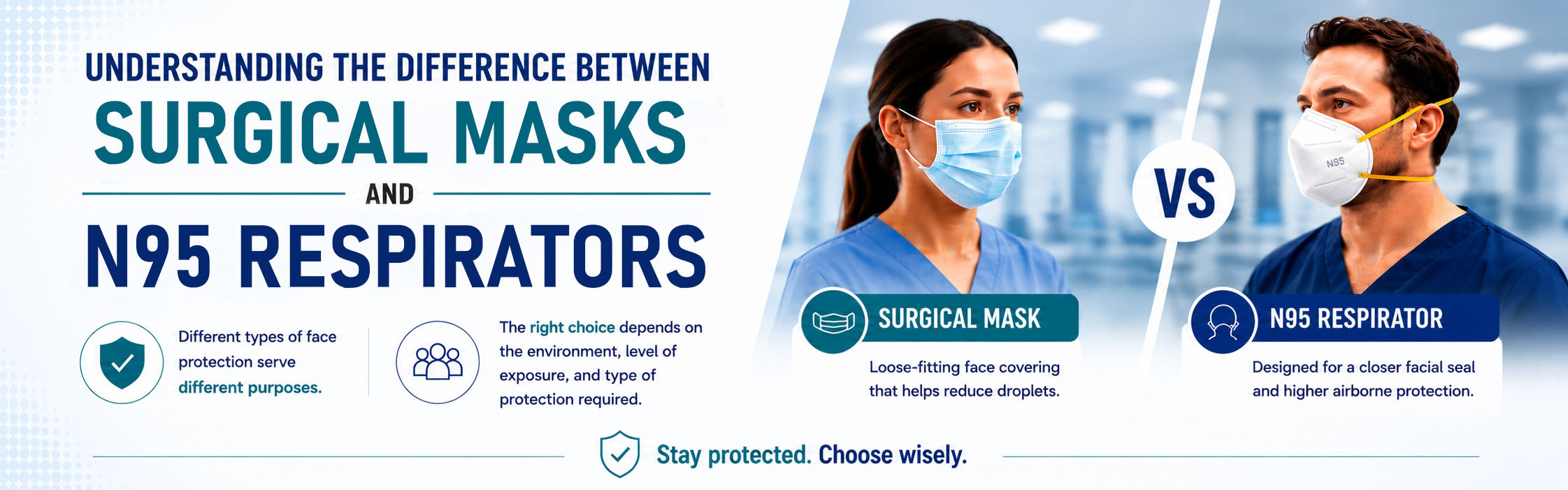
Surgical masks and N95 respirators are two common forms of face protection used in healthcare, workplace, and public environments. While both are designed to help reduce exposure to airborne particles and droplets, they differ in fit, filtration characteristics, and intended use.
This guide explains the differences between surgical masks and N95 respirators, including how these types of face protection are commonly used in different environments.
This page provides general educational information about face protection and respiratory protective equipment.
This page is intended to provide general information and does not focus on specific products or purchasing options.
What Is a Surgical Mask?
A surgical mask is a disposable face covering designed to help reduce the spread of droplets and provide a barrier against splashes and larger particles. This type of face protection is commonly used in healthcare, workplace, and public environments.
What Is an N95 Respirator?
An N95 respirator is a type of respiratory protective equipment designed to provide a closer facial fit and advanced particle filtration. This form of respiratory protection is commonly used in healthcare and workplace environments where airborne exposure may be a concern.
Key Differences Between Surgical Masks and N95 Respirators
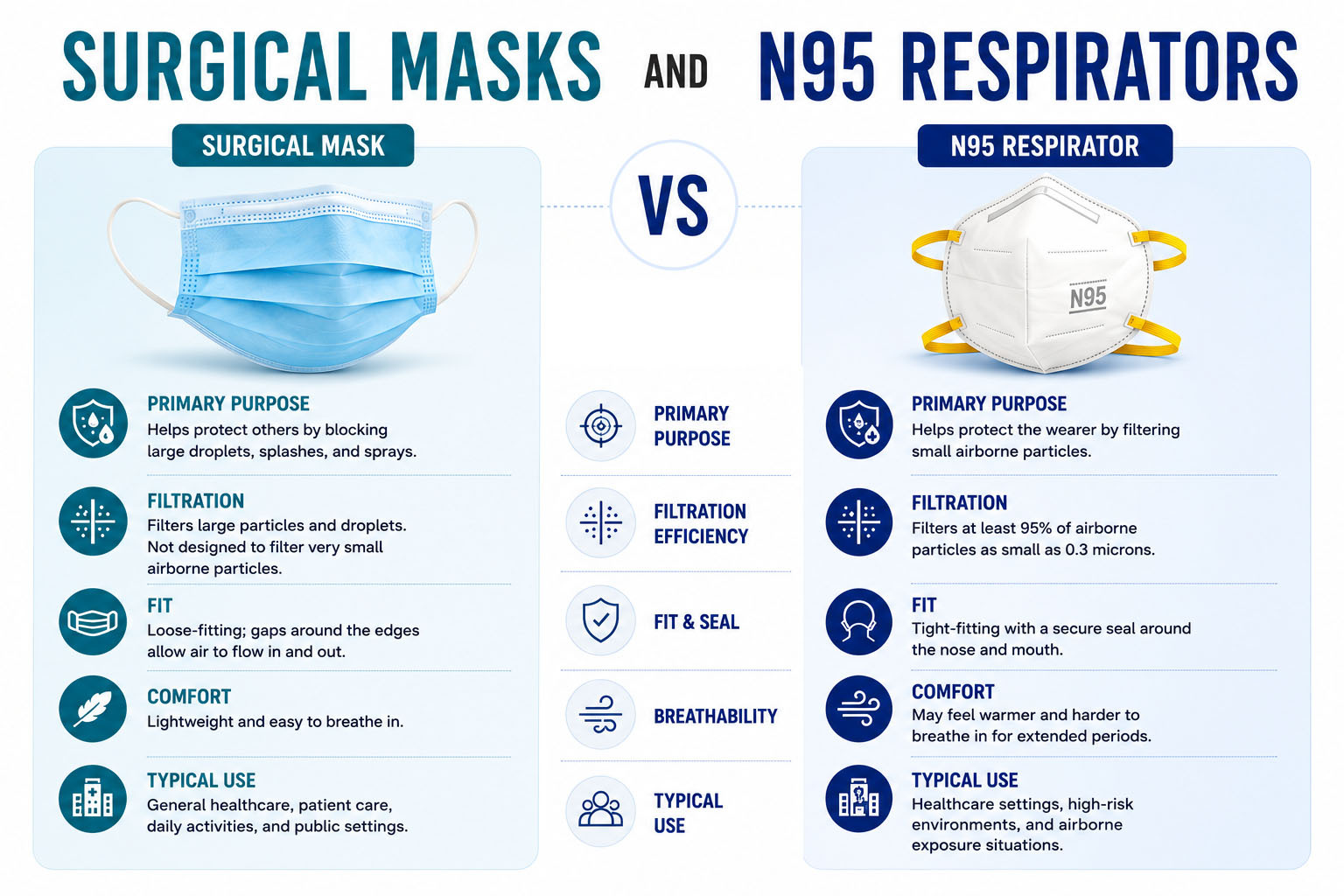
| Feature | Surgical Mask | N95 Respirator |
|---|---|---|
| Fit | Loose-fitting face covering | Designed for a closer facial seal |
| Filtration | Helps reduce droplets and larger particles | Designed for higher airborne particle filtration |
| Breathing Resistance | Lighter and easier for extended wear | May feel tighter due to filtration design |
| Common Environment | General healthcare and public environments | Healthcare and workplace environments requiring respiratory protection |
Filtration Differences
N95 respirators are designed with different filtration characteristics compared to standard surgical masks. Surgical masks are primarily intended to help reduce droplets and splashes, while respirators are designed for environments requiring respiratory protective equipment.
Fit and Seal Differences
Surgical masks are generally loose-fitting, while N95 respirators are designed to create a closer fit around the face to help reduce gaps where airborne particles may enter.
Face Protection and Respiratory Protection
Both surgical masks and N95 respirators are commonly classified as forms of face protection used in healthcare and workplace environments.
Different environments may use different types of face protection depending on workplace or healthcare requirements.
If you want to explore related categories, you can explore face protection categories.
Where Is Face Protection Commonly Used?
Face protection and respiratory protective equipment are commonly used in healthcare facilities, aged care settings, workplaces, laboratories, and environments where respiratory exposure may be a concern.
Frequently Asked Questions
What is the difference between surgical masks and N95 respirators?
Surgical masks are designed to help reduce droplets and splashes, while N95 respirators are designed for closer facial fit and advanced airborne particle filtration.
How do N95 respirators and surgical masks differ in filtration?
N95 respirators are designed with different filtration characteristics and closer facial fit compared to standard surgical masks.
Do surgical masks protect against airborne particles?
Surgical masks help reduce exposure to droplets and larger particles but are not designed to provide the same level of respiratory filtration as N95 respirators.
Where is respiratory protective equipment commonly used?
Respiratory protective equipment is commonly used in healthcare, workplace, laboratory, and higher-exposure environments.
Where is face protection commonly used?
Face protection is commonly used in healthcare, workplace, aged care, and public environments.
Learn More About PPE
Learn more about personal protective equipment and how different types are used in various environments.
- What Is PPE? Types of Personal Protective Equipment
- Nitrile vs Latex vs Vinyl Gloves
- Surgical Masks vs N95 Respirators
This information reflects general use of face protection and respiratory protective equipment in healthcare, workplace, and safety environments.
This information is intended for general educational purposes and does not recommend specific face protection products or equipment.
Updated May 2026: Based on commonly used face protection categories and general usage guidance.