



Baby Nasal Congestion: Safe Ways to Clear a Blocked Nose
A blocked nose can make a baby upset and uncomfortable. It may make feeding, sleeping and breathing through the nose more difficult.
Baby nasal congestion is common. It can happen because of a cold, dry air, dust or other irritation inside the nose.
Most cases are mild and improve with simple care. However, parents may consider using saline drops or a nasal aspirator for baby when mucus is affecting feeding or comfortable breathing.
A baby nasal aspirator is a small device that uses gentle suction to remove visible mucus from the front of the nose. It may also be called a baby nose suction device, mucus remover or snot sucker.
This guide explains what causes a blocked nose, how a nasal aspirator works and how to use one safely.
Important: This article provides general information only. It does not replace advice from a doctor, pharmacist or child and family health nurse.
What Is Baby Nasal Congestion?
Baby nasal congestion happens when mucus builds up or the lining inside the nose becomes swollen.
Babies have very small nasal passages. Even a small amount of mucus can make their breathing sound loud or blocked.
According to Pregnancy, Birth and Baby, young babies mainly breathe through their noses, especially while feeding. Nasal congestion may make it harder for them to stay attached to the breast or bottle.
A baby may have:
- A blocked or stuffy nose
- A runny nose
- Noisy nasal breathing
- Sneezing
- Trouble feeding comfortably
- Difficulty settling to sleep
- Mucus around the nostrils
A noisy nose does not always mean that a baby is having serious breathing trouble. Look at the baby’s feeding, skin colour, alertness and effort of breathing.
What Causes a Blocked Nose in Babies?
Common causes of baby nasal congestion include:
- The common cold
- Respiratory syncytial virus, or RSV
- Flu and other viral infections
- Dry air
- Dust
- Cigarette smoke or vaping aerosols
- Strong perfume or cleaning fumes
- Changes in temperature
- Allergies in older babies and children
Less common causes may include:
- An object inside one nostril
- A problem with the shape of the nose
- Swollen adenoids
- Ongoing irritation
- Another health condition
Seek medical advice if the congestion only affects one nostril, smells bad, causes regular nosebleeds or continues for a long time.
What Does a Baby Nasal Aspirator Do?
A baby nasal aspirator uses gentle suction to pull loose mucus from the front of the nostril.
It may help:
- Remove visible mucus
- Clear the entrance of the nasal passage
- Make feeding more comfortable
- Reduce mucus around the nostrils
- Help when thick mucus cannot be removed by wiping
A nasal aspirator does not cure the common cold, RSV, flu or allergies.
It also cannot remove swelling or mucus from deep inside the airways. Its purpose is to remove mucus that is close to the nostril opening.
The Sydney Children’s Hospitals Network describes a nasal aspirator as a tool that can use gentle suction to clear mucus from a newborn’s nose when used correctly.
Do You Really Need a Nasal Aspirator for a Baby?
Not every baby needs a nasal aspirator.
A baby may have a small amount of mucus but still breathe, feed and sleep normally. In this case, gently wiping around the nostrils may be enough.
Pregnancy, Birth and Baby states that a blocked or runny nose by itself is not usually a sign of serious illness. Many babies recover without medical treatment.
A nasal aspirator for baby may be useful when:
- Mucus is clearly blocking the nostrils
- Your baby is having trouble staying attached during feeding
- Your baby keeps stopping during a feed to breathe
- Thick mucus does not come away with gentle wiping
- Your baby appears uncomfortable because of visible mucus
- A doctor, pharmacist or nurse recommends suction
A nasal aspirator is an optional care tool. It does not need to be part of every baby’s daily routine.
Is It Safe to Use a Nasal Aspirator on a Baby?
A nasal aspirator can generally be used safely when it is designed for babies and used according to its instructions.
The suction should be gentle. The tip should stay at or near the entrance of the nostril.
Children’s Health Queensland states that surface-level suction may help some babies when congestion affects feeding. However, deep suction is not recommended because it may irritate the upper airway and cause swelling.
For safer use:
- Choose a product made for babies.
- Check the recommended age.
- Read the instructions before use.
- Wash your hands.
- Use gentle suction.
- Keep the tip near the nostril opening.
- Stop if you notice blood or irritation.
- Clean and dry the aspirator after use.
- Replace disposable filters as directed.
- Keep small parts away from children.
Never connect a manual baby aspirator to a vacuum cleaner, medical suction pump or other powered device.
When Can I Start Using a Nasal Aspirator for Baby?
Some nasal aspirators are suitable from birth. Others are designed for older babies.
Always read the age information on the product packaging.
The Sydney Children’s Hospitals Network notes that a gentle nasal aspirator may be used for newborn nasal congestion at home when used correctly.
Before using a nasal aspirator for a newborn:
- Check that it is suitable from birth
- Follow the manufacturer’s directions
- Use the lowest suction needed
- Keep the tip near the nostril opening
- Ask a health professional for help if you are unsure
Babies who were born early or have breathing, heart, facial or nasal conditions may need individual medical advice before suction is used.
How to Use a Nasal Aspirator for Baby Safely
Each product may work differently. Follow the directions supplied with your aspirator.
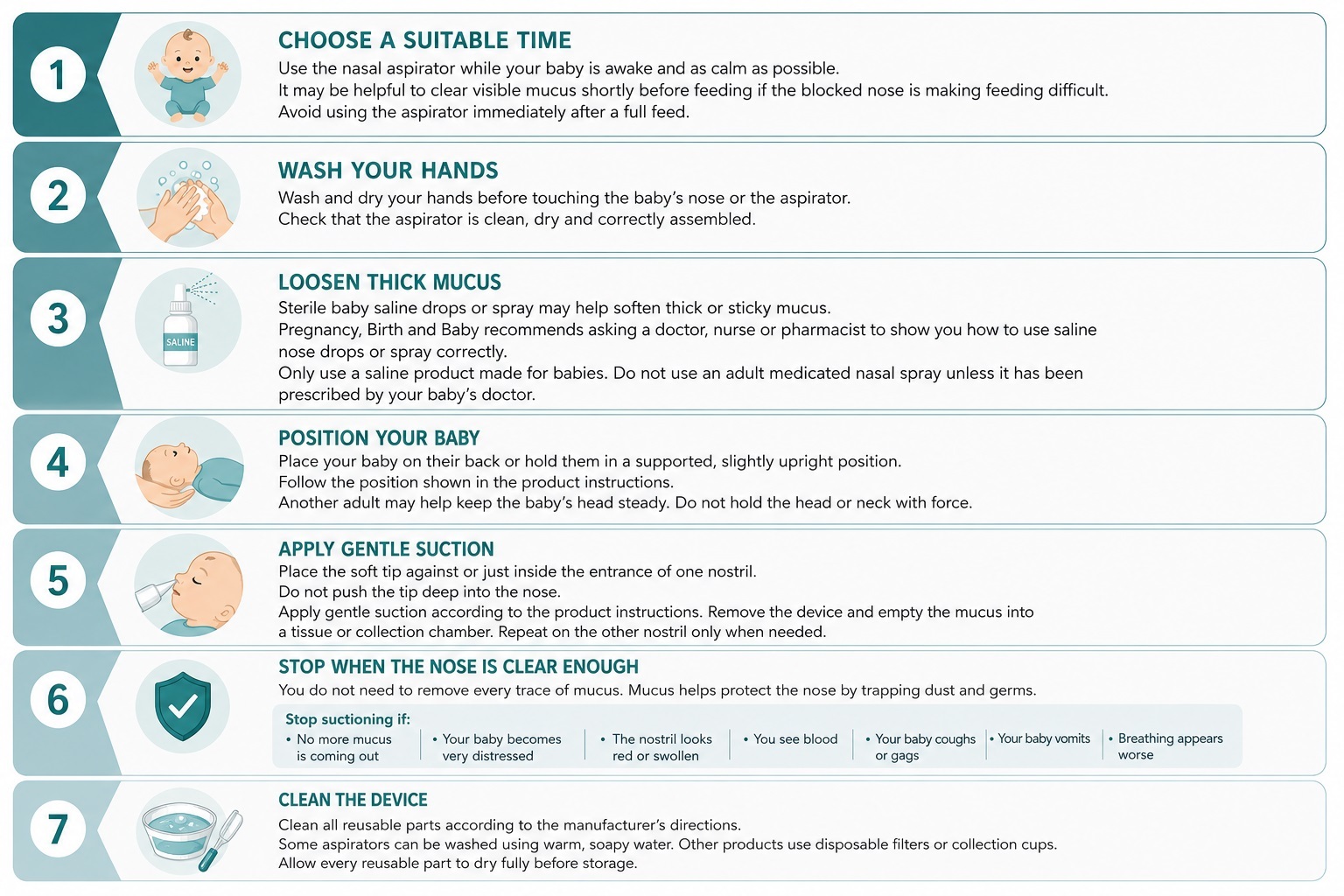
The steps below are a general guide.
Step 1: Choose a Suitable Time
Use the nasal aspirator while your baby is awake and as calm as possible.
It may be helpful to clear visible mucus shortly before feeding if the blocked nose is making feeding difficult.
Avoid using the aspirator immediately after a full feed. Crying, coughing or gagging may cause the baby to bring up milk.
Step 2: Wash Your Hands
Wash and dry your hands before touching the baby’s nose or the aspirator.
Check that the aspirator is clean, dry and correctly assembled.
Step 3: Loosen Thick Mucus
Sterile baby saline drops or spray may help soften thick or sticky mucus.
Pregnancy, Birth and Baby recommends asking a doctor, nurse or pharmacist to show you how to use saline nose drops or spray correctly.
Only use a saline product made for babies. Do not use an adult medicated nasal spray unless it has been prescribed by your baby’s doctor.
Step 4: Position Your Baby
Place your baby on their back or hold them in a supported, slightly upright position.
Follow the position shown in the product instructions.
Another adult may help keep the baby’s head steady. Do not hold the head or neck with force.
Step 5: Apply Gentle Suction
Place the soft tip against or just inside the entrance of one nostril.
Do not push the tip deep into the nose.
Apply gentle suction according to the product instructions. Remove the device and empty the mucus into a tissue or collection chamber.
Repeat on the other nostril only when needed.
Step 6: Stop When the Nose Is Clear Enough
You do not need to remove every trace of mucus.
Mucus helps protect the nose by trapping dust and germs.
Stop suctioning if:
- No more mucus is coming out
- Your baby becomes very distressed
- The nostril looks red or swollen
- You see blood
- Your baby coughs or gags
- Your baby vomits
- Breathing appears worse
Step 7: Clean the Device
Clean all reusable parts according to the manufacturer’s directions.
Some aspirators can be washed using warm, soapy water. Other products use disposable filters or collection cups.
Allow every reusable part to dry fully before storage.
Should Saline Be Used Before a Nasal Aspirator?
Saline is sterile salt water. It can help moisten the nose and loosen thick mucus.
Pregnancy, Birth and Baby states that saline drops or spray may help keep a baby’s nasal passages clear. Children’s Health Queensland also notes that saline may be considered before feeding when congestion is causing a problem.
Saline and nasal aspirators have different purposes:
- Baby saline moistens and loosens mucus.
- A nasal aspirator removes some of the loosened mucus.
Use saline that is suitable for your baby’s age. Follow the directions on the packaging.
Do not add essential oils, eucalyptus oil, menthol or other ingredients to baby saline.
Is It Okay to Suction a Baby’s Nose Every Day?
A baby’s nose should not be suctioned as a routine when there is no need.
Daily use may sometimes be suitable for a short period when a baby is congested. However, repeated suction can irritate the soft lining of the nose.
Use the aspirator when visible mucus is affecting feeding or comfortable nasal breathing.
Follow these safety tips:
- Use the fewest attempts needed
- Use gentle suction
- Do not suction when no mucus is coming out
- Stop if the nose looks sore
- Give the nose time to rest
- Follow the product instructions
Speak with a doctor or child health nurse if your baby needs suction many times each day or for a long period.
How Often Can You Use a Nasal Aspirator?
There is no single number that is right for every baby.
The correct frequency depends on:
- The baby’s age
- The amount of mucus
- Whether feeding is affected
- The type of aspirator
- The product instructions
- Advice from a health professional
Children’s Health Queensland warns against deep nasal suction because it can cause irritation and swelling.
Gentle suction should only be used when it provides a clear benefit.
How Can You Tell If a Baby Needs Nose Suction?
Your baby may benefit from gentle suction when you can see mucus and it is causing a problem.
Possible signs include:
- Thick mucus around the nostril
- Difficulty feeding because of a blocked nose
- Stopping often during feeding
- Trouble using a dummy
- Mucus that cannot be removed by wiping
- Becoming upset while trying to feed
- A healthcare professional has recommended suction
Noisy breathing alone does not always mean suction is needed. Babies have small nasal passages, so normal mucus can sound louder than expected.
What Happens If You Do Not Suction a Baby’s Nose?
In many cases, nothing serious will happen.
Mild baby nasal congestion often improves as the cold or irritation passes. If the baby is feeding, sleeping and breathing comfortably, you may only need to wipe away visible mucus.
Pregnancy, Birth and Baby states that most babies with a blocked or runny nose do not develop serious complications.
Nasal suction is most useful when mucus is causing a clear problem. It is not necessary to keep the nose completely free of mucus.
Seek medical advice if congestion:
- Stops the baby from feeding
- Causes fewer wet nappies
- Continues for a long time
- Only affects one nostril
- Produces bad-smelling mucus
- Causes repeated bleeding
- Comes with fever or breathing trouble
What Are the Disadvantages of a Nasal Aspirator?
A baby nasal aspirator can be useful, but it also has limits.
Nasal Irritation
Repeated or strong suction may irritate the soft lining inside the nose.
Swelling
Irritation may cause swelling. This can make the nose feel more blocked.
Children’s Health Queensland warns that deep suction can cause irritation and swelling in the upper airway.
Nosebleeds
The inside of a baby’s nose contains small blood vessels. Strong suction or pushing the tip too far may cause bleeding.
Pregnancy, Birth and Baby advises against inserting objects deep into a baby’s nose because this can cause damage or bleeding.
Distress
Many babies cry, turn their heads or push the device away.
Crying does not always mean that the baby is in pain. However, the process may still be uncomfortable or frightening.
Germ Build-Up
A nasal aspirator that is not cleaned and dried correctly may collect mucus, germs or mould.
Replacement Costs
Some manual and electric aspirators need replacement filters, tips, batteries or collection cups.
False Reassurance
A nasal aspirator only removes mucus from the front of the nose.
It does not treat serious breathing problems, pneumonia, bronchiolitis, RSV or another infection.
What Are the Side Effects of Suctioning a Newborn?
Possible side effects of rough, deep or repeated suction include:
- Redness
- Soreness
- Nasal swelling
- Small amounts of blood
- Coughing
- Gagging
- Vomiting after feeding
- Increased crying
- Temporary breathing changes
Stop using the aspirator if bleeding, swelling or discomfort occurs.
Seek medical advice if symptoms continue or the baby appears unwell.
Medical suction used in a hospital is different from a home nasal aspirator. Hospital suction may go deeper and must be performed by trained healthcare workers.
Why Do Babies Hate Nose Suction?
Babies may cry during nose suction because they do not understand what is happening.
They may dislike:
- Being held still
- Pressure around the nose
- The sound of an electric aspirator
- The feeling of saline drops
- A change in airflow
- Being handled while tired or unwell
To make the process easier:
- Prepare everything before starting
- Keep the process short
- Speak or sing softly
- Use gentle movements
- Have another adult comfort the baby
- Stop after one or two gentle attempts
- Cuddle the baby afterwards
Do not continue forcefully when the baby is moving their head strongly.
Should You Suction a Baby’s Nose While Sleeping?
It is usually better to use a nasal aspirator while the baby is awake.
Using the device on a sleeping baby may startle them and cause sudden head movement.
If your baby is sleeping comfortably, has a healthy skin colour and is breathing without effort, you usually do not need to wake them only to suction their nose.
If your baby appears to be struggling to breathe while sleeping, wake them and check their condition.
Seek urgent medical help if the baby is:
- Grunting
- Struggling for breath
- Very difficult to wake
- Pale or blue
- Having pauses in breathing
- Unusually floppy
Do not rely on nasal suction when serious breathing signs are present.
How Can I Unblock My Baby’s Nose Naturally?
The word “natural” does not always mean safe. Use methods recommended by health professionals.
Use Baby Saline
Sterile baby saline drops or spray may help loosen thick mucus.
Choose a product suitable for your baby’s age and follow the directions.
Wipe Visible Mucus
Use a soft damp cloth, clean tissue or cotton wool to clean around the nostrils.
Do not push cotton buds, fingers or twisted tissues inside the nose.
Offer Regular Feeds
A blocked nose may make long feeds difficult.
Offering smaller or more frequent feeds may help some babies stay hydrated.
Watch for fewer wet nappies, which may be a sign of dehydration.
Use a Cool-Mist Humidifier
Pregnancy, Birth and Baby lists a cool-mist humidifier as one option that may help with congestion.
Clean the humidifier regularly according to its instructions. Dirty humidifiers can collect germs or mould.
Keep the Air Clean
Keep babies away from:
- Cigarette smoke
- Vaping aerosols
- Strong perfume
- Dust
- Aerosol sprays
- Harsh cleaning fumes
These may irritate the nose and airways.
Avoid Adult Cold Medicines
Do not give a baby adult decongestants, cough medicines or medicated nasal sprays.
Pregnancy, Birth and Baby states that decongestant medicines for adults or older children should not be given to babies unless prescribed by a doctor.
Follow Safe Sleep Advice
Do not place pillows, rolled towels or sleep positioners under a baby to raise their head.
The Australian Government’s Pregnancy, Birth and Baby service recommends placing babies on their backs on a firm, flat and clear sleep surface.
Types of Nasal Aspirators for Babies
There are several types of nasal aspirators available.
Bulb Nasal Aspirator
A bulb aspirator is squeezed before the tip is placed near the nostril. As the bulb expands, it pulls mucus inside.
Possible benefits:
- Simple design
- Low cost
- No batteries
- Easy to carry
Things to check:
- Whether it opens for cleaning
- Whether the inside can dry properly
- Whether the tip is soft
- Whether it is suitable for newborns
Manual Oral-Suction Aspirator
This product uses a tube and mouthpiece. A parent creates suction using their mouth.
A filter and collection chamber help stop mucus from entering the mouthpiece.
Possible benefits:
- The parent controls the suction
- No batteries are needed
- Many models can be taken apart
Things to check:
- Replacement filter costs
- Cleaning instructions
- Tip size
- Availability of spare parts
Electric Nasal Aspirator
An electric aspirator uses batteries or a rechargeable motor.
Possible benefits:
- One-hand operation
- Set suction levels on some products
- Reusable tips
- Consistent operation
Things to check:
- Noise level
- Age suitability
- Suction settings
- Battery life
- Cleaning requirements
- Tip size
Saline and Aspirator Kit
Some products include baby saline and a nasal aspirator. This can be convenient when thick mucus needs to be loosened before suction. Read the instructions for both the saline and aspirator.
How to Choose a Nasal Aspirator for Baby
The most expensive aspirator is not always the best option.
Consider the following features before buying.
Age Suitability
Check whether the device is suitable for newborns, infants or older children.
Soft and Suitable Tip
Choose a tip that is smooth, soft and suitable for a small nostril.
Gentle Suction
Look for a device that allows controlled suction.
Stronger suction is not always better.
Easy Cleaning
Choose an aspirator that can be opened, washed and dried correctly.
Avoid products with closed spaces that are difficult to clean.
Replacement Parts
Check whether you will need:
- Filters
- Batteries
- Replacement tips
- Collection cups
- Charging cables
Clear Instructions
The product should explain how to use, clean, dry and store the aspirator.
Product Condition
Check the aspirator before each use.
Do not use it if the tip is damaged, cracked, rough or loose.
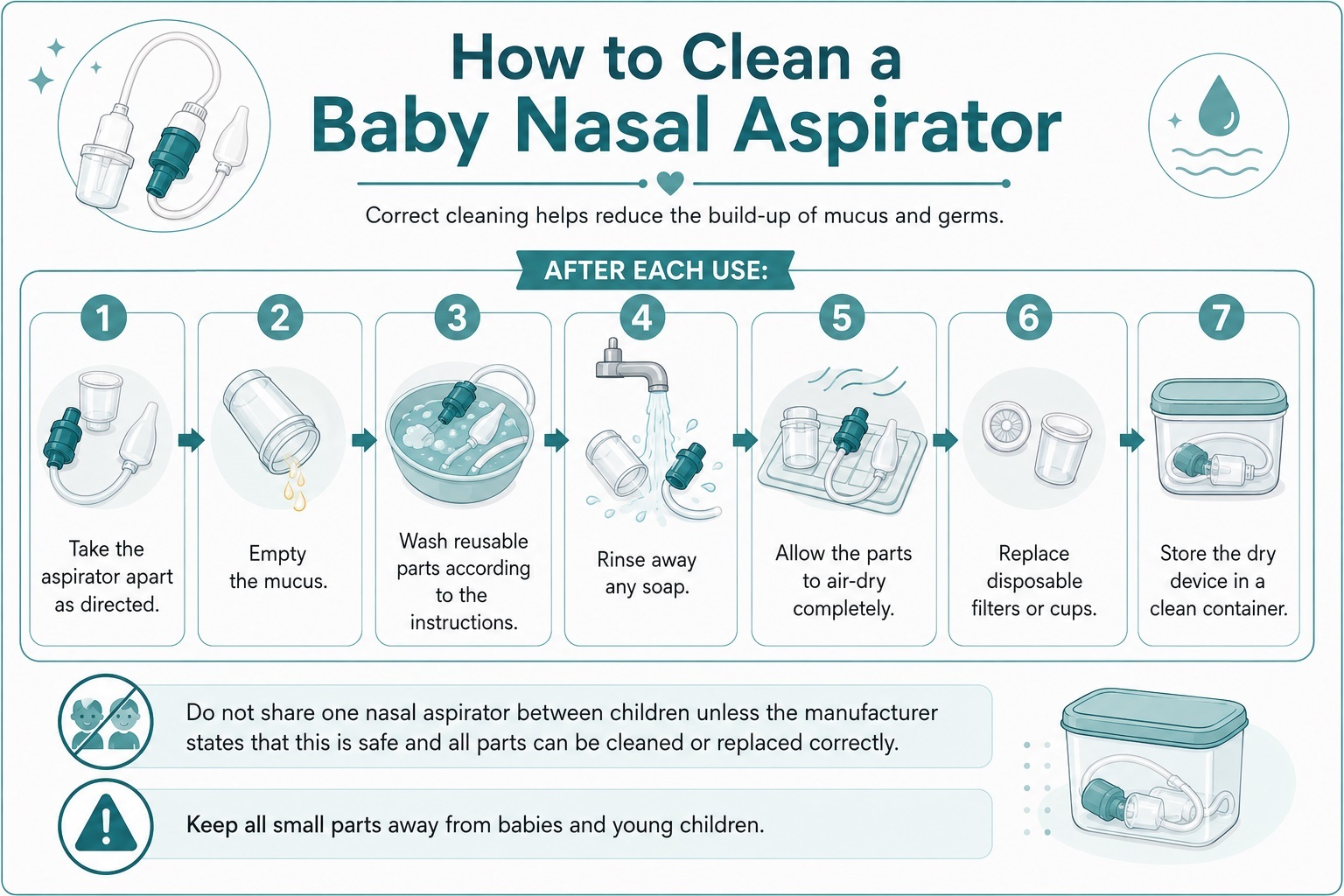
How to Clean a Baby Nasal Aspirator
Correct cleaning helps reduce the build-up of mucus and germs.
After each use:
- Take the aspirator apart as directed.
- Empty the mucus.
- Wash reusable parts according to the instructions.
- Rinse away any soap.
- Allow the parts to air-dry completely.
- Replace disposable filters or cups.
- Store the dry device in a clean container.
Do not share one nasal aspirator between children unless the manufacturer states that this is safe and all parts can be cleaned or replaced correctly.
Keep all small parts away from babies and young children.
When Should You See a Doctor?
Arrange medical advice if:
- Congestion is affecting feeding
- Your baby has fewer wet nappies
- The baby appears unusually tired
- Symptoms are getting worse
- Only one nostril is blocked
- Mucus smells bad
- There are repeated nosebleeds
- Congestion continues for a long time
- You think something is inside the nose
- The baby has an ongoing cough
- You are worried about their breathing
A baby under three months old with a temperature of 38°C or higher needs urgent medical assessment, according to Pregnancy, Birth and Baby.
When Is Baby Nasal Congestion an Emergency?
Call Triple Zero on 000 or go to the nearest emergency department if your baby:
- Is struggling to breathe
- Is grunting while breathing
- Has blue, grey or very pale lips or skin
- Is difficult to wake
- Becomes unwell very quickly
- Has pauses in breathing
- Appears floppy or unresponsive
- Cannot feed because of breathing trouble
These signs require urgent medical care.
Do not continue trying to clear the nose at home when a baby is showing serious breathing symptoms.
Frequently Asked Questions
Is a nasal aspirator painful for a baby?
Gentle suction near the nostril entrance should not usually be painful.
However, babies may dislike being held or having something placed near their nose.
Stop if you notice bleeding, swelling or signs of pain.
Can a nasal aspirator damage a baby’s nose?
Damage may occur if the tip is pushed too far, the suction is too strong or the device is used too often.
Keep the tip near the opening and follow the product instructions.
Can I use a nasal aspirator without saline?
Loose mucus may sometimes be removed without saline.
Saline may make thick or dry mucus easier to remove.
Is a manual or electric nasal aspirator better?
Neither type is best for every family.
Manual aspirators allow the parent to control the suction. Electric aspirators may be easier to operate.
Focus on age suitability, gentle suction and easy cleaning.
Can I use a nasal aspirator when my baby has RSV?
Gentle surface suction may sometimes help when mucus is affecting feeding.
However, RSV can affect the small airways and lungs. A nasal aspirator does not treat RSV.
Seek medical advice if your baby is breathing quickly, working hard to breathe, feeding poorly or becoming unusually tired.
Does green mucus mean my baby needs antibiotics?
Not always.
The colour of mucus alone does not prove that antibiotics are needed.
Pregnancy, Birth and Baby recommends seeing a doctor when yellow or green mucus lasts for more than 10 days and occurs with a fever.
Should all mucus be removed?
No.
A small amount of mucus is normal. It helps trap dust and germs.
The goal is to remove enough visible mucus to support comfortable breathing or feeding.
Key Points to Remember
Baby nasal congestion is common and is often mild.
A nasal aspirator for baby may help remove visible mucus when a blocked nose is affecting feeding or comfortable breathing.
Use gentle suction and keep the tip near the nostril opening.
Do not perform deep or repeated suction.
Baby saline may help loosen thick mucus. Use a saline product that is suitable for your baby’s age.
You do not need to remove every small amount of mucus.
Seek urgent medical help if your baby is struggling to breathe, grunting, difficult to wake or turning pale or blue.
Where to Buy a Nasal Aspirator for Baby
Parents and carers can explore baby nasal care products through MedCart Australia.
Depending on current seller stock, the range may include:
- PharmaSystems Nasal Aspirator PS900, a reusable bulb-style nasal aspirator with a soft tip
- FESS Little Noses Saline Nasal Spray and Aspirator, which combines saline spray with a nasal aspirator
- FLO Baby Saline Nasal Drops, a non-medicated saline product for baby nasal care
Product range, prices and stock may change.
Always check the product’s age guidance, warnings and directions before use.
MedCart Australia is an Australian online marketplace where consumers can compare healthcare, pharmacy, personal care and baby care products from Australian sellers.
References
- Pregnancy, Birth and Baby. Runny or Blocked Nose in Babies. Healthdirect Australia.
- Pregnancy, Birth and Baby. Coughs in Babies. Healthdirect Australia.
- Pregnancy, Birth and Baby. Cleaning Your Baby’s Ears, Eyes and Nose. Healthdirect Australia.
- Sydney Children’s Hospitals Network. Common Newborn Concerns. NSW Government.
- Children’s Health Queensland. Bronchiolitis: Emergency Management in Children. Queensland Paediatric Clinical Guideline.
- Healthdirect Australia. Symptoms of Serious Illness in Babies and Children.
- The Royal Children’s Hospital Melbourne. Dehydration in Babies and Children.