


Build Your Medical Kit for Travel with the Simple 4P System
Imagine you are leaving for a two-week family holiday.
You take daily allergy medicine. Your partner often gets headaches. Your child sometimes feels sick during long car rides. You also plan to spend several days hiking and visiting beaches.
You could buy a ready-made first aid kit and place it in your suitcase. However, it may not contain everything your family needs.
It might contain bandages and wipes, but no motion sickness supplies. It may have adult-sized items, but nothing suitable for your child. It will not include your regular prescription medicines.
This is why each travel medical kit should be personal.
A useful kit should match:
- The people travelling
- The place you are visiting
- The problems you may face
- The supplies you need to pack
You can remember these four points as the 4P Travel Kit System:
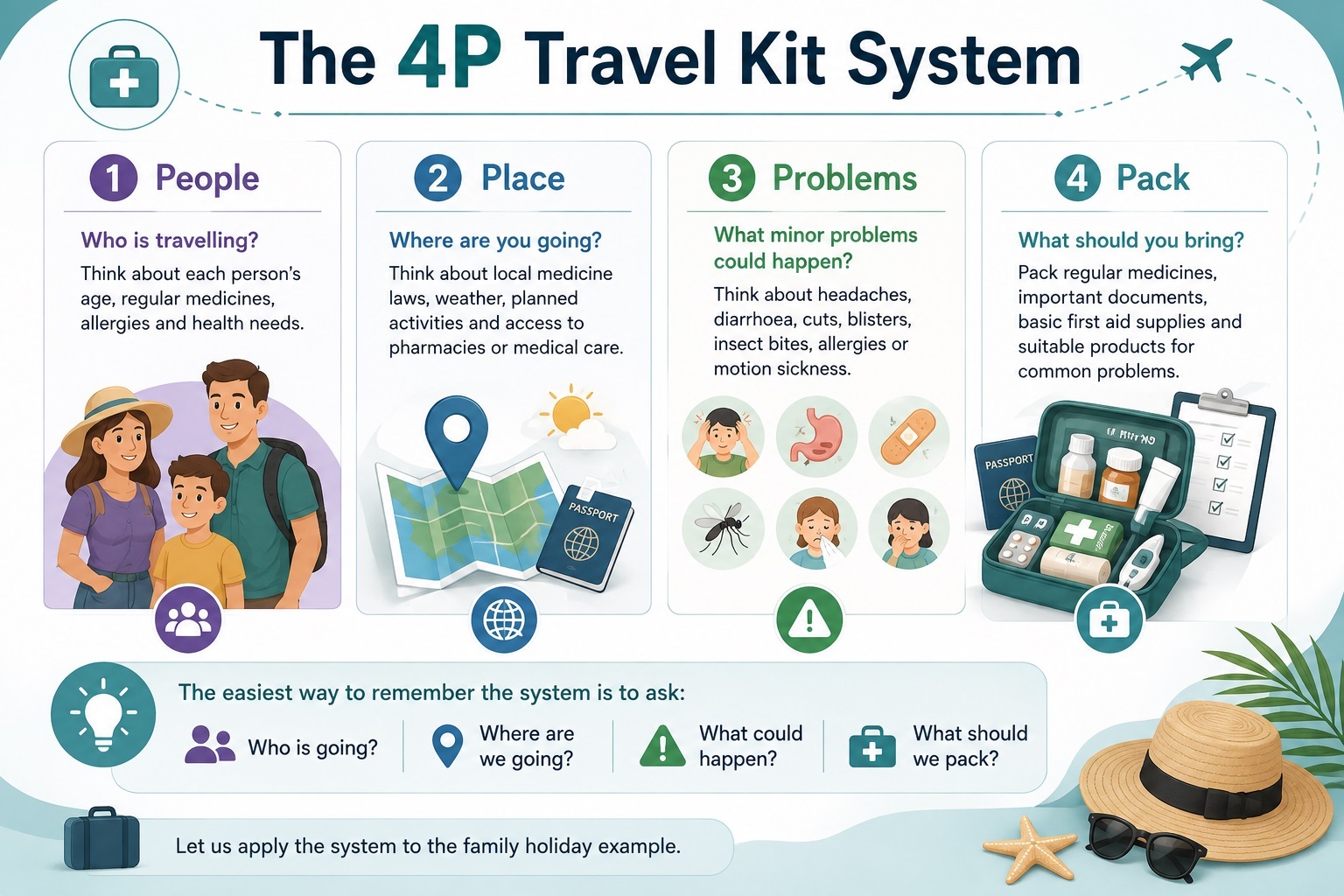
The 4P Travel Kit System
1. People
Who is travelling?
Think about each person’s age, regular medicines, allergies and health needs.
2. Place
Where are you going?
Think about local medicine laws, weather, planned activities and access to pharmacies or medical care.
3. Problems
What minor problems could happen?
Think about headaches, diarrhoea, cuts, blisters, insect bites, allergies or motion sickness.
4. Pack
What should you bring?
Pack regular medicines, important documents, basic first aid supplies and suitable products for common problems.
The easiest way to remember the system is to ask:
Who is going? Where are we going? What could happen? What should we pack?
Let us apply the system to the family holiday example.
How the 4P System Works: A Simple Example
People
The family includes two adults and one child.
One adult needs daily allergy medicine. The child sometimes experiences motion sickness. Each person may need a different product or dose.
Place
The family is travelling overseas to a warm destination.
They will be near pharmacies while staying in the city. However, they will also spend several days hiking and visiting places farther from shops.
They need to check whether their medicines are allowed at the destination and during any stopovers.
Problems
Based on the trip, they may need to prepare for:
- Small cuts and grazes
- Blisters from walking
- Headaches
- Sun exposure
- Insect bites
- Motion sickness
- Mild stomach problems
They do not need to pack a product for every possible illness. They should focus on their personal needs and the most likely minor problems.
Pack
Their medical kit may include:
- Regular allergy medicine
- A suitable child motion sickness product recommended by a pharmacist
- Prescription copies
- A doctor’s letter, if needed
- Adhesive bandages
- Sterile dressings
- Antiseptic wipes
- Disposable gloves
- Sunscreen
- Insect repellent
- Oral rehydration sachets
- A digital thermometer
This process helps the family pack with a clear purpose. They are not simply filling a bag with random medical products.
Now, let us look at each part of the system in more detail.
Part 1: People — Start with Who Is Travelling
The first step when you build your medical kit for travel is to think about the people going on the trip.
A kit for a healthy adult travelling alone will look different from a kit for:
- A family with young children
- An older traveller
- A pregnant traveller
- Someone with allergies
- Someone with diabetes
- Someone who uses an inhaler
- Someone who takes several daily medicines
- A person with a long-term health condition
Write down the name of every traveller. Then list their regular medicines, allergies and health needs.
Pack Regular Medicines First
Regular medicines should be the first items added to your travel medical kit.
These may include:
- Daily prescription tablets
- Asthma inhalers
- Allergy medicines
- Diabetes medicines and supplies
- Adrenaline autoinjectors
- Eye drops
- Skin treatments
- Contraceptive medicine
- Prescription creams
- Medical devices
- Approved supplements
Smartraveller advises Australians to take enough regular medicine for their whole trip where possible. Finding the same medicine or refilling a prescription overseas may be difficult.
Ask your doctor or pharmacist how much you should take. You may need extra supplies if your return is delayed, but the amount must follow the laws of your destination.
Speak to Your Doctor Early
For overseas travel, Smartraveller recommends seeing a doctor around six to eight weeks before departure. This gives you time to act on advice, arrange medicines and receive any recommended vaccinations.
Tell your doctor:
- Where you are going
- How long you will be away
- Every country where you will stop
- What activities you plan to do
- Whether you will visit remote areas
- What medicines you take
- Whether you have allergies
- Whether you are travelling with children
- Whether you are pregnant
- Whether you have a long-term health condition
Your doctor can give advice that matches your health and destination.
They may help you arrange:
- Enough regular medicine
- Repeat prescriptions
- A medicine list
- A letter explaining your medicines
- Recommended vaccines
- Destination-specific advice
- A treatment plan for an existing condition
Make a Personal Medicine List
Create a simple list for each traveller.
Include:
- The person’s full name
- Medicine brand name
- Active ingredient
- Medicine strength
- Regular dose
- Time the medicine is taken
- Reason for taking it
- Known allergies
- Doctor’s contact details
- Emergency contact details
The active ingredient is important because medicine brand names may be different in other countries.
Keep a paper copy in your travel medical kit. You can also save a secure digital copy on your phone.
Consider Age and Personal Needs
Medicines and first aid supplies are not always suitable for every person.
Children may need:
- Child-safe medicines recommended by a doctor or pharmacist
- A dosing syringe
- A digital thermometer
- Child-sized bandages
- Extra oral rehydration supplies
- Copies of allergy or asthma plans
Older travellers may need:
- A larger supply of regular medicines
- An easy-to-read medicine schedule
- Backup glasses or hearing aid batteries
- Mobility or continence supplies
- Copies of health records
Pregnant or breastfeeding travellers should ask a doctor or pharmacist before packing over-the-counter medicines.
Do not assume that a medicine used by one family member is suitable for another.
Part 2: Place — Think About Where You Are Going
The second step is to study your destination.
A weekend trip to a nearby city is different from:
- An overseas holiday
- A cruise
- A camping trip
- A tropical holiday
- A ski trip
- A long road trip
- A visit to a remote area
Ask yourself:
- Will pharmacies be easy to find?
- Will the pharmacy staff speak my language?
- Will I recognise the local medicine brands?
- Will I be far from a hospital?
- Is the weather hot, cold, wet or humid?
- Will I be hiking, swimming or driving?
- Are insect-borne illnesses a concern?
- Are my medicines legal there?
- Do my medicines need special storage?
Check Medicine Laws Before You Leave
A medicine that is legal in Australia may be controlled or banned in another country.
This may apply to:
- Medicines containing codeine
- Strong pain medicines
- Sleeping medicines
- Sedatives
- Stimulant medicines
- Some mental health medicines
- Medicinal cannabis
- Injectable medicines
- Needles and syringes
The Therapeutic Goods Administration says countries have different laws about which medicines and medical devices travellers can bring across their borders.
Check the rules for:
- Your main destination
- Every country you will visit
- Every country where you have a stopover
A medicine may still cause a problem during a stopover, even when you do not leave the airport.
Contact the embassy, high commission or consulate of the country you are visiting. Ask:
- Is the medicine allowed?
- Is there a limit on the amount?
- Do I need a permit?
- Do I need to declare it?
- Do I need a doctor’s letter?
- Does the letter need to be translated?
- Are there special rules for needles or liquids?
Do not rely only on social media posts or advice from other travellers. Rules can change.
Keep Medicines in Their Original Packaging
Avoid placing prescription tablets in unmarked plastic bags.
Keep medicines in their original labelled packaging. This makes it easier to show:
- What the medicine is
- Who it belongs to
- The prescribed dose
- The medicine strength
- The prescribing pharmacy or doctor
The TGA advises travellers to carry a prescription or a letter from their doctor when travelling with medicines.
A pill box or pill organiser may help you follow your medicine schedule after you arrive. However, keep the original packaging with you.
Ask your pharmacist before removing medicine from its packaging. Some products need protection from heat, light or moisture.
Carry a Prescription and Doctor’s Letter
Your doctor’s letter may include:
- Your full name
- The medicine name
- The medicine strength
- Your dose
- A statement that the medicine is for personal use
- Information about medical devices you need
Carry copies of your prescriptions where possible.
Keep:
- One copy with your medicines
- One copy in another bag
- One secure digital copy
Smartraveller also advises travellers to check that their medicines are legal at their destination and to carry prescription copies and a doctor’s letter.
Do Not Depend on Finding the Same Medicine Overseas
You may not find your usual medicine brand at your destination.
The medicine may have:
- A different brand name
- A different strength
- Different active ingredients
- Instructions in another language
- Different packaging
- Different buying rules
Smartraveller advises Australians not to buy or use prescription medicine overseas without a valid prescription and medical advice. It also warns that medicine quality, strength and purity can vary.
If you need medicine while overseas:
- Visit a licensed and established pharmacy.
- Ask a local doctor or pharmacist for advice.
- Check the active ingredient.
- Check the strength.
- Read the expiry date.
- Make sure the packaging is sealed.
- Avoid street sellers and unknown websites.
Preparing at home may give you more confidence, especially when you are unfamiliar with the local language or healthcare system.
Part 3: Problems — Prepare for Likely Minor Issues
You cannot pack for every illness or accident.
Instead, think about the minor problems that are most likely based on:
- Your personal health
- Your destination
- Your planned activities
- The length of your trip
The aim is not to diagnose or treat serious conditions yourself. A travel medical kit is mainly for regular medicines, basic first aid and common minor problems.
Headaches, Mild Pain and Fever
A pharmacist may recommend a suitable product for mild headaches, aches or fever.
Before packing pain medicine:
- Check who will use it
- Check the correct dose
- Read the warnings
- Check for allergies
- Check for medicine interactions
- Make sure it is suitable for children, if needed
Some cold and flu products already contain pain-relief medicine. Taking two products with the same active ingredient may lead to an unsafe dose.
Read every label carefully.
Colds and Flu
Simple cold and flu supplies may include:
- Tissues
- Throat lozenges
- Face masks
- Hand sanitiser
- A thermometer
- A suitable symptom-relief product recommended by a pharmacist
Cold and flu medicines may not be suitable for everyone. Some can cause drowsiness or interact with regular medicine.
Should You Pack Antibiotics Just in Case?
Antibiotics should not be treated as a normal item in every travel medical kit.
The Australian Department of Health says antibiotics do not work against the viruses that cause colds and flu. Taking antibiotics when they are not needed may cause avoidable side effects and contribute to antimicrobial resistance.
Do not:
- Buy antibiotics without medical advice
- Use antibiotics prescribed for another person
- Save unfinished antibiotics for another illness
- Use antibiotics for a cold or flu
- Pack old antibiotics from a previous prescription
In some cases, a doctor may give a traveller a specific treatment plan based on their health, destination or access to medical care.
Only pack antibiotics when they have been prescribed for you with clear instructions about when and how to use them.
Diarrhoea and Stomach Problems
Different foods, water and routines may affect your stomach.
Ask a pharmacist whether your travel medical kit should contain:
- Oral rehydration sachets
- A suitable diarrhoea product
- Indigestion or heartburn medicine
- Motion sickness medicine
- A thermometer
Oral rehydration products can help replace fluids and salts lost through diarrhoea. Different products may be needed for adults and children.
Seek medical help if diarrhoea is severe or comes with:
- Blood in the stool
- A high fever
- Severe pain
- Signs of dehydration
- Ongoing vomiting
- Confusion
- Unusual weakness
- Symptoms that are not improving
Babies, young children, older adults and pregnant people may become dehydrated more quickly.
Motion Sickness
Motion sickness may happen during travel by:
- Car
- Bus
- Boat
- Cruise ship
- Plane
Healthdirect says travel sickness medicines may cause side effects such as drowsiness. It recommends asking a doctor or pharmacist for advice, especially for children, pregnant people and anyone taking other medicines.
A pharmacist can help you choose a suitable product before the trip. This is often easier than searching for an unfamiliar product after symptoms begin.
Allergies and Insect Bites
Travellers with known allergies should pack their usual allergy medicines.
Depending on the person and destination, this may include:
- An antihistamine
- An adrenaline autoinjector, when prescribed
- Insect repellent
- Bite or sting relief
- A copy of an allergy action plan
Check local insect risks before travelling. Smartraveller advises travellers to ask about insect-borne illnesses and ways to reduce their risk.
Cuts, Grazes and Blisters
Walking, hiking and outdoor activities can lead to small cuts, grazes and blisters.
Useful supplies may include:
- Adhesive bandages
- Blister dressings
- Sterile gauze
- Non-stick dressings
- Medical tape
- Antiseptic wipes
- Sterile saline
- Disposable gloves
Healthdirect says an organised and properly stocked first aid kit can help during an accident or emergency.
Serious, deep or heavily bleeding wounds need professional medical care.
Sun and Heat
For warm destinations, consider packing:
- SPF 30 to 50+ sunscreen
- A hat
- Protective clothing
- Oral rehydration sachets
- A reusable water bottle
- A thermometer
Smartraveller includes sunscreen and insect repellent among the items travellers may place in a small first aid kit.
Follow local advice about heat, water safety and sun protection.
Part 4: Pack — Put Everything Together
The final step is to pack your supplies in a clear and organised way.
You can buy a ready-made travel first aid kit or create your own.
A ready-made kit gives you a useful starting point. You can then add personal medicines and supplies based on the first three parts of the 4P System.
Use the Three-Pouch Packing Method
To keep your medical kit easy to use, separate it into three small sections.
Pouch 1: Daily Medicines
Place regular and important medicines here.
Examples include:
- Prescription tablets
- Inhalers
- Allergy medicine
- Diabetes supplies
- Adrenaline autoinjectors
- Eye drops
- Daily supplements approved by your health professional
Keep the doctor’s letter and prescription copies close to this pouch.
Pouch 2: First Aid
Use this pouch for cuts, grazes, blisters and minor injuries.
It may include:
- Adhesive bandages in several sizes
- Waterproof bandages
- Sterile gauze
- Non-stick dressings
- Medical tape
- Antiseptic wipes
- Sterile saline
- Crepe bandage
- Disposable gloves
- Tweezers
- Blunt-ended scissors
- Safety pins
- A basic first aid guide
Check airport rules before placing scissors or sharp tools in your hand luggage.
Pouch 3: Common Problems
Use this pouch for suitable over-the-counter products.
Depending on advice from your doctor or pharmacist, it may include:
- Pain relief
- Oral rehydration sachets
- Motion sickness medicine
- Allergy medicine
- Throat lozenges
- Indigestion products
- Insect bite relief
Label each pouch clearly so you can find items quickly.
Keep Essential Medicine in Your Hand Luggage
Do not place all important medicines in checked baggage.
Checked bags can be delayed, damaged or lost. Keep essential medicines, medical devices and important documents where you can reach them.
Smartraveller recommends planning for missing luggage and keeping copies of key documents, including prescriptions and insurance details.
Check your airline and airport rules for:
- Medicines
- Liquids
- Needles
- Syringes
- Scissors
- Cold packs
- Batteries
- Medical devices
Carry proof when needles or syringes are medically necessary.
Check Storage Instructions
Some medicines can be damaged by:
- Heat
- Direct sunlight
- Moisture
- Freezing temperatures
Do not leave medicines inside a hot car.
Ask your pharmacist how to carry medicines that need refrigeration or a controlled temperature. You may need an insulated medicine bag or approved cooling product.
Do not place medicine directly against ice unless the product instructions allow it.
Check Every Expiry Date
Check your travel medical kit before each trip.
Look for:
- Expired medicines
- Expired dressings
- Open sterile packs
- Leaking liquids
- Damaged packaging
- Empty containers
- Flat thermometer batteries
- Labels that can no longer be read
Healthdirect says medicines should not be used after their expiry date because they may no longer work as well.
Replace anything that is expired, used, open or damaged.
Add Emergency Information
Place an emergency information card inside the kit.
Include:
- Traveller names
- Known allergies
- Health conditions
- Regular medicines
- Emergency contacts
- Doctor’s contact details
- Travel insurer’s contact details
- Policy number
- Local emergency number
- Accommodation details
Keep another copy on your phone and give one to a trusted travel companion.
Do Not Forget Travel Insurance
A medical kit can help with minor problems. It cannot replace medical care or insurance.
Smartraveller says Australians usually need to pay for medical care received overseas. Travel insurance may help protect travellers from large medical and evacuation costs.
Check whether your policy covers:
- Existing health conditions
- Hospital treatment
- Medical evacuation
- Prescription medicines
- Pregnancy
- Cruises
- Adventure activities
- All countries and stopovers
- The full length of the trip
Read the policy details before you leave.
How to Adjust the 4P System for Different Trips
The same four questions can be used for almost any trip.
Family Holiday
People: Adults and children with different needs.
Place: Hotel, theme park, beach or overseas city.
Problems: Motion sickness, fever, grazes, sun exposure and stomach problems.
Pack: Child-safe products, dosing syringe, thermometer, sunscreen and extra dressings.
Solo City Trip
People: One traveller with regular medicines.
Place: A city with easy access to shops and medical care.
Problems: Headaches, blisters, mild stomach problems and small cuts.
Pack: A compact kit, regular medicines, bandages, pain relief and emergency details.
Camping or Hiking Trip
People: Consider each person’s fitness, allergies and medicines.
Place: A remote area with limited access to shops.
Problems: Blisters, cuts, bites, sprains, heat or cold exposure.
Pack: Extra dressings, compression bandage, emergency blanket, insect repellent, torch and communication equipment.
Cruise Holiday
People: Check who experiences motion sickness or takes daily medicine.
Place: A ship where products and medical care may cost more or be limited.
Problems: Motion sickness, stomach problems, headaches and minor injuries.
Pack: Regular medicines for the full trip, motion sickness supplies, oral rehydration sachets and basic first aid items.
Tropical Holiday
People: Consider allergies, children and people sensitive to heat.
Place: A hot or humid area where insects may be common.
Problems: Sun exposure, insect bites, dehydration, blisters and stomach problems.
Pack: Sunscreen, insect repellent, oral rehydration supplies, waterproof dressings and regular medicines.
Road Trip
People: Consider the driver, passengers, children and older travellers.
Place: Long roads that may be far from pharmacies.
Problems: Motion sickness, headaches, small injuries and medicine delays.
Pack: A car first aid kit, regular medicines, water, motion sickness supplies and emergency contacts.
Your 4P Travel Medical Kit Checklist
Before closing your suitcase, ask the four questions one more time.
1. People: Who Is Going?
- I listed every traveller.
- I checked regular medicines.
- I considered ages and allergies.
- I asked a doctor or pharmacist for personal advice.
- I prepared a medicine list.
- I packed enough regular medicine.
2. Place: Where Are We Going?
- I researched the destination.
- I checked stopover rules.
- I confirmed that my medicine is legal.
- I checked weather and local risks.
- I checked access to pharmacies and medical care.
- I arranged travel insurance.
3. Problems: What Could Happen?
- I considered headaches and mild pain.
- I prepared for stomach problems.
- I considered motion sickness.
- I packed allergy supplies.
- I prepared for cuts and blisters.
- I considered sun and insect exposure.
4. Pack: What Should We Bring?
- Regular medicines
- Original medicine packaging
- Prescription copies
- Doctor’s letter
- First aid supplies
- Suitable common-problem products
- Emergency information
- Insurance details
- Medicines in hand luggage
- Checked expiry dates
Frequently Asked Questions
What should I put in a travel medical kit?
Start with your regular medicines. Then add prescription documents, basic first aid supplies and products for likely minor problems.
Use the 4P System:
- People
- Place
- Problems
- Pack
Your final kit should match your health, destination and planned activities.
Can I use a ready-made travel first aid kit?
Yes. A ready-made kit can be a useful starting point.
Check the list of contents before buying. Add your own regular medicines, documents and personal supplies.
Do not assume one kit will meet the needs of every traveller.
Can I put medicines in a pill organiser?
A pill organiser can help you manage a daily schedule. However, you should also keep the original labelled packaging, especially during overseas travel.
Check with your pharmacist before removing medicines from their packaging.
Should I pack antibiotics for my trip?
Only pack antibiotics when a doctor has prescribed them for you and explained when to use them.
Antibiotics do not treat viral colds or flu. Do not use old antibiotics or medicine prescribed for another person.
Should medicine go in my carry-on bag?
Keep essential medicines and important medical devices in your hand luggage where possible.
Check the rules of your airline, departure airport, stopover airports and destination.
How often should I check my travel medical kit?
Check it:
- Before every trip
- After it has been used
- When a medicine expires
- When your health needs change
- When travelling to a new destination
Replace opened, damaged, missing or expired items.
Where to Buy Travel First Aid Kits and Medical Supplies
You can create your own travel medical kit or begin with a ready-made kit.
MedCart Australia offers medical and healthcare supplies from Australian sellers. You can compare different products and choose items that match your trip and personal needs.
Explore:
- Travel and general first aid kits
- Pill boxes and pill cases
- Adhesive bandages
- Sterile dressings and gauze
- Disposable gloves
- Digital thermometers
- Bandages and wound care supplies
- Masks and personal protection products
Read the product description before buying. Kit contents, sizes and quantities can vary.
Medicines and personal treatments should be selected with advice from a doctor or pharmacist.
Final Thoughts
There is no single travel medical kit that is right for everyone.
A young solo traveller, a family with children and a person taking daily medicine will each need something different.
The 4P Travel Kit System makes planning easier:
People: Who is travelling?
Place: Where are you going?
Problems: What could reasonably happen?
Pack: What do you need to bring?
Start with your regular medicines. Research your destination. Prepare for likely minor problems. Then organise everything in a simple and easy-to-carry kit.
A little preparation before your trip may save you from searching for an unfamiliar pharmacy when you are tired, unwell or far from home.
References
- Australian Government Department of Foreign Affairs and Trade, Smartraveller. Health Advice for Travelling Australians. Updated 13 February 2026.
- Australian Government Department of Foreign Affairs and Trade, Smartraveller. What You Need to Know Before You Go. Updated 20 February 2026.
- Australian Government Department of Foreign Affairs and Trade, Smartraveller. Prescription Drugs and Travel. Published 11 January 2024.
- Australian Government Therapeutic Goods Administration. Travelling with Medicines and Medical Devices: Leaving Australia. Updated 27 March 2024.
- Australian Government Department of Health, Disability and Ageing. Antibiotics Won’t Do for Colds and Flu. Published 17 June 2025.
- Healthdirect Australia. First Aid Kits for Your Home, Workplace and Car.
- Healthdirect Australia. Out-of-Date Medicines.
- Healthdirect Australia. Motion Sickness: Travel, Sea, Car and Medication.
General information notice: This article provides general information only. It does not replace advice from a doctor, pharmacist or other qualified health professional. Always read the product label and follow the directions for use. Seek medical care for serious, unusual or worsening symptoms.