


Introduction
Nasal strips are small adhesive strips that sit across the outside of your nose. Many people use them at night, during sleep, or when they feel their nose is blocked.
They are also called nose strips, nasal breathing strips, or external nasal dilators.
The main job of nasal strips is simple. They gently lift and open the sides of the nose. This may help air move through the nose more easily.
This guide explains how nasal strips work, what they do, and when they may be useful. It also explains what nasal strips cannot do, so you can make a safe and informed buying choice.
You can also browse nasal strips on MedCart Australia or view the featured Breathe Right range on MedCart.
What Are Nasal Strips?
Nasal strips are flexible strips that stick to the bridge of the nose.
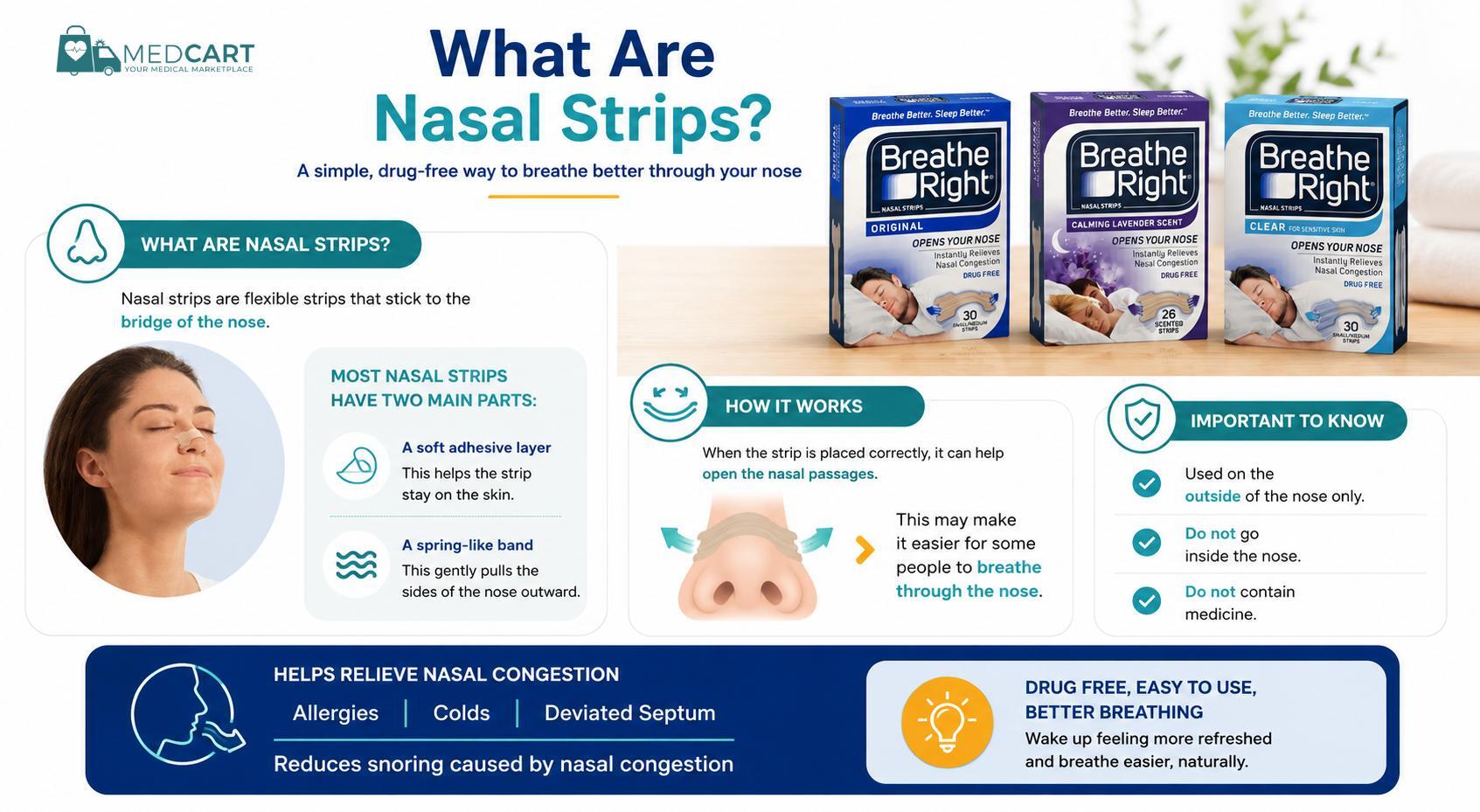
Most nasal strips have two main parts:
- A soft adhesive layer
- This helps the strip stay on the skin.
- A spring-like band
This gently pulls the sides of the nose outward.
When the strip is placed correctly, it can help open the nasal passages. This may make it easier for some people to breathe through the nose.
Nasal strips are used on the outside of the nose only. They do not go inside the nose. They also do not contain medicine.
How Do Nasal Strips Work?
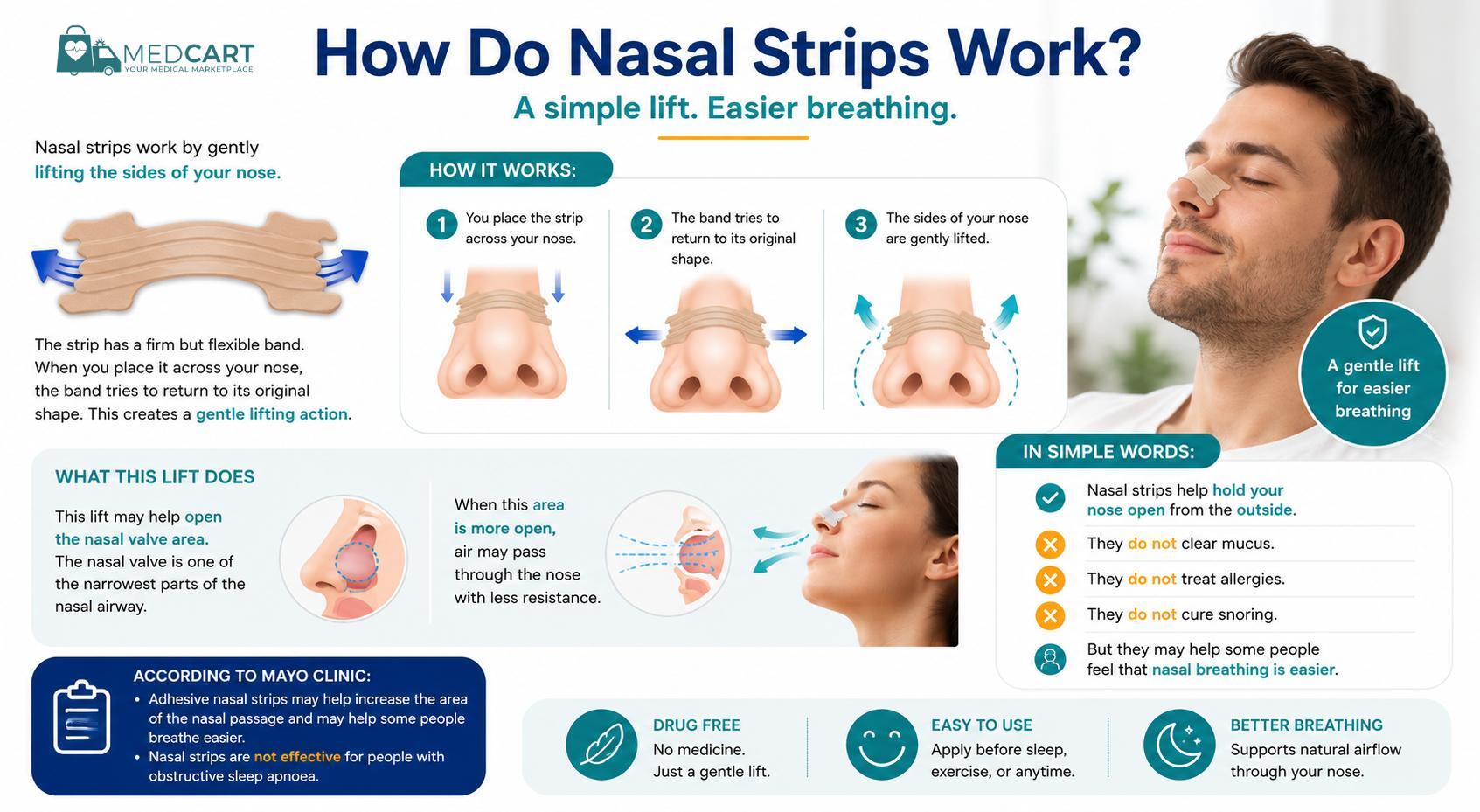
Nasal strips work by gently lifting the sides of the nose.
The strip has a firm but flexible band. When you place it across your nose, the band tries to return to its original shape. This creates a gentle lifting action.
This lift may help open the nasal valve area. The nasal valve is one of the narrowest parts of the nasal airway.
When this area is more open, air may pass through the nose with less resistance.
In simple words:
Nasal strips help hold your nose open from the outside.
They do not clear mucus. They do not treat allergies. They do not cure snoring. But they may help some people feel that nasal breathing is easier.
According to Mayo Clinic, adhesive nasal strips may help increase the area of the nasal passage and may help some people breathe easier. Mayo Clinic also states that nasal strips are not effective for people with obstructive sleep apnoea.
What Do Nasal Strips Do?
Nasal strips may help with airflow through the nose.
People may use nasal strips for:
- Night-time nasal breathing
- Mild blocked nose feeling
- Snoring linked to nasal airflow
- Exercise breathing support
- Sleep comfort
- Temporary nasal stuffiness
A nasal strip does not force you to breathe through your nose. It only helps open the nose from the outside.
If your nose feels tight or narrow at night, a nasal strip may give a gentle “open” feeling.
Do Nasal Strips Really Work?
Nasal strips may work for some people, but not for everyone.
Research has shown mixed results. Some studies suggest that nasal strips may improve nasal airflow. Some people also report easier breathing when using them.
A PubMed-listed study on Breathe Right strips in people with chronic rhinitis found that external nasal dilation may reduce snoring in some people. Another research review in PMC noted that nasal dilators may improve nasal breathing, but they have not shown strong improvement in obstructive sleep apnoea outcomes.
This means nasal strips may be helpful if the problem is linked to nasal airflow. But they may not help if snoring is caused by the throat, tongue, sleep position, alcohol, weight, or obstructive sleep apnoea.
Simple Answer
Yes, nasal strips may work for some people.
They may help if:
- Your nose feels narrow
- You have mild nasal stuffiness
- You snore because of nasal airflow issues
- You prefer a non-medicine option
They may not work well if:
- You have obstructive sleep apnoea
- Your snoring is loud and constant
- You wake up choking or gasping
- You feel very sleepy during the day
- You have a serious nasal blockage
If symptoms are ongoing, it is best to ask a doctor or pharmacist.
Are Nasal Strips Good for Snoring?
Nasal strips may help with some types of snoring.
Snoring can happen when air cannot move smoothly through the nose or throat. Better Health Channel says simple snoring tips may include treating nasal congestion, sleeping on your side, and avoiding alcohol before bed.
If snoring happens because the nose is blocked or narrow, nasal strips may help by opening the nose.
But snoring can have many causes. It can also be linked to obstructive sleep apnoea.
Healthdirect Australia explains that obstructive sleep apnoea happens when the airway partly or fully blocks during sleep. This can cause breathing pauses and brief waking during the night.
Nasal strips should not be used as a replacement for medical care if sleep apnoea is possible.
Speak with a health professional if you or your partner notice:
- Loud snoring most nights
- Pauses in breathing
- Choking or gasping during sleep
- Morning headaches
- Dry mouth when waking
- Daytime tiredness
- Poor focus during the day
Is It Okay to Wear Nasal Strips Every Night?
For many people, nasal strips can be used at night as directed on the product label.
They are made for external use. They are not medicine. They are usually designed to be worn while sleeping and removed in the morning.
However, it is important to follow the pack instructions.
You should avoid using nasal strips on:
- Broken skin
- Sunburned skin
- Irritated skin
- Very oily skin
- Skin with a rash
- Skin with cuts or wounds
You should stop using the strip if it causes:
- Redness
- Pain
- Itching
- Skin peeling
- Swelling
- Strong discomfort
If your skin is sensitive, remove the strip slowly and gently. You can also test one strip first before using it every night.
If you need nasal strips every night because you always feel blocked, it may be worth asking a doctor or pharmacist. Long-term blocked nose may be linked to allergies, sinus issues, nasal structure, or other causes.
Is It Good to Use a Nose Strip?
A nose strip can be useful for some people.
It may be a good option if you want a simple, non-medicine way to support nasal airflow.
Nasal strips may suit people who:
- Want a drug-free option
- Do not want a spray
- Want temporary support at night
- Feel mild nasal stuffiness
- Snore due to nasal airflow
- Need a simple travel-friendly product
Nasal strips may not be suitable if:
- You have sensitive skin
- You react to adhesives
- You have a skin condition on the nose
- Your snoring may be linked to sleep apnoea
- You have severe or long-term nasal blockage
Always read the product label before use.
How to Use Nasal Strips Correctly
Nasal strips work best when they are placed properly.
Follow the instructions on the pack. In general, the steps are:
1. Wash and dry your nose
Clean skin helps the strip stick better. Remove oil, lotion, or makeup from the nose area.
2. Place the strip across the nose
The strip usually goes across the bridge of the nose, above the nostrils.
Do not place it too high near the eyes. Do not place it too low on the soft tip of the nose.
3. Press down gently
Press the strip for a few seconds so it sticks well.
4. Wear as directed
Most people use nasal strips during sleep.
5. Remove slowly
In the morning, loosen the ends gently. Remove the strip slowly to reduce skin pulling.
Tip: Warm water can help loosen the adhesive before removal.
Common Mistakes When Using Nasal Strips
Nasal strips are simple, but small mistakes can affect comfort and results.
Avoid these common mistakes:
- Using the strip on oily skin. Oil can stop the strip from sticking well.
- Placing it too high or too low. The strip needs to sit over the right part of the nose to help lift the nasal passage.
- Reusing the same strip. Most nasal strips are single-use only.
- Removing it too fast. Pulling the strip off quickly may irritate the skin.
- Expecting it to fix all snoring. Nasal strips may only help if nasal airflow is part of the problem.
Nasal Strips vs Nasal Sprays
Nasal strips and nasal sprays are different.
A nasal strip works from the outside. It helps lift and open the nose.
A nasal spray works inside the nose. Some sprays may help with congestion, allergies, or dryness, depending on the type.
Nasal strips do not contain medicine. This may make them a simple choice for people who want a non-drug option.
But if your blocked nose is due to allergies, sinus problems, or inflammation, a pharmacist or doctor may suggest a different option.
Do not use medicated nasal sprays for longer than directed on the label unless advised by a health professional.
Nasal Strips vs Internal Nasal Dilators
Both products aim to support nasal airflow.
The difference is where they are used.
Nasal strips
- Stick outside the nose
- Lift the nose from the outside
- Are usually single-use
- Do not go inside the nostrils
Internal nasal dilators
- Sit inside the nostrils
- Help hold the nostrils open from inside
- May be reusable depending on the product
- May not suit everyone
Some people prefer nasal strips because they are simple and do not sit inside the nose.
Who May Benefit from Nasal Strips?
Nasal strips may be helpful for people who feel mild nasal airflow limits.
They may be useful for:
- Adults who snore due to nasal stuffiness
- People with mild blocked nose at night
- People who want a non-medicine option
- Travellers who want simple sleep support
- People who feel their nostrils narrow when breathing in
They may also be used during exercise by some people. However, results can vary.
Who Should Be Careful with Nasal Strips?
Nasal strips may not be right for everyone.
Be careful if you have:
- Sensitive skin
- Adhesive allergy
- Skin irritation on the nose
- Recent nose injury
- Severe nasal blockage
- Ongoing sleep problems
- Possible sleep apnoea symptoms
Children should only use nasal strips if the product label says it is suitable for their age.
For any medical concern, speak with a doctor or pharmacist.
Can Nasal Strips Help with a Blocked Nose?
Nasal strips may help if the blocked feeling is partly from narrow nasal passages.
They do not remove mucus. They also do not treat the cause of congestion.
If your blocked nose is from a cold, allergies, sinus issues, or other causes, nasal strips may only give temporary support.
Sleep Health Foundation Australia notes that a blocked nose can cause mouth breathing and may lead to snoring. It also says a doctor can assess blocked nose causes such as allergies, sinus disease, or a deviated septum.
If your blocked nose is long-term, it is best to get advice.
Can Nasal Strips Help with Sleep Apnoea?
Nasal strips are not a treatment for obstructive sleep apnoea.
This is important.
Obstructive sleep apnoea is a sleep breathing condition. Healthdirect Australia says it happens when the airway partly or fully blocks during sleep. This can cause breathing pauses and brief waking.
A research review in PMC found that nasal dilators may improve nasal breathing, but they have not shown strong improvement in obstructive sleep apnoea outcomes.
Mayo Clinic also states that nasal strips and external nasal dilators are not effective for people with obstructive sleep apnoea.
If you think you may have sleep apnoea, do not rely on nasal strips alone. Speak with a doctor.
How to Choose the Right Nasal Strips
When buying nasal strips, check these points:
1. Size
Some nasal strips come in different sizes. Choose a size that fits your nose shape.
2. Skin type
If you have sensitive skin, look for strips made for sensitive skin if available.
3. Strength
Some strips are made with stronger lift. These may suit people who want more opening support.
4. Use case
Check if the strip is for night use, sport use, or general breathing support.
5. Brand
Choose a trusted brand with clear product information and instructions.
You can browse Breathe Right nasal strips on MedCart Australia or shop the wider nasal strips category.
Breathe Right Nasal Strips
Breathe Right is a well-known nasal strip brand.
Breathe Right nasal strips are designed to be placed on the outside of the nose. They help gently open the nasal passages. This may help reduce nasal airflow resistance for some people.
They are commonly used at night by people who want a simple, drug-free breathing support option.
Before using any nasal strip, always read the product label and follow the directions.
Shop Breathe Right products on MedCart Australia.
Frequently Asked Questions About Nasal Strips
Do nasal strips really work?
Nasal strips may work for some people. They may help open the nasal passages and make nasal breathing feel easier. Research shows mixed results. They may be more helpful when snoring or breathing discomfort is linked to nasal airflow.
What do nasal strips do?
Nasal strips gently lift the sides of the nose. This may help open the nasal passage and reduce airflow resistance. They do not contain medicine.
Is it okay to wear nasal strips every night?
Many people use nasal strips at night as directed. Always follow the product instructions. Do not use them on broken, irritated, or sunburned skin. Stop use if the strip causes skin irritation.
Is it good to use a nose strip?
A nose strip can be a good non-medicine option for people who want temporary nasal airflow support. It may not be right for people with sensitive skin, adhesive reactions, or possible sleep apnoea symptoms.
Can nasal strips stop snoring?
Nasal strips may help some snoring that is linked to nasal airflow. They may not help snoring caused by the throat, tongue, sleeping position, alcohol, weight, or sleep apnoea.
Are nasal strips safe?
Nasal strips are usually used externally and do not contain medicine. Skin irritation can happen in some people. Always read and follow the label.
Can I use nasal strips with a cold?
Some people use nasal strips when they feel stuffy. They may help open the nose, but they do not treat the cold or remove mucus.
Do nasal strips help with allergies?
Nasal strips do not treat allergies. They may help support airflow if the nose feels narrow. For allergy symptoms, speak with a pharmacist or doctor.
Simple Buying Checklist
Before buying nasal strips, ask yourself:
- Do I want a non-medicine option?
- Is my blocked nose mild or temporary?
- Do I need a sensitive skin option?
- Do I snore loudly or gasp during sleep?
- Have I read the product directions?
- Should I ask a pharmacist or doctor first?
If snoring is loud, ongoing, or linked with tiredness, it is safer to seek medical advice.
Key Takeaways
- Nasal strips are small adhesive strips that sit across the outside of the nose.
- They may help open the nasal passages and support nasal airflow.
- They may help some people who snore due to nasal airflow issues.
- They do not treat allergies, colds, sinus problems, or obstructive sleep apnoea.
- They should be used as directed on the product label.
- If symptoms are ongoing or serious, speak with a health professional.
Where to Buy Nasal Strips in Australia
You can buy nasal strips on MedCart Australia.
MedCart Australia features health care and personal care products from trusted marketplace sellers. You can also browse the featured Breathe Right nasal strips range.
Visit MedCart Australia to shop nasal strips and other health care products online.
References
- Healthdirect Australia. “Obstructive Sleep Apnoea - Symptoms and Treatment.”
- Better Health Channel. “Snoring.”
- Better Health Channel. “Sleep Apnoea.”
- Sleep Health Foundation Australia. “Treatment Options for Obstructive Sleep Apnoea.”
- Mayo Clinic. “Snoring - Diagnosis and Treatment.”
- Camacho M, et al. “Nasal Dilators for Snoring and Obstructive Sleep Apnea: A Systematic Review and Meta-Analysis.” Published in PMC.
- Pevernagie D, et al. “External Nasal Dilation Reduces Snoring in Chronic Rhinitis Patients: A Randomized Controlled Trial.” Published in PubMed.
- Sleep Foundation. “How Do Nasal Strips Work?”