


Quick Answer
You can test for the flu with a flu test. This is usually done with a swab from the nose or throat.
A flu test may be done in a clinic, hospital, or at home. Some tests check for flu only. Some tests check for flu and COVID-19 at the same time.
A rapid flu test kit can give results in about 10 to 20 minutes, depending on the product. A lab test, such as a PCR test, may be more sensitive, but it must be processed by a lab.
If you have flu-like symptoms, a test can help you understand what virus may be causing them. It can also help you decide what steps to take next.
What Is the Flu?
The flu is also called influenza. It is a contagious illness caused by influenza viruses.
Flu can affect the nose, throat, and lungs. It can spread when a sick person coughs, sneezes, talks, or touches shared surfaces.
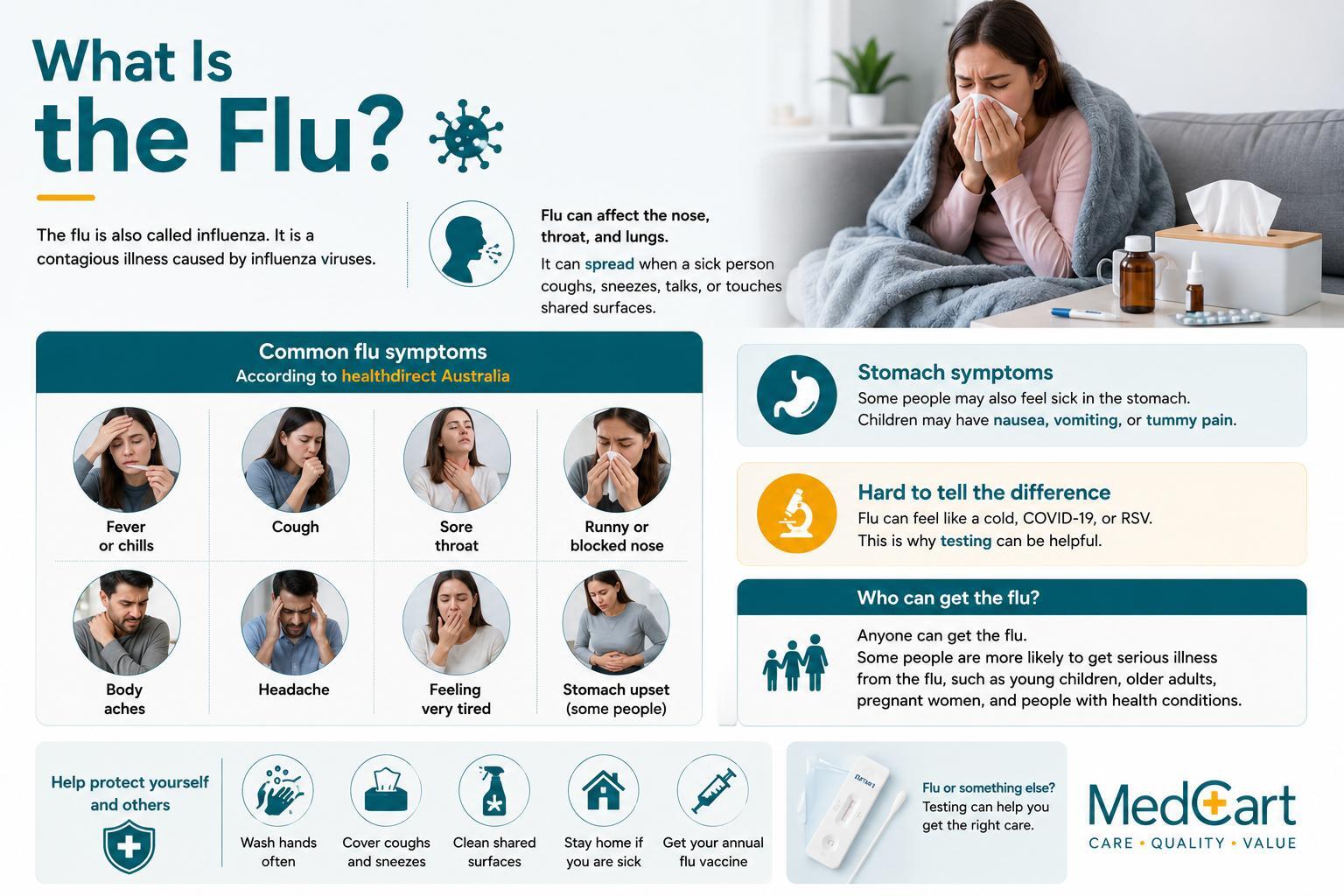
According to healthdirect Australia, common flu symptoms can include:
- Fever or chills
- Cough
- Sore throat
- Runny or blocked nose
- Body aches
- Headache
- Feeling very tired
Some people may also feel sick in the stomach. Children may have nausea, vomiting, or tummy pain.
Flu can feel like a cold, COVID-19, or RSV. This is why testing can be helpful.
Why Should You Use a Flu Test?
A flu test helps check if influenza may be causing your symptoms.
This can be useful because many respiratory viruses have similar symptoms. COVID-19, flu, RSV, and colds can all cause cough, fever, sore throat, and tiredness.
A test may help you:
- Know if you may have influenza
- Decide if you should stay home
- Reduce the risk of spreading illness
- Speak to a doctor sooner if you are at higher risk
- Choose the right type of care
A test is not the same as medical advice. If you are very unwell, at high risk, or unsure what to do, speak with a doctor or pharmacist.
How Do You Test for the Flu?
A flu test is usually done with a swab.
The swab collects a sample from the nose or throat. The sample is then tested for signs of the influenza virus.
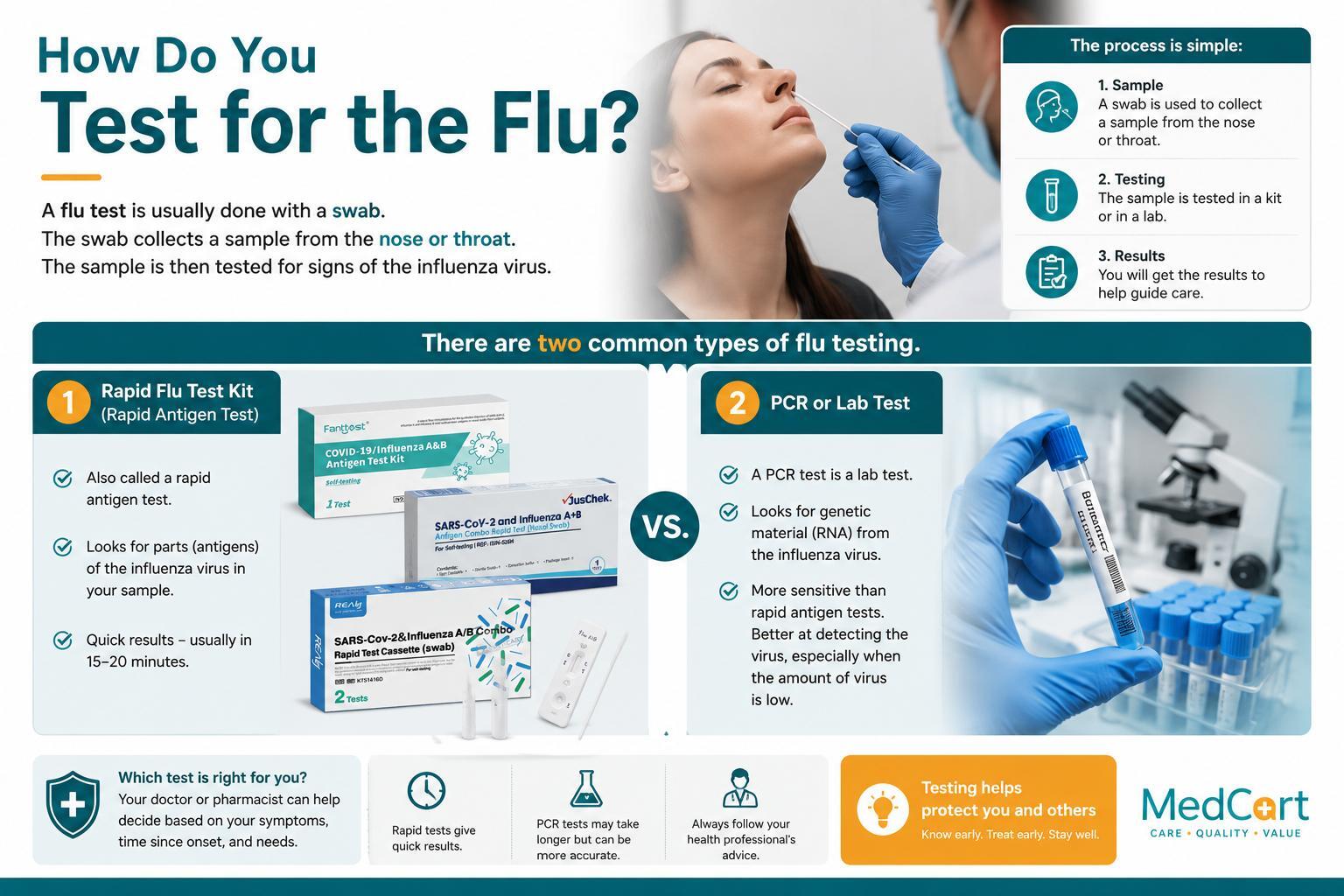
There are two common types of flu testing.
1. Rapid Flu Test Kit
A rapid flu test kit is also called a rapid antigen test. It looks for parts of the virus in your sample.
Some rapid tests can be used at home. Others may be used in clinics or other care settings.
A rapid test is popular because it can give results quickly. Many rapid antigen tests show results in around 10 to 20 minutes.
A rapid test can be helpful when you want a fast result. But it may not detect every case of flu.
According to the CDC, a positive rapid flu test during a flu outbreak likely means you have flu. But a negative rapid flu test does not always mean you do not have flu.
This means you should still be careful if you have symptoms.
2. PCR or Lab Test
A PCR test is a lab test. It looks for genetic material from the virus.
PCR tests are often more sensitive than rapid antigen tests. This means they may be better at finding the virus, especially when the amount of virus is low.
A PCR test is usually arranged by a doctor, clinic, or hospital. The result may take longer because it needs lab testing.
According to healthdirect Australia, influenza can be diagnosed using a PCR test or a rapid antigen test.
Flu Test vs COVID and Flu Test
A regular flu test kit checks for influenza. Some kits check for influenza A and influenza B.
A covid and flu test can check for more than one virus at the same time. These tests may check for:
- COVID-19
- Influenza A
- Influenza B
Some tests may also check for RSV.
This can be useful because COVID-19 and flu symptoms can look very similar. Better Health Channel Victoria says it can be hard to tell the difference between COVID-19 and flu symptoms.
A covid and flu test may help you check more than one possible cause using one swab and one test device.
What Is Influenza A and Influenza B?
Many flu test kits check for influenza A and influenza B.
Influenza A and B are the main types that cause seasonal flu in people.
A test result may show:
- Influenza A positive
- Influenza B positive
- Negative
- Invalid result
If your test shows influenza A or B positive, follow the product instructions and local health advice.
How to Check Influenza Test at Home
You can check for influenza at home with a test kit flu product that is made for home use.
Always read the instructions that come with your test kit. Each brand may have slightly different steps.
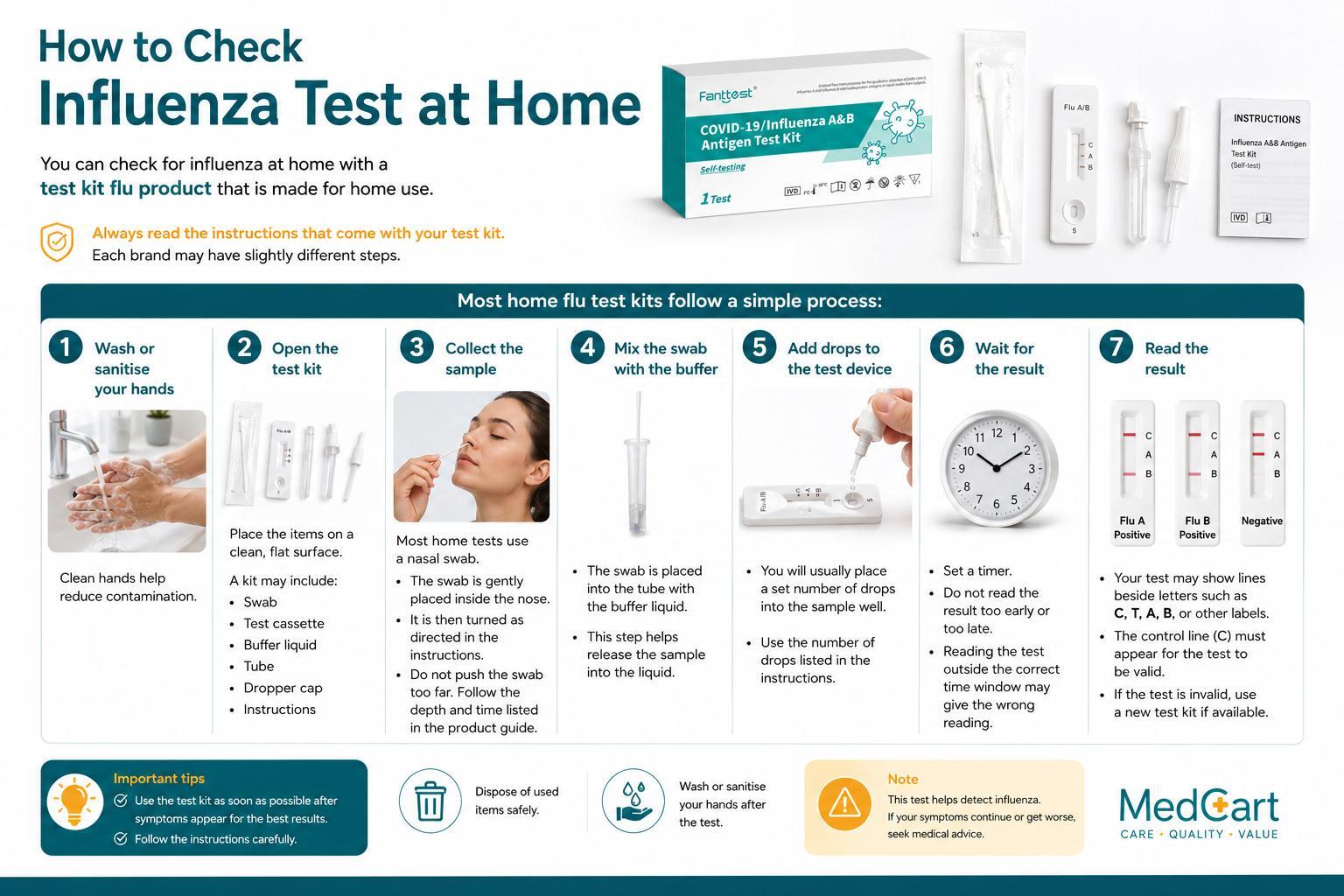
Most home flu test kits follow a simple process:
Step 1: Wash or sanitise your hands
Clean hands help reduce contamination.
Step 2: Open the test kit
Place the items on a clean, flat surface.
A kit may include:
- Swab
- Test cassette
- Buffer liquid
- Tube
- Dropper cap
- Instructions
Step 3: Collect the sample
Most home tests use a nasal swab.
The swab is gently placed inside the nose. It is then turned as directed in the instructions.
Do not push the swab too far. Follow the depth and time listed in the product guide.
Step 4: Mix the swab with the buffer
The swab is placed into the tube with the buffer liquid.
This step helps release the sample into the liquid.
Step 5: Add drops to the test device
You will usually place a set number of drops into the sample well.
Use the number of drops listed in the instructions.
Step 6: Wait for the result
Set a timer.
Do not read the result too early or too late. Reading the test outside the correct time window may give the wrong reading.
Step 7: Read the result
Your test may show lines beside letters such as C, T, A, B, or other labels.
The control line must appear for the test to be valid.
If the test is invalid, use a new test kit if available.
When Is the Best Time to Use a Flu Test?
A flu test may be most useful when you have symptoms.
Common symptoms may include:
- Fever
- Cough
- Sore throat
- Body aches
- Tiredness
- Chills
- Runny nose
Testing early can be helpful, but the best timing can depend on the type of test and the product instructions.
If your result is negative but you still feel unwell, you may need to test again or speak with a doctor.
This is because rapid tests can miss some infections.
Can a CBC Detect Influenza?
A CBC means complete blood count. It is a blood test.
A CBC can show general signs that your body is fighting illness. For example, it may show changes in white blood cells.
But a CBC does not confirm influenza.
A CBC cannot tell you that you have the flu in the same way a flu swab test can.
To check for influenza, a doctor may use a nose or throat swab. This may be tested with a rapid antigen test, PCR test, or other lab method.
So, the simple answer is:
No, a CBC cannot directly detect influenza. A flu test is needed to check for influenza virus.
Is a Flu Test Accurate?
No test is perfect.
A rapid flu test kit can give fast results. But it may be less sensitive than a PCR test.
This means a rapid test may sometimes show a negative result even if a person has flu.
According to the CDC, rapid influenza tests can vary in how well they detect influenza. The CDC also says a negative rapid test does not always rule out flu.
For this reason, look at both your result and your symptoms.
If you are very sick, at higher risk, or worried about your symptoms, seek medical advice even if the test is negative.
What Does a Positive Flu Test Mean?
A positive flu test means the test found signs of influenza in your sample.
If you test positive, you may be contagious. You should take steps to protect others.
What If My Flu Test Is Positive?
If your flu test is positive:
- Stay home and rest.
- Avoid close contact with others.
- Drink fluids.
- Wear a mask if you need to be near others.
- Wash your hands often.
- Cover coughs and sneezes.
- Speak with a doctor or pharmacist if you are at higher risk.
- Seek urgent help if symptoms are severe.
Do not go to work, school, or public places while you are very unwell.
If you live with older people, babies, pregnant people, or people with weak immune systems, take extra care.
When Should You Call a Doctor?
You should consider medical advice if:
- You have trouble breathing
- You have chest pain
- You are very drowsy or confused
- Your fever is high or does not improve
- Symptoms get worse
- You are pregnant
- You are elderly
- The sick person is a baby or young child
- You have a chronic health condition
- You have a weak immune system
- You are unsure what to do
Healthdirect Australia says flu can be serious for some people. People at higher risk should get medical advice early.
Do You Need Medicine After a Positive Flu Test?
Some people may only need rest, fluids, and symptom care.
Some people may need medical treatment.
Flu antiviral medicines are prescription medicines. They are not the same as antibiotics. Antibiotics do not work against viruses like influenza.
If you are at higher risk, your doctor may discuss treatment options with you.
Do not self-medicate with prescription medicine. Always follow medical advice.
What Does a Negative Flu Test Mean?
A negative result means the test did not detect influenza in your sample.
But it does not always mean you do not have the flu.
A negative result can happen if:
- The sample was not collected well
- You tested too early
- You tested too late
- The amount of virus was too low
- The test was less sensitive
- The illness is caused by another virus
If you still have symptoms, stay home and avoid spreading illness.
You may need to test again, use a different test, or speak with a healthcare professional.
What Is an Invalid Flu Test Result?
An invalid result means the test did not work properly.
This may happen if:
- The control line does not appear
- Too much or too little sample was used
- The test was read at the wrong time
- The test kit was damaged
- The instructions were not followed correctly
If your result is invalid, use a new test kit.
Flu Test Kit Buying Guide
When buying a flu test kit, check the product details carefully.
Look for:
- What the test detects
- Whether it checks influenza A and B
- Whether it also checks COVID-19
- Whether it is for home use
- How fast the result appears
- How many tests are in the pack
- Expiry date
- Storage instructions
- Clear instructions
- TGA or Australian supply details where relevant
For many homes, a covid and flu test may be useful because symptoms can overlap.
For workplaces, clinics, aged care, schools, and shared homes, test kits may help people check symptoms earlier.
Who May Use a Flu Test Kit?
A flu test kit may be useful for:
- Families
- Carers
- Workplaces
- Schools
- Clinics
- Aged care settings
- People with flu-like symptoms
- People who want to check COVID-19 and flu symptoms
Always follow the instructions for age use and sample collection.
Some tests may not be suitable for very young children unless an adult collects the sample.
How to Store a Flu Test Kit
Store test kits as directed on the box.
Most test kits should be kept:
- In a cool, dry place
- Away from direct sunlight
- Away from children
- Within the temperature range on the label
Do not use a test kit after the expiry date.
Do not use a test kit if the package is damaged or open.
How to Use a Flu Test Safely
To use a flu test safely:
- Read the instructions first
- Wash your hands before and after testing
- Use the swab only once
- Do not share swabs
- Place used items in a rubbish bag
- Clean the surface after testing
- Keep the test kit away from children
- Follow local health advice
If you are helping someone else test, wear a mask if possible and wash your hands after.
Flu Test Kit vs Symptoms Only
You cannot know for sure if you have flu based on symptoms alone.
Symptoms can give clues, but they can overlap with other illnesses.
A flu test gives more information. It can help you decide what to do next.
But remember, a test result is only one part of the picture. Your symptoms, risk level, and medical history also matter.
Flu Test and COVID-19: Why Testing Both Can Help
COVID-19 and flu can both cause:
- Fever
- Cough
- Sore throat
- Runny nose
- Tiredness
- Headache
- Body aches
Because the symptoms are similar, a covid and flu test may help you check for more than one virus.
This can be helpful when you need a quick result at home.
Healthdirect Australia notes that some rapid tests can test for COVID-19, influenza A and B, and RSV.
Can You Have COVID-19 and Flu at the Same Time?
It may be possible to have more than one respiratory virus at the same time.
This is one reason some combination tests check for more than one virus.
If you feel very unwell, or if your symptoms are getting worse, speak with a doctor.
How Long Should You Stay Home With the Flu?
If you have flu symptoms, stay home while you are unwell.
You should avoid close contact with others, especially people at higher risk.
Follow advice from your doctor, workplace, school, or local health authority.
If you must go out, wear a mask and avoid crowded places.
How to Reduce the Spread of Flu
Testing is one helpful step. But it is not the only step.
You can reduce the spread of flu by:
- Staying home when sick
- Washing hands often
- Covering coughs and sneezes
- Wearing a mask when needed
- Cleaning shared surfaces
- Avoiding close contact with sick people
- Getting yearly flu vaccination if recommended for you
According to the Australian Government Department of Health, vaccination is a key way to help protect against flu.
Common Questions About Flu Testing
How do you test for the flu?
You test for the flu with a swab sample from the nose or throat. The sample may be tested using a rapid antigen test or a lab test such as PCR.
How to check influenza test at home?
Use a home flu test kit. Read the instructions, collect a nasal sample, mix it with the buffer, add drops to the test device, wait for the correct time, then read the result.
Can a CBC detect influenza?
No. A CBC is a blood test. It may show general signs of illness, but it does not confirm influenza. A flu swab test is used to check for influenza.
What if my flu test is positive?
Stay home, rest, drink fluids, avoid close contact with others, and follow health advice. Speak with a doctor if you are at higher risk or if symptoms are severe.
Is a rapid flu test kit the same as a PCR test?
No. A rapid flu test kit usually gives fast results and detects viral antigens. A PCR test is a lab test and may be more sensitive.
Can a flu test also test for COVID-19?
Some tests can check for both COVID-19 and flu. These are often called combination tests or COVID and flu tests.
Can I use a flu test if I only have mild symptoms?
You may use a home test if the product is suitable and you follow the instructions. If symptoms are mild, rest and monitor your condition. Seek advice if you are worried.
Should I test again after a negative result?
If symptoms continue or get worse, you may need to test again or speak with a healthcare professional. A negative rapid test does not always rule out flu.
Simple Summary
A flu test helps check if influenza may be causing your symptoms.
You can use a rapid flu test kit for fast results. Some test kits can check for both COVID-19 and flu.
A PCR test may be arranged by a doctor and may be more sensitive.
A CBC blood test does not directly detect influenza.
If your flu test is positive, stay home and avoid spreading illness. If you are at higher risk or very unwell, seek medical advice.
Where to Buy Flu Test Kits in Australia
If you are looking for a flu test kit, test kit flu, covid and flu test, or rapid flu test kit, you can browse MedCart Australia.
MedCart Australia offers a range of healthcare, medical, and home testing products for consumers, workplaces, clinics, and care settings.
Shop here: Flu and COVID Combo Antigen Test
You can also visit MedCart Australia here: MedCart Australia
References
This article was written using information from reliable health sources, including:
- healthdirect Australia: Flu information and diagnosis guidance
- Australian Government Department of Health and Aged Care: Influenza information
- Better Health Channel Victoria: Flu and COVID-19 health guidance
- Centers for Disease Control and Prevention: Influenza testing guidance and rapid test interpretation