


Introduction
Small cuts and grazes are common. Most minor wounds can be cared for at home, but good wound care starts with simple steps: stop the bleeding, remove dirt, rinse the wound and protect it.
Healthdirect Australia says most minor wounds can be managed at home by cleaning them with clean water or saline and covering them with a non-stick dressing. More serious wounds need medical care. (Healthdirect)
This guide explains the best way to clean a wound, how to care for it at home, whether it should be covered, and when to see a healthcare professional. It is intended for minor cuts and grazes, not deep wounds, surgical wounds, ulcers or major injuries.
What Is the Best Thing to Clean a Wound With?
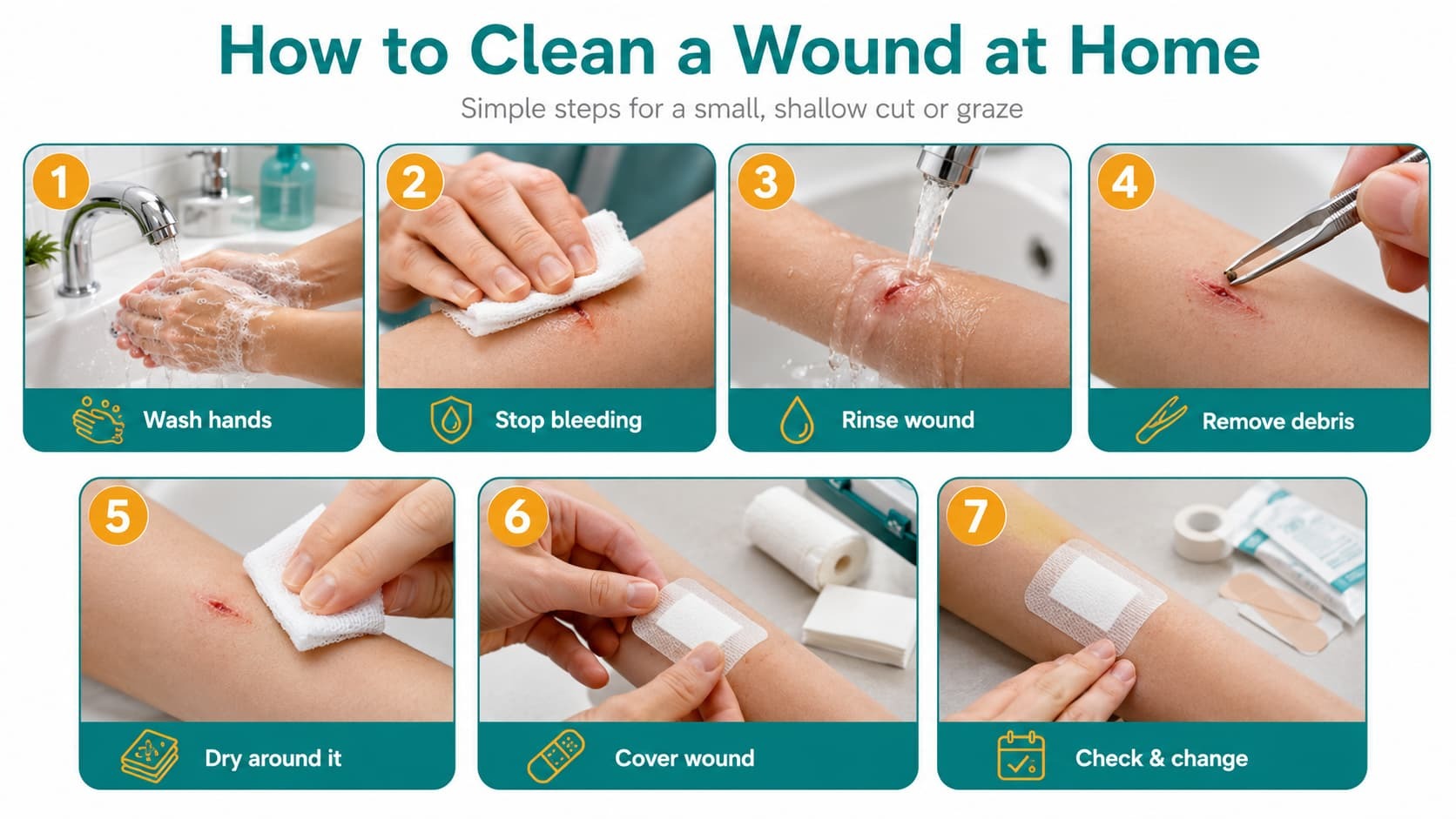
For a simple minor wound, clean running tap water or saline is usually suitable.
Healthdirect recommends rinsing minor wounds with clean water or saline. The aim is to wash away dirt and other material without causing more damage to the skin.
A 2022 Cochrane review looked at studies comparing tap water, saline and other types of water for wound cleansing. The researchers found that the evidence was too uncertain to show that tap water or saline was clearly better for healing or preventing infection. This supports keeping wound cleaning simple rather than assuming a more complicated solution is always better. (PubMed)
Do not assume that a strong antiseptic is better. The Royal Children's Hospital Melbourne notes that substances such as strong hydrogen peroxide or iodine solutions may irritate or damage injured tissue when used to wash an open wound. Healthdirect also says antiseptic creams are not routinely needed for minor wounds. (Royal Children's Hospital)
Some antiseptic products are intended for specific first-aid uses. If you use one, check the label and follow the directions. Ask a pharmacist or healthcare professional if you are unsure.
For everyday wound cleaning, the simple answer is: rinse well with clean water or saline and remove visible dirt gently.
How to Clean a Minor Wound at Home: 7 Steps
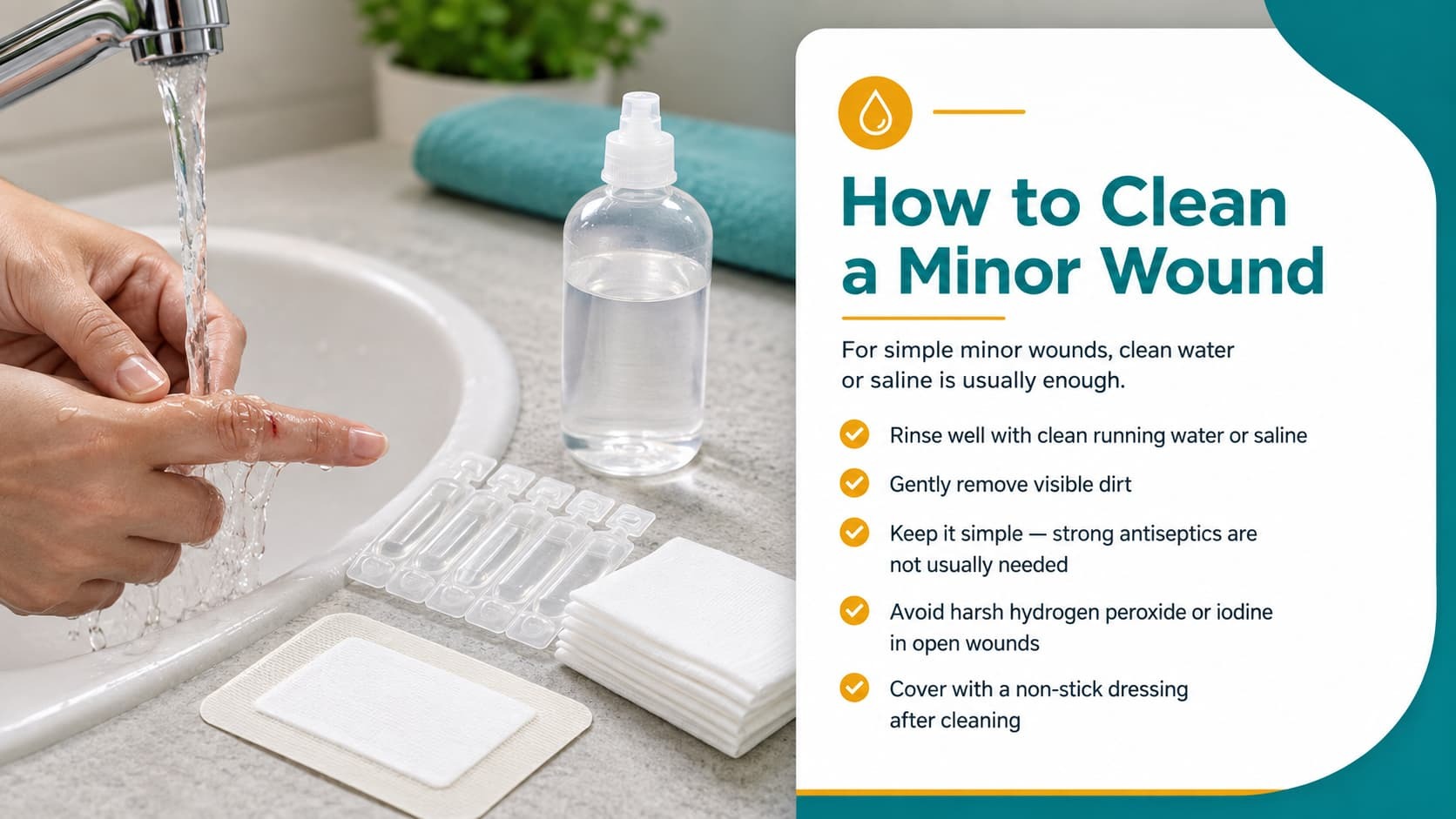
How can I clean my wound at home? For a small, shallow cut or graze, the following seven-step approach is a useful guide.
1. Wash your hands
Clean your hands well before touching the wound or dressing. This helps reduce the chance of adding dirt or germs.
2. Stop the bleeding
Apply firm pressure with clean gauze, a dressing or a clean cloth. Healthdirect recommends maintaining pressure for about five minutes or until the bleeding stops.
3. Rinse the wound
Use plenty of clean running water or saline. Let the liquid wash away loose dirt rather than aggressively scrubbing the wound.
4. Remove easy-to-see debris
If small pieces of dirt are still present, they may be gently removed with clean tweezers or gauze. Do not dig into the wound or try to remove deeply embedded material.
5. Dry the surrounding skin
Gently pat the skin around the wound with clean gauze or a towel. Avoid rubbing the injured area.
6. Cover the wound
Place a clean, non-stick dressing over the wound. Depending on the size and location, gauze and a bandage may be used to help secure and protect the area.
7. Check and change the dressing
Keep the dressing clean and change it if it becomes wet, dirty or loose. Continue to watch for increasing redness, swelling, heat, pain or pus.
These steps are for minor injuries. If you cannot remove dirt, bleeding continues or the wound is deep or gaping, seek medical advice instead of continuing to treat it yourself. (Healthdirect)
Covered or Uncovered: Which Helps Wounds Heal?
Do wounds heal faster covered or uncovered? For many minor wounds, keeping the wound clean and appropriately covered during early healing is generally preferred.
The Royal Children's Hospital Melbourne explains that a dressing protects a wound from further injury and contamination. It can also help maintain a moist healing environment. (Royal Children's Hospital)
Research has also challenged the old idea that wounds need to dry out and form a hard scab to heal well. A review by researchers associated with Harvard Medical School found that an appropriately moist wound environment can support the movement of new skin cells across the wound and may help wounds heal more efficiently. (PubMed Central (PMC))
“Moist” does not mean leaving a wound wet or soaked. A suitable dressing should manage moisture while protecting the area.
A non-stick dressing is a simple option for many small cuts and grazes. Gauze and bandages can also help protect or secure a dressing. Change the dressing when recommended for the product, or sooner if it becomes dirty, wet, loose or soaked through.
Once a simple wound has closed and no longer needs protection from dirt or rubbing, a dressing may no longer be necessary.
When to Seek Medical Care for a Wound
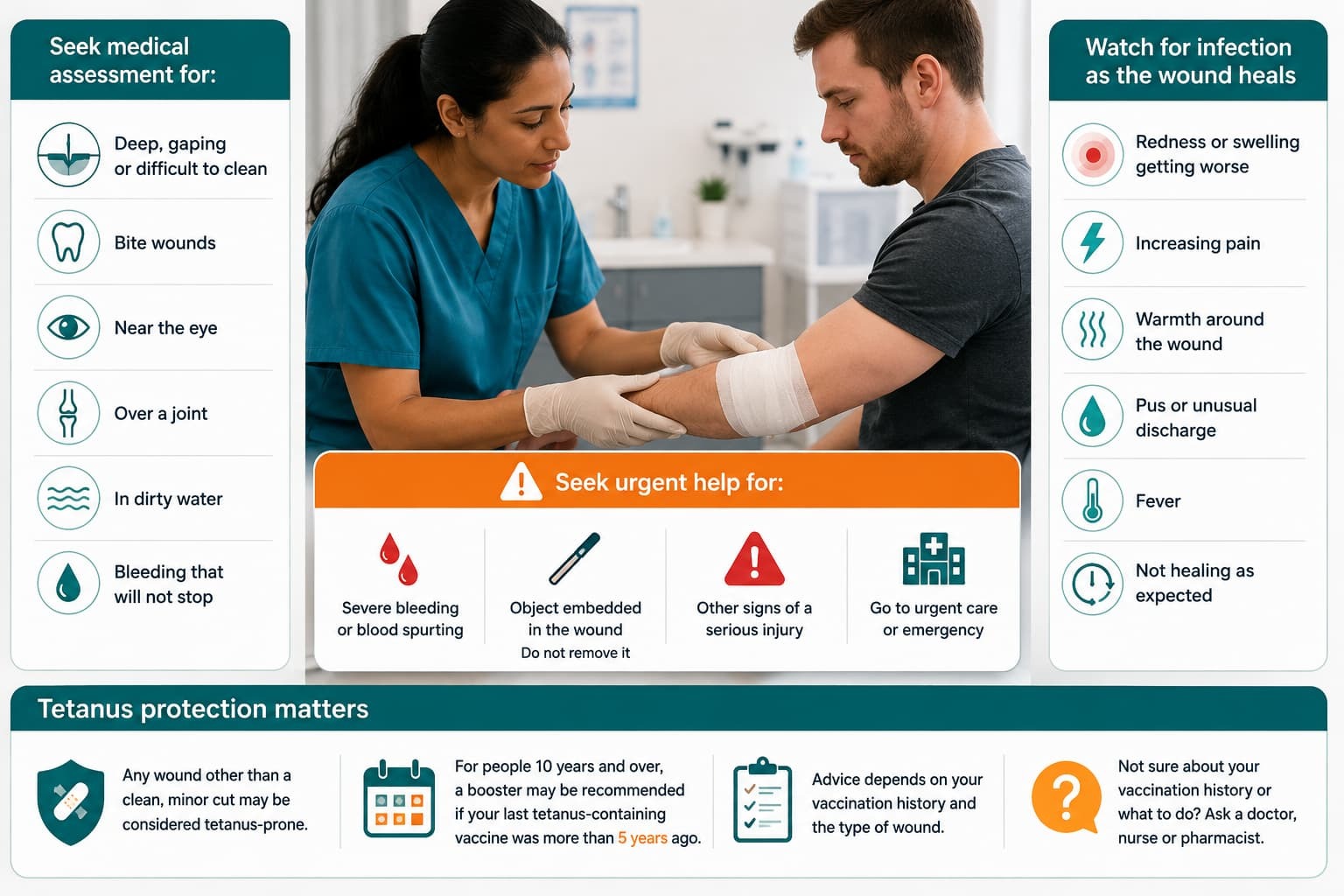
Home wound care is not right for every injury. Healthdirect recommends medical assessment for wounds that are deep, gaping, difficult to clean, caused by a bite, near the eye, over a joint or caused in dirty water. Bleeding that will not stop also needs medical attention. (Healthdirect)
Seek urgent help for severe bleeding, blood that is spurting, an object embedded in the wound, or other signs of a serious injury. Do not pull an embedded object out yourself.
Also watch for possible infection while the wound heals. Signs can include:
- redness or swelling that is getting worse
- increasing pain
- warmth around the wound
- pus or other unusual discharge
- fever
- a wound that is not healing as expected
Tetanus protection is another consideration. The Australian Immunisation Handbook says any wound other than a clean, minor cut may be considered tetanus-prone. For people aged 10 years and over with a tetanus-prone wound, a booster may be recommended if the last tetanus-containing vaccine was more than five years ago. Advice also depends on vaccination history and wound type. (The Australian Immunisation Handbook)
If you are unsure about your vaccination history or whether your wound needs professional treatment, ask a doctor, nurse or pharmacist.
FAQs
What is the best thing to clean a wound with?
For most minor cuts and grazes, use plenty of clean running water or saline. The main goal is to rinse away dirt and debris gently.
How can I clean my wound at home?
Wash your hands, stop bleeding with direct pressure, rinse the wound, gently remove visible dirt, dry the surrounding skin, apply a clean non-stick dressing and monitor it while it heals.
Do wounds heal faster covered or uncovered?
For many minor wounds, a clean dressing that maintains an appropriately moist, protected environment is generally preferred during early healing. The best dressing depends on the wound and the amount of fluid it produces.
Should I use antiseptic every time?
Not necessarily. Healthdirect says antiseptic creams are not routinely needed for minor wounds. If an antiseptic product has been recommended or is designed for your situation, follow its label or advice from a healthcare professional. (Healthdirect)
Summary
The best way to care for a simple cut or graze is often also the simplest: control bleeding, rinse with clean water or saline, remove loose dirt and protect the wound with an appropriate dressing.
Avoid harsh cleaning methods. Check the wound as it heals, and seek medical care if it is deep, badly contaminated, infected, difficult to clean or continues to bleed.
Where to Buy Wound Care Supplies
Keeping a few basic first-aid items at home can make minor wound care easier.
MedCart Australia offers a range of Wound Care supplies, including Dressings, Gauzes and Bandages.
You can also browse Ointments, Creams and Oils and First Aid Antiseptics where appropriate. Always check product directions before using a product on broken skin.
Browse the wider range of First Aid Supplies at MedCart Australia.
References
- healthdirect Australia. Wounds, cuts and grazes. Last reviewed December 2025. https://www.healthdirect.gov.au/wounds-cuts-and-grazes
- Agency for Clinical Innovation, NSW Health – Emergency Care Institute. Wound care clinical tool. Published February 2015; minor revision July 2026. https://aci.health.nsw.gov.au/networks/eci/clinical/tools/wound-care
- The Royal Children's Hospital Melbourne. Cuts, grazes, and lacerations. Publication date not stated on the current page. https://www.rch.org.au/kidsinfo/fact_sheets/Cuts_grazes_lacerations/
- Australian Government Department of Health, Disability and Ageing – Australian Immunisation Handbook. Tetanus. Updated 24 October 2025. https://immunisationhandbook.health.gov.au/contents/vaccine-preventable-diseases/tetanus
- Fernandez R, Green HL, Griffiths R, Atkinson RA, Ellwood LJ; Cochrane Collaboration. Water for wound cleansing. Cochrane Database of Systematic Reviews. Published 14 September 2022. https://pubmed.ncbi.nlm.nih.gov/36103365/
- Nuutila K, Eriksson E; Harvard Medical School. Moist Wound Healing with Commonly Available Dressings. Advances in Wound Care. Published 21 September 2021. https://pubmed.ncbi.nlm.nih.gov/32870777/