



Quick Summary
Laboratory lab coats are protective garments worn over clothing in labs, clinics, and other work areas. They help reduce direct contact with splashes, spills, dust, and other workplace hazards.
A lab coat is part of personal protective equipment, also called PPE. It should be chosen based on the task, workplace rules, and type of risk.
Lab coats do not replace gloves, masks, goggles, or safe work practices. They are one part of a full safety system.
What Is a Lab Coat in the Laboratory?
A lab coat is a protective coat worn in a laboratory. It helps cover the wearer’s clothes and skin from minor splashes, spills, and contamination.
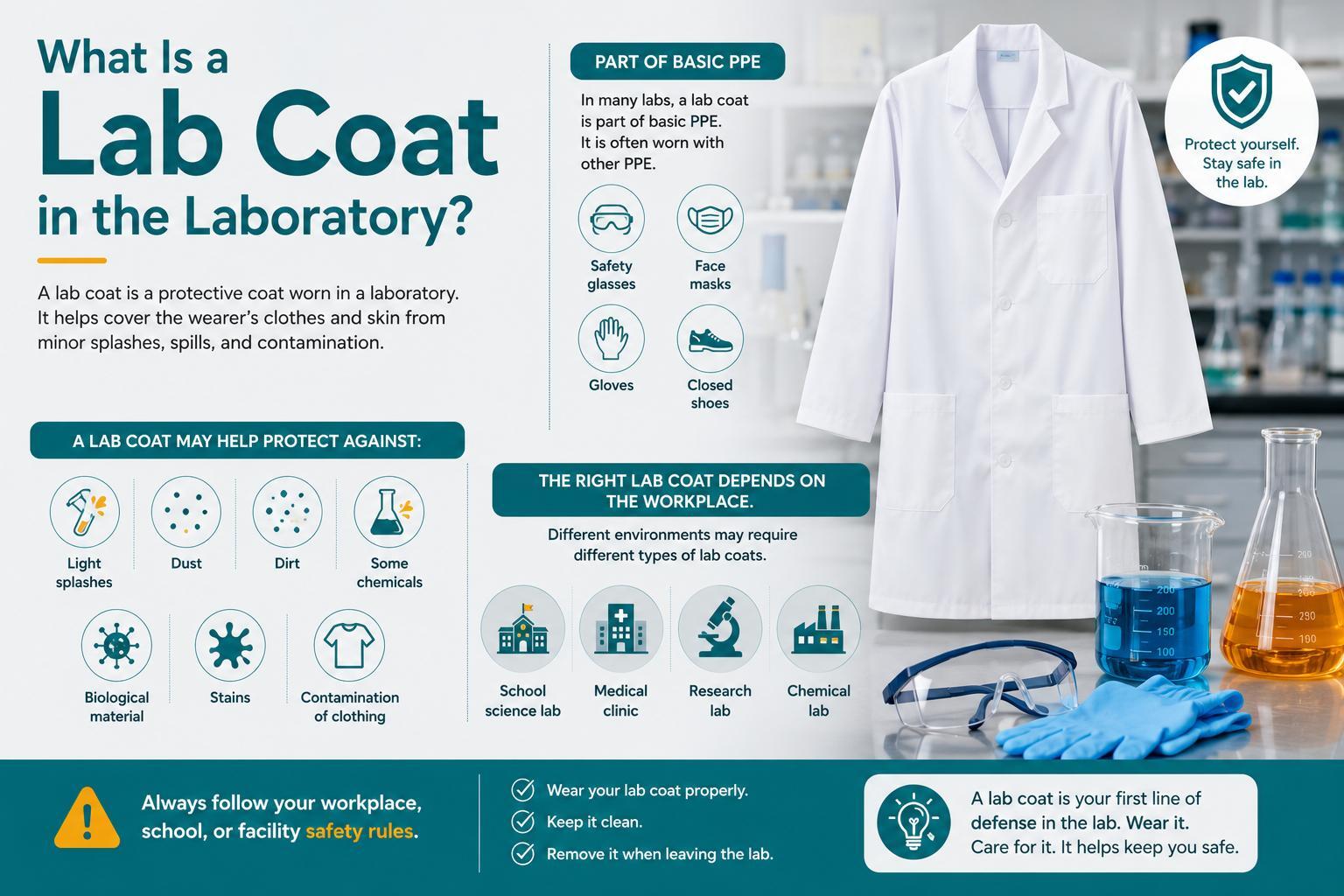
In many labs, a lab coat is part of basic PPE. It is often worn with other PPE, such as gloves, safety glasses, face masks, or closed shoes.
A lab coat may help protect against:
- Light splashes
- Dust
- Dirt
- Some chemicals
- Biological material
- Stains
- Contamination of clothing
The right lab coat depends on the workplace. A school science lab, medical clinic, research lab, and chemical lab may need different types of coats.
Always follow your workplace, school, or facility safety rules.
What Is a Lab Coat Called?
A lab coat is also called a laboratory coat. In some workplaces, it may also be called a white coat, clinical coat, science coat, PPE coat, or protective coat.
The name can change based on where it is used.
Common names include:
- Lab coat
- Laboratory coat
- White coat
- Doctor coat
- Clinical coat
- Science coat
- Protective coat
- PPE coat
- Disposable coat
- Barrier coat
Most people use the words “lab coat” and “laboratory coat” to mean the same thing.
What Are Laboratory Lab Coats Used For?
Laboratory lab coats are used to add a protective layer between the person and the work area. They help reduce contact with light splashes, spills, and workplace contamination.
Lab coats are commonly used in:
- Laboratories
- Clinics
- Dental practices
- Pharmacies
- Universities
- Schools
- Research centres
- Food testing areas
- Pathology areas
- Beauty and skincare clinics
- Medical and healthcare settings
A lab coat can also help keep work clothing cleaner. It can give a more professional look in clinical, science, and healthcare environments.
Lab coats should not be worn outside the work area if they may be contaminated. Many lab safety guides advise removing lab coats before leaving the lab or entering clean areas.
Why Are Lab Coats Important?
Lab coats are important because they help reduce exposure to some workplace hazards. They also help protect everyday clothing from contamination.
According to Safe Work Australia, PPE is anything used or worn to help keep a worker healthy and safe.
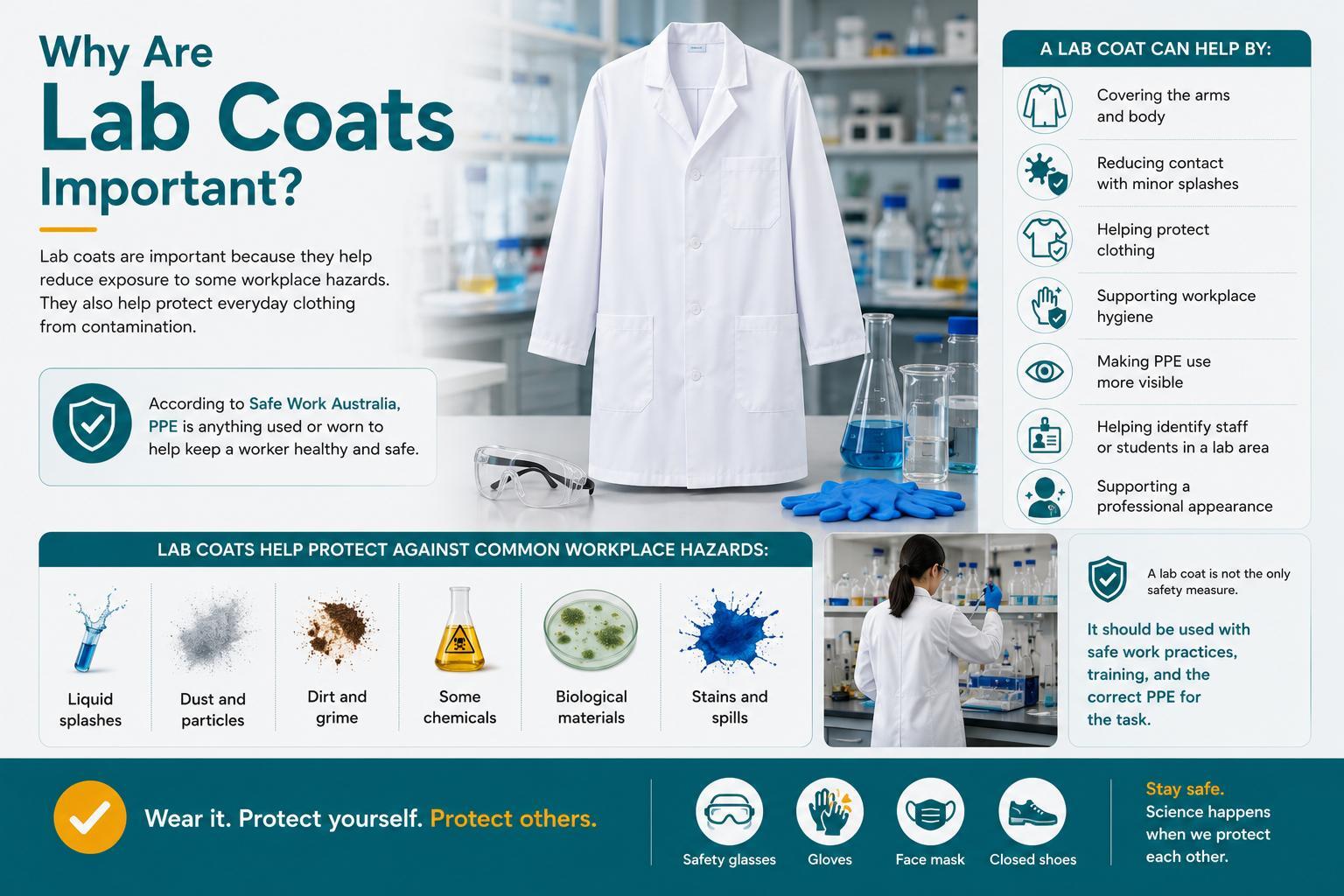
A lab coat can help by:
- Covering the arms and body
- Reducing contact with minor splashes
- Helping protect clothing
- Supporting workplace hygiene
- Making PPE use more visible
- Helping identify staff or students in a lab area
- Supporting a professional appearance
A lab coat is not the only safety measure. It should be used with safe work practices, training, and the correct PPE for the task.
What Do Lab Coats Look Like?
Most lab coats look like long button-up coats with sleeves, pockets, and a simple collar. They are usually worn over normal clothing.
A standard lab coat often has:
- Long sleeves
- Front buttons or snap closures
- A collar
- Side pockets
- A chest pocket
- Knee-length or mid-thigh length design
- White, blue, or other workplace colour
Some lab coats have elastic cuffs. Some have knit cuffs. Some have back vents for easier movement.
Disposable lab coats may look lighter and more simple. Reusable lab coats may look more structured and fabric-based.
What Type of Coat Do Labs Have?
Labs may use different types of coats depending on the hazard. Common types include reusable lab coats, disposable lab coats, fluid-resistant coats, and flame-resistant coats.
There is no single lab coat for every job. The right type depends on the work.
Common lab coat types include:
1. Standard Reusable Lab Coats
Standard reusable lab coats are common in schools, clinics, and general lab settings. They are often made from cotton, polyester, or a cotton-polyester blend.
These coats are usually washable and can be worn many times.
They may suit:
- General lab work
- Clinical settings
- School science labs
- Light-duty work
- Basic clothing protection
They may not be suitable for strong chemicals, flame risk, or high splash risk. Always check the product details and workplace rules.
2. Disposable Lab Coats
Disposable lab coats are made for single-use or limited-use situations. They are often used when hygiene or contamination control is important.
Disposable lab coats are usually lightweight. They may be made from non-woven materials such as polypropylene.
They may suit:
- Visitor protection
- Short tasks
- Food handling areas
- Cleaning tasks
- Light contamination control
- Some healthcare or clinical areas
They should be disposed of according to workplace rules.
3. Fluid-Resistant Lab Coats
Fluid-resistant lab coats are designed to help reduce liquid contact with clothing. They may be used in settings where light splashes may happen.
These coats may be used in some clinical, dental, pathology, or biological work areas.
Fluid-resistant does not always mean waterproof or chemical-proof. Always check the product description before use.
They may suit:
- Clinical work
- Light fluid splash risk
- Some healthcare areas
- Some biological work areas
For higher-risk liquids, a different protective gown, apron, or coverall may be needed.
4. Flame-Resistant Lab Coats
Flame-resistant lab coats are made for workplaces where there may be flame, heat, or flammable material risk.
These are different from standard lab coats. They are made from special fabrics or treated materials.
They may be used in some chemistry, research, or industrial labs.
Flame-resistant lab coats should be selected based on workplace safety advice. Not all lab coats are flame-resistant.
5. Chemical-Resistant Coats or Aprons
Chemical-resistant protection is used when there is a risk of chemical splash. A standard lab coat may not be enough for strong chemicals.
Some tasks may need a chemical-resistant apron, sleeve protection, or other protective clothing over a lab coat.
Chemical risk depends on the chemical type, amount, and task.
Always follow the safety data sheet, workplace risk assessment, and PPE instructions.
6. Barrier Lab Coats
Barrier lab coats are designed to give added protection in some biological or clinical settings. They may have coated front panels or sleeves.
These coats may be used where biological material or fluid contact is a concern.
They may suit:
- Some biological research areas
- Some pathology areas
- Some clinical areas
- Controlled work zones
Barrier coats should be chosen based on the hazard and facility rules.
7. Student Lab Coats
Student lab coats are used in schools, universities, and training labs. They are usually simple, lightweight, and easy to wear.
They help students follow lab safety rules and protect clothing from minor spills or stains.
Student lab coats should still fit well. Sleeves should not hang too loose. The coat should close properly at the front.
8. Clinical Lab Coats
Clinical lab coats are often worn by healthcare, pharmacy, dental, and medical staff. They may help with hygiene, professional presentation, and basic protection.
Clinical lab coats may be white, blue, or another workplace colour.
They are often used in:
- Clinics
- Pharmacies
- Dental rooms
- Medical practices
- Pathology collection areas
- Healthcare offices
For clinical work with fluid risk, the coat should be suitable for that task.
Benefits of Wearing Laboratory Lab Coats
Laboratory lab coats help protect clothing, support hygiene, and give a professional look in lab and clinical settings.
Here are the main benefits:
1. Helps Protect Clothing
A lab coat creates a layer over normal clothing. This may help protect clothes from light spills, stains, dust, and contamination.
2. Helps Reduce Skin Contact
Long sleeves and full-front coverage may help reduce direct contact with some materials.
3. Supports Workplace Safety
Lab coats remind workers and visitors that they are in a controlled work area. They also make PPE rules easier to follow.
4. Supports Hygiene
In some settings, lab coats help reduce the movement of dirt or contamination from one area to another.
5. Looks Professional
Lab coats give a clean and trusted look in science, healthcare, dental, and pharmacy settings.
6. Can Help Identify Roles
Some workplaces use different coat colours or styles to identify staff, students, visitors, or departments.
What Do Lab Coat Colours Mean?
Lab coat colours can mean different things depending on the workplace. There is no single universal colour rule for all labs.
White is the most common lab coat colour. It is often linked with cleanliness, science, healthcare, and professional use.
Other colours may be used for:
- Department identification
- Staff roles
- Student groups
- Visitor coats
- Disposable PPE
- Barrier protection
- Flame-resistant coats
- Facility colour coding
For example, some workplaces may use white for standard coats and blue for barrier or flame-resistant coats. Other workplaces may choose colours for branding or team roles.
Always follow your workplace colour code.
Common Lab Coat Colours and Possible Uses
Lab coat colours are often chosen for visibility, role sorting, or workplace preference. The meaning can change between facilities.
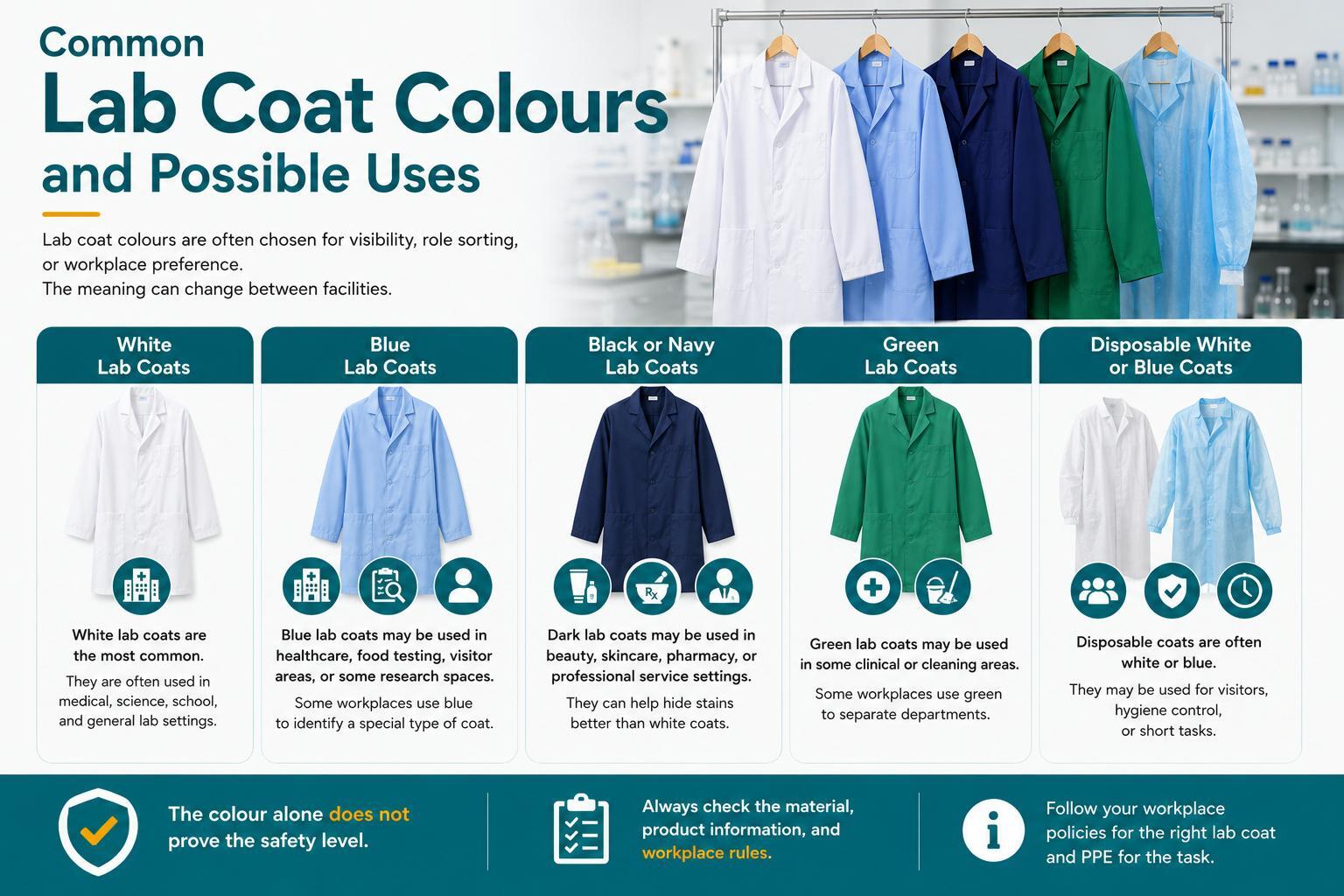
Here is a simple guide:
White Lab Coats
White lab coats are the most common. They are often used in medical, science, school, and general lab settings.
Blue Lab Coats
Blue lab coats may be used in healthcare, food testing, visitor areas, or some research spaces. Some workplaces use blue to identify a special type of coat.
Black or Navy Lab Coats
Dark lab coats may be used in beauty, skincare, pharmacy, or professional service settings. They can help hide stains better than white coats.
Green Lab Coats
Green lab coats may be used in some clinical or cleaning areas. Some workplaces use green to separate departments.
Disposable White or Blue Coats
Disposable coats are often white or blue. They may be used for visitors, hygiene control, or short tasks.
The colour alone does not prove the safety level. Always check the material, product information, and workplace rules.
What Are Lab Coats Made Of?
Lab coats can be made from cotton, polyester, cotton-polyester blends, polypropylene, or special protective fabrics.
The material affects comfort, durability, washability, and protection level.
Common materials include:
Cotton Lab Coats
Cotton lab coats are breathable and comfortable. They may be used in some general lab and clinical settings.
Cotton can feel soft and cool. It may be more comfortable for long wear.
However, cotton can absorb liquids. It may not be suitable for all chemicals or high splash risks.
Polyester or Poly-Cotton Lab Coats
Polyester and poly-cotton lab coats are common because they are durable, easy to wash, and often cost-effective.
Poly-cotton means a mix of polyester and cotton.
These coats may suit:
- General clinical use
- School labs
- Light-duty lab work
- Everyday workplace use
They may not be right for flame risk or some chemical tasks.
Polypropylene Disposable Lab Coats
Polypropylene lab coats are often disposable and lightweight. They are used for short tasks or contamination control.
They may suit visitor use, light splash areas, or hygiene-focused spaces.
Always check whether the coat is fluid-resistant or only a simple cover garment.
Flame-Resistant Fabrics
Flame-resistant fabrics are used for lab coats where heat or flame risk is present.
These coats should meet the safety needs of the workplace. They should be chosen with help from safety officers or workplace PPE rules.
Fluid-Resistant Materials
Fluid-resistant materials help reduce liquid contact. They are useful where light splashes may happen.
Fluid-resistant does not mean the coat protects from all liquids or chemicals. The product information should be checked carefully.
How Should a Lab Coat Fit?
A lab coat should cover the body well, close at the front, and allow safe movement. It should not be too tight or too loose.
A good fit is important. A coat that is too loose may catch on objects. A coat that is too tight can limit movement.
A lab coat should:
- Cover the arms
- Close properly at the front
- Fit over normal clothing
- Allow easy movement
- Have sleeves that are not too long
- Not drag or hang loosely
- Be easy to remove if needed
Elastic or knit cuffs may help keep sleeves in place. This can be useful for some tasks.
How to Choose the Right Laboratory Lab Coat
Choose a lab coat based on the work task, hazard type, comfort, fit, and workplace safety rules.
Before buying, ask:
- What will the coat be used for?
- Is the work general, clinical, chemical, or biological?
- Is there a splash risk?
- Is there heat or flame risk?
- Does the coat need to be disposable?
- Does the coat need to be washable?
- What size is needed?
- Does the workplace require a specific colour?
- Are pockets needed?
- Are elastic cuffs needed?
- Is an auto-removal or snap closure needed?
A lab coat should match the risk. Do not choose only based on colour or price.
Lab Coat Features to Look For
Good lab coats should be practical, comfortable, and suitable for the work environment.
Useful features may include:
- Long sleeves
- Front closure
- Comfortable fabric
- Good body coverage
- Easy-to-use buttons or snaps
- Pockets
- Elastic or knit cuffs
- Clear sizing
- Washable fabric, if reusable
- Disposable material, if needed
- Fluid-resistant finish, if required
- Flame-resistant material, if required
For busy workplaces, comfort matters. If a coat is too hot, too tight, or hard to move in, people may be less likely to wear it correctly.
Reusable vs Disposable Lab Coats
Reusable lab coats are made to be washed and worn again. Disposable lab coats are made for single-use or short-term use.
Both can be useful. The best choice depends on the work setting.
Reusable Lab Coats May Suit:
- Schools
- Universities
- General labs
- Clinics
- Pharmacies
- Low-risk daily work
- Staff who need regular uniforms
Disposable Lab Coats May Suit:
- Visitors
- Short tasks
- Contamination control
- Some hygiene areas
- Some clinical or food testing settings
- Workplaces that need easy disposal
Reusable lab coats may be more cost-effective over time. Disposable coats may be better when contamination control or convenience is important.
Lab Coat Safety Tips
A lab coat should be worn correctly to help it do its job. It should be closed, clean, and suitable for the task.
Follow these simple tips:
- Wear the right size
- Button or snap the coat closed
- Keep sleeves secure
- Wear other PPE when needed
- Remove the coat before leaving the lab if required
- Do not wear contaminated coats in clean areas
- Do not take contaminated coats home for washing unless your workplace says it is safe
- Replace torn or damaged coats
- Follow workplace laundry and disposal rules
A lab coat should not be used as the only form of protection. Many tasks also need gloves, safety glasses, face shields, aprons, masks, or closed shoes.
When Should You Replace a Lab Coat?
Replace a lab coat when it is damaged, heavily stained, contaminated, too small, or no longer suitable for the task.
A lab coat may need replacing if:
- It has holes
- It has tears
- The sleeves are damaged
- The front closure does not work
- It is heavily stained
- It has chemical or biological contamination
- It no longer fits
- It has lost its protective finish
- It does not meet current workplace rules
Disposable coats should be replaced according to the product instructions and workplace policy.
Can You Wash Lab Coats at Home?
Some lab coats may be washable, but contaminated lab coats should not be washed at home unless your workplace says it is safe.
Reusable lab coats often have care instructions. Always follow the label.
In labs with chemical, biological, or other hazards, laundering may need to follow strict workplace rules. Some workplaces use professional laundry services.
Do not take a contaminated lab coat into your car, home, or normal laundry unless your workplace has confirmed it is safe.
Lab Coats vs Gowns vs Coveralls
Lab coats, gowns, and coveralls are all protective clothing, but they are not the same.
Lab Coats
Lab coats are usually worn over clothing. They are common in labs, clinics, schools, and research spaces.
Gowns
Gowns often give more front coverage and may be used in healthcare or clinical settings. Some gowns are made for fluid protection.
Coveralls
Coveralls cover more of the body, including the legs. They may be used in higher-risk work areas or industrial settings.
The right choice depends on the risk and workplace rules.
Who Uses Laboratory Lab Coats?
Laboratory lab coats are used by people who work or study in science, healthcare, testing, and clinical environments.
Common users include:
- Scientists
- Lab technicians
- Doctors
- Nurses
- Pharmacists
- Dentists
- Dental assistants
- Pathology staff
- University students
- School students
- Research workers
- Beauty and skincare clinic staff
- Food testing workers
- Veterinary workers
Different users may need different types of lab coats.
Frequently Asked Questions About Laboratory Lab Coats
What is a lab coat in the laboratory?
A lab coat is protective clothing worn over normal clothes in a laboratory. It helps reduce contact with light splashes, spills, and contamination.
It is usually worn with other PPE, such as gloves and safety glasses.
What is a lab coat called?
A lab coat is also called a laboratory coat, white coat, clinical coat, science coat, protective coat, or PPE coat.
The name depends on the workplace and how it is used.
What type of coat do labs have?
Labs may use standard reusable coats, disposable coats, barrier coats, fluid-resistant coats, or flame-resistant coats.
The right type depends on the hazards in the lab.
What do lab coat colours mean?
Lab coat colours can mean different things in different workplaces. White is common, but blue, green, black, and other colours may be used for roles, departments, or PPE types.
Colour alone does not show the protection level. Always check the product details.
What do lab coats look like?
Most lab coats look like long button-up coats with sleeves, pockets, and a collar. They are usually worn over normal clothes.
Some are short. Some are long. Some are disposable. Some have elastic cuffs or fluid-resistant panels.
Are lab coats PPE?
Yes, lab coats can be PPE when they are used to help protect the wearer from workplace hazards.
They should be selected based on the task and used with other PPE when needed.
Are all lab coats the same?
No. Lab coats can differ by material, length, colour, protection level, and use.
A coat for a school lab may not be suitable for a chemical lab or biological lab.
Can lab coats protect from chemicals?
Some lab coats may help reduce light splash contact, but not all lab coats protect from chemicals.
Chemical work may need special protective clothing, aprons, gloves, or other PPE.
Should lab coats be buttoned?
Yes, lab coats should usually be closed at the front when worn in a lab.
An open lab coat gives less coverage and may not protect clothing as well.
Can lab coats be worn outside the lab?
Lab coats should not be worn outside the lab if they may be contaminated.
Many workplaces require lab coats to be removed before entering offices, lunch areas, bathrooms, or public spaces.
Simple Buying Guide: How to Choose Laboratory Lab Coats
Choose laboratory lab coats based on safety needs, comfort, fit, material, and workplace rules.
Before buying, check:
- Intended use
- Material
- Size range
- Sleeve length
- Coat length
- Closure type
- Cuff style
- Pockets
- Colour
- Washability
- Disposable or reusable design
- Fluid resistance, if needed
- Flame resistance, if needed
- Workplace PPE rules
For general clinical or lab use, a standard reusable or disposable lab coat may be enough. For higher-risk work, speak with a workplace safety officer or supplier before choosing.
Where to Buy Laboratory Lab Coats in Australia
You can shop laboratory lab coats online at MedCart Australia.
MedCart Australia is an online marketplace for healthcare, PPE, clinical supplies, and workplace essentials. You can browse lab coats and other PPE products in one place.
Shop here: Laboratory Lab Coats
Visit: MedCart Australia
Final Thoughts
Laboratory lab coats are useful protective garments for labs, clinics, schools, and healthcare settings. They help cover clothing and reduce contact with light splashes, spills, and contamination.
The best lab coat depends on the task. A standard coat may suit general use, while other work may need disposable, barrier, fluid-resistant, or flame-resistant protection.
Always choose the right coat for the job. Follow workplace rules, wear other PPE when needed, and replace damaged or contaminated coats.
References
- Safe Work Australia. “Personal Protective Equipment.”
- WorkSafe Queensland. “Personal Protective Equipment.”
- National Institute for Occupational Safety and Health. “Protective Clothing and Ensembles.”
- National Institute for Occupational Safety and Health. “Selecting Protective Clothing.”
- Massachusetts Institute of Technology Environment, Health and Safety. “Lab Coat Selection, Use, and Care.”
- National Institutes of Health Office of Research Services. “Guidance for the Selection of Laboratory Coats.”
- Occupational Safety and Health Administration. “Laboratory Safety Guidance.”
- Princeton University Environmental Health and Safety. “Lab Coat Program.”
- Weill Cornell Medicine Environmental Health and Safety. “Laboratory Coats.”
- University of Waterloo Safety Office. “Protective Clothing Guideline.”