

Quick Answer
Non disposable face masks are masks that can be used more than once.
They are often called reusable face masks or cloth masks.
A reusable face mask is usually made from fabric. It is worn over the nose and mouth. It may help reduce the spread of droplets when a person talks, coughs, or sneezes.
A reusable face mask is not the same as a medical mask or a respirator.
It is important to choose a mask that fits well, has good layers, and can be washed after use.
What Are Non Disposable Face Masks?
Non disposable face masks are face masks that are made to be reused.
They are different from single-use masks. Single-use masks are made to be worn once and then thrown away.
Reusable masks are usually made from washable fabric. Some have ear loops. Some have head ties. Some have a nose wire. Some may have a pocket for a filter, depending on the product design.
The Australian Department of Health and Aged Care says cloth masks are reusable, but they must be washed after use.
This means a reusable mask should be cleaned often and stored safely.
What Is a Reusable Face Mask?
A reusable face mask is a mask you can wash and wear again.
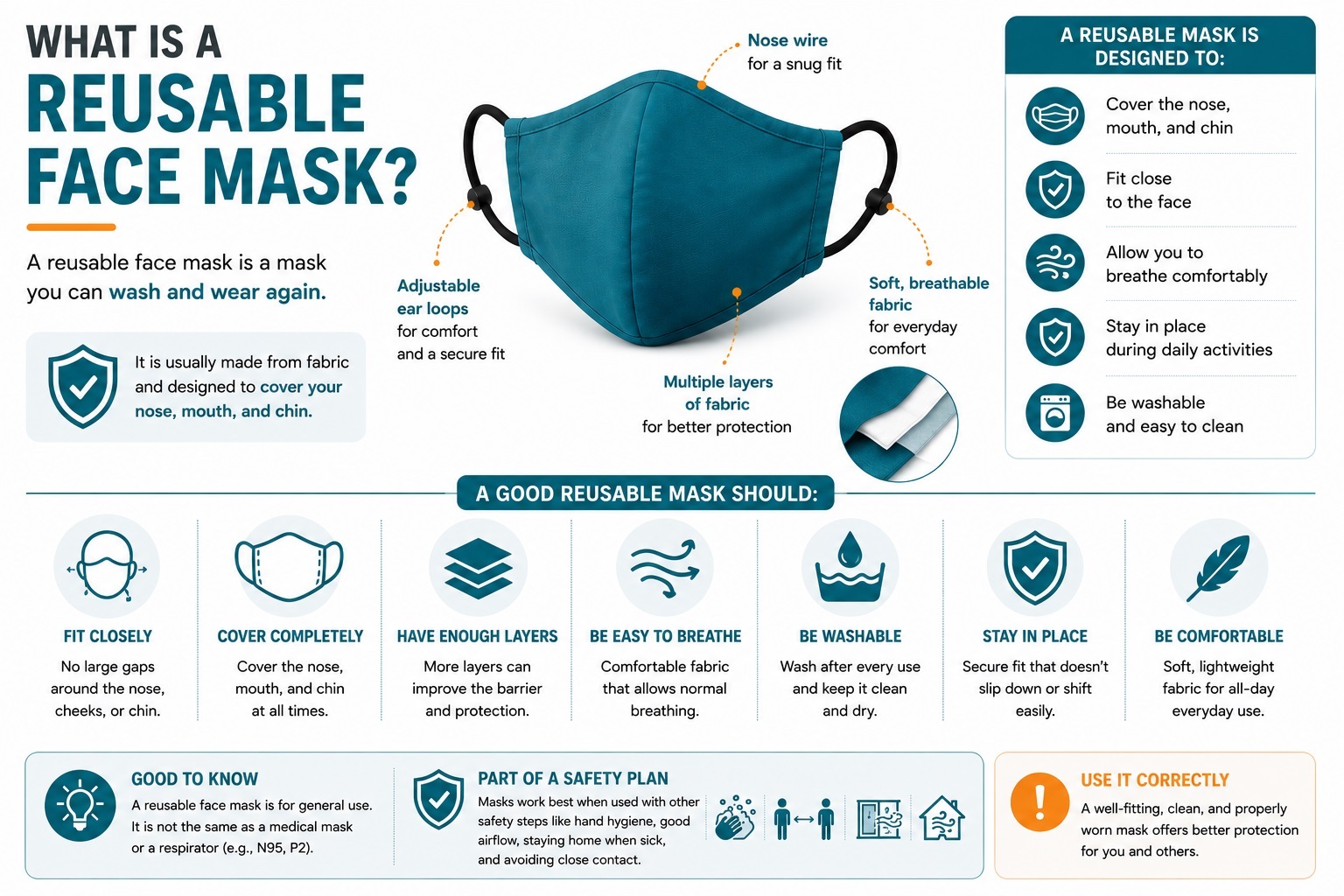
It is usually made from fabric. It should cover your nose, mouth, and chin.
A good reusable mask should:
- Fit close to the face
- Cover the nose and mouth
- Stay in place
- Be easy to breathe through
- Have enough layers
- Be washable
- Be comfortable for daily use
The CDC says cloth masks generally offer lower protection than surgical masks or respirators. However, design and fit can affect how well a mask works.
This means a well-fitting reusable mask is better than a loose or poor-fitting mask.
What Do Non-Disposable Face Masks Do?
Non-disposable face masks act as a barrier.
They may help reduce the release of droplets from the nose and mouth.
Droplets can be released when a person:
- Talks
- Coughs
- Sneezes
- Laughs
- Sings
- Breathes heavily
The WHO says masks should be used as part of a wider safety plan. A mask alone is not enough.
Other steps may include hand hygiene, staying home when sick, good airflow, and avoiding close contact when unwell.
How Do Reusable Face Masks Work?
Reusable face masks work by placing fabric between your nose and mouth and the air around you.
The fabric may help block some droplets from going out or coming in.
How well a mask works can depend on:
- The fabric
- The number of layers
- The fit
- Whether it covers the nose and mouth
- Whether there are gaps
- Whether it is clean and dry
- Whether it is worn correctly
A loose mask may let air escape through gaps. This can reduce how well it works.
Why Fit Matters
A reusable face mask should fit well.
It should sit close to the sides of the face. It should not have large gaps around the nose, cheeks, or chin.
A good fit helps the mask stay in place and cover the right areas.
A reusable mask should:
- Cover the nose
- Cover the mouth
- Cover the chin
- Sit close to the cheeks
- Feel secure
- Allow normal breathing
If a mask keeps slipping down, it may not be the right size or shape.
Why Layers Matter
Layers can help improve the barrier.
The WHO says that if you make your own non-medical mask, it should have three layers of fabric:
- An inner absorbent layer, such as cotton
- A middle non-woven layer, such as polypropylene
- An outer non-absorbent layer, such as polyester or polyester blend
Not all reusable masks have the same design. Always check the product details before buying.
Reusable Face Mask vs Disposable Face Mask
Reusable and disposable masks are used in different ways.
The Australian Department of Health and Aged Care says single-use surgical masks should not be reused and should be placed in a bin after use.
Reusable Face Mask vs Surgical Mask
A reusable face mask is not the same as a surgical mask.
A surgical mask is usually a single-use medical mask. It may be used in healthcare or other settings, depending on the product and local rules.
A reusable face mask is often made from cloth. It is usually for general use.
The CDC says cloth masks generally offer lower levels of protection than surgical or disposable masks. Respirators, such as N95 or similar products, may offer higher levels of protection when used correctly.
For general use, a reusable mask may be helpful. For healthcare or high-risk settings, you may need a different mask type.
Reusable Face Mask vs Respirator
A respirator is a special type of mask.
Examples include P2, N95, KN95, or similar filtering facepiece respirators.
Respirators are designed to fit closely and filter small particles. Some are used in healthcare or higher-risk workplaces.
A reusable fabric mask is not a respirator.
If a workplace or healthcare setting requires a respirator, a reusable non-medical mask should not be used instead.
Main Benefits of Non-Disposable Face Masks
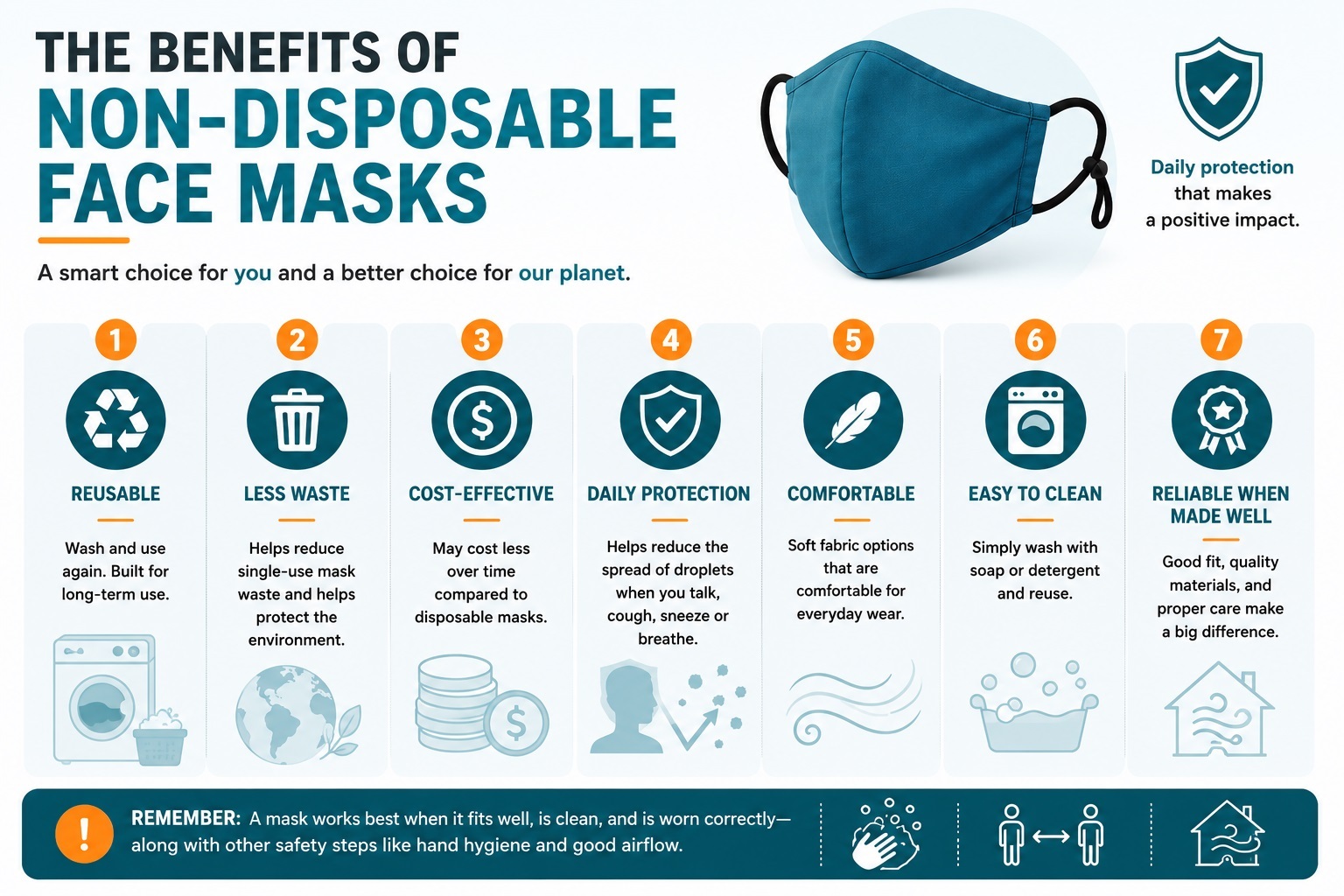
1. Reusable
The main benefit is that the mask can be washed and worn again.
This may reduce how many single-use masks you need to buy.
2. Less Single-Use Waste
Reusable masks may help reduce waste compared with daily disposable mask use.
3. Comfortable for Daily Use
Many reusable masks are made from soft fabric.
They may be more comfortable for some people during daily activities.
4. Easy to Keep at Home or Work
You can keep reusable masks at home, in your bag, at your desk, or in your car.
Make sure clean and used masks are stored separately.
5. Different Sizes and Styles
Reusable masks may come in different sizes, colours, and shapes.
This can help people choose a mask that fits their face better.
Common Uses for Non Disposable Face Masks
Non disposable face masks may be used in:
- Public transport
- Waiting rooms
- Workplaces
- Schools
- Shops
- Travel
- Shared indoor spaces
- Community settings
- Home care, if suitable
They may also be useful when you want to be careful around others, especially if you have mild symptoms or are around people at higher risk.
Always follow current health advice, workplace rules, or care setting rules.
When Should You Wear a Reusable Face Mask?
You may choose to wear a reusable face mask when:
- You are in a crowded indoor place
- You are on public transport
- You are around people who are unwell
- You have mild respiratory symptoms and need to be near others
- You are visiting a higher-risk person
- You are in a setting that asks for masks
- You want an extra barrier in shared spaces
The WHO says masks should be part of a full safety approach. This can also include hand cleaning and good airflow.
When Should You Not Use a Reusable Mask?
A reusable non-medical mask may not be suitable when:
- A medical mask is required
- A respirator is required
- The mask is wet or dirty
- The mask is damaged
- The mask is too loose
- The mask makes breathing hard
- It is not safe for the person to wear a mask
- A child cannot use it safely
Do not use a mask that is hard to breathe through.
Do not use a mask while sleeping.
Do not place masks on children under the age advised by local health guidance or product instructions.
How to Wear a Reusable Face Mask
Follow the product instructions.
A general guide is:
- Wash or sanitise your hands.
- Pick up the mask by the ear loops or ties.
- Place it over your nose and mouth.
- Secure the ear loops or ties.
- Make sure it covers your chin.
- Press the nose wire if the mask has one.
- Check for large gaps.
- Avoid touching the front of the mask while wearing it.
If you touch the mask, clean your hands.
How to Remove a Reusable Face Mask
The Australian Department of Health and Aged Care advises people not to touch the front of the mask when removing it.
To remove a reusable mask:
- Clean your hands.
- Remove it using the ear loops or ties.
- Do not touch the front of the mask.
- Place it in a bag or laundry basket.
- Wash your hands again.
- Wash the mask before using it again.
Do not place a used mask loose in your bag with clean items.
How to Wash Reusable Face Masks
Wash reusable masks after use.
The Australian Department of Health and Aged Care says cloth masks are reusable but must be washed after use.
General washing tips:
- Use laundry detergent.
- Wash with warm or hot water if the fabric allows it.
- Dry the mask fully before wearing it again.
- Store it in a clean, dry place.
- Follow the care label or product instructions.
Do not wear a damp mask.
A damp mask can feel uncomfortable and may not work as intended.
How Many Reusable Masks Do You Need?
It may help to own more than one reusable face mask.
This makes it easier to have a clean mask ready while others are being washed.
You may need:
- One for wearing
- One spare in your bag
- One or more in the wash
- Extra masks for work or travel
For families, it may help to label masks by person.
Do not share masks.
How to Store Clean and Used Masks
Keep clean and used masks separate.
Clean Masks
Store clean masks in:
- A clean pouch
- A zip bag
- A clean drawer
- A sealed container
Used Masks
Store used masks in:
- A separate bag
- A laundry bag
- A washable pouch
Wash used masks before wearing them again.
How to Choose Non Disposable Face Masks
When buying non disposable face masks, check these points.
1. Fit
The mask should cover the nose, mouth, and chin.
It should not leave large gaps at the sides.
2. Layers
Look for masks with multiple layers, where possible.
The WHO gives guidance for non-medical masks with three layers when making cloth masks.
3. Breathability
The mask should be easy to breathe through.
If it feels too hard to breathe, it may not be suitable.
4. Fabric
Choose fabric that feels comfortable on the skin.
The inner layer should feel soft enough for longer wear.
5. Nose Wire
A nose wire can help improve fit around the nose.
This may also reduce slipping.
6. Ear Loops or Ties
Choose the style that feels secure.
Ear loops are quick to use. Ties may help create a closer fit for some people.
7. Wash Instructions
Check if the mask is machine washable or hand wash only.
Choose one that suits your routine.
8. Size
Some masks come in adult and child sizes.
A mask that is too big may leave gaps. A mask that is too small may feel tight.
Product Buying Checklist
Before buying reusable face masks, ask:
- Is it reusable?
- Is it washable?
- How many layers does it have?
- Does it fit my face shape?
- Does it have a nose wire?
- Is it easy to breathe through?
- Is it soft enough for daily use?
- Does it have adjustable straps?
- How many masks come in the pack?
- What are the washing instructions?
- Is it for general use or medical use?
This can help you choose the right mask for your needs.
Who May Use Non Disposable Face Masks?
Reusable face masks may be useful for:
- Adults
- Older children, if safe and suitable
- Commuters
- Workers
- Travellers
- Students
- Carers
- People in shared indoor spaces
- People who want a reusable mask option
Always check the size, age guide, and product instructions.
Are Non-Disposable Face Masks Safe?
Reusable masks can be safe for many people when used correctly.
But they must fit well, be breathable, and be cleaned after use.
Do not use a reusable mask if:
- It is dirty
- It is damp
- It is damaged
- It smells bad after washing
- It has loose parts
- It blocks breathing
- It causes skin pain or rash
If you have breathing concerns, skin problems, or a medical condition, ask a health professional what type of mask is best for you.
Can Reusable Masks Protect Against Viruses?
Reusable masks may help reduce exposure to droplets and particles.
But protection can vary.
The CDC says cloth masks generally offer lower protection than surgical masks and respirators. The WHO also says masks should not be the only safety step.
This means reusable masks may be useful in some settings, but they should be used with other hygiene steps.
These include:
- Washing hands
- Staying home when sick
- Good airflow
- Covering coughs and sneezes
- Keeping distance when needed
- Following local health advice
Are Reusable Masks Good for Allergies or Dust?
Some people wear masks to reduce contact with dust or pollen.
However, non-medical reusable masks are not the same as respirators.
They may not filter fine particles as well as a fitted respirator.
If you need protection for dust, chemicals, smoke, or workplace hazards, check workplace safety rules and use the correct PPE.
Reusable Masks for Workplaces
Reusable masks may be useful in some workplace settings.
They may suit:
- Office spaces
- Reception areas
- Retail counters
- Shared staff rooms
- Public-facing roles
- Travel between sites
However, some workplaces need specific PPE. This may include surgical masks or respirators.
Employers should follow workplace health and safety rules.
Reusable Masks for Travel
Reusable masks can be helpful for travel because they are light and easy to pack.
When travelling, pack:
- Clean masks
- A bag for used masks
- Hand sanitiser
- Tissues
- Spare masks
Wash reusable masks after use.
Do not reuse a dirty mask just because it looks clean.
Reusable Masks for Families
Families may keep reusable masks at home for times when someone is unwell or when masks are needed in shared spaces.
Tips for families:
- Keep masks in different sizes
- Label each person’s masks
- Keep clean masks in one place
- Use a separate bag for used masks
- Wash masks after use
- Do not share masks
Common Mistakes to Avoid
Mistake 1: Wearing the Mask Under the Nose
The mask should cover both the nose and mouth.
Mistake 2: Touching the Front of the Mask
Avoid touching the front while wearing or removing it.
Mistake 3: Wearing a Wet Mask
Do not wear a damp or wet mask.
Mistake 4: Not Washing After Use
Reusable masks should be washed after use.
Mistake 5: Sharing Masks
Do not share face masks with others.
Mistake 6: Using a Damaged Mask
Replace masks that are stretched, torn, thin, or damaged.
How Often Should You Replace a Reusable Mask?
Reusable masks do not last forever.
Replace your mask if:
- It becomes thin
- It loses shape
- The straps stretch
- It no longer fits well
- It has holes
- It smells after washing
- It is hard to breathe through
- The nose wire breaks
- The fabric becomes damaged
A mask that no longer fits well may not work as intended.
Frequently Asked Questions
What are non-disposable face masks?
Non-disposable face masks are reusable masks. They are made to be washed and worn again.
Are non-disposable face masks the same as reusable masks?
Yes. In most cases, non-disposable face masks mean reusable face masks or cloth masks.
Are reusable masks medical masks?
No. Most reusable fabric masks are non-medical masks. They are not the same as surgical masks or respirators.
Can I wash a reusable face mask?
Yes. Reusable cloth masks should be washed after use. Follow the product care guide.
How should a reusable face mask fit?
It should cover your nose, mouth, and chin. It should sit close to the face without large gaps.
Are reusable masks better than disposable masks?
Not always. Reusable masks create less single-use waste and can be washed. Disposable masks may offer different levels of protection depending on the type and fit.
Can I reuse a disposable mask?
Single-use masks should not be reused. The Australian Department of Health and Aged Care says single-use masks should be disposed of after use.
How many layers should a reusable mask have?
The WHO says non-medical fabric masks should have three layers when made at home. Product designs may vary, so check the details before buying.
Can children wear reusable masks?
Some older children may be able to wear masks safely. Check the product size and age guide. Follow local health advice.
Can I wear a reusable mask all day?
You may need to change it if it becomes damp, dirty, hard to breathe through, or uncomfortable. Wash it after use.
Simple Summary
Non-disposable face masks are reusable face masks.
They are usually made from fabric and can be washed after use.
They are not the same as medical masks or respirators.
A good reusable mask should fit well, cover the nose and mouth, have suitable layers, and be easy to breathe through.
Wash reusable masks after use. Store clean and used masks separately.
Use masks as part of a wider hygiene plan, not as the only safety step.
Where to Buy Non-Disposable Face Masks
If you are looking for non disposable face masks, reusable masks, or general face protection products, you can browse reusable mask options at MedCart Australia.
Shop reusable masks here: Non Disposable Face Masks and Reusable Masks
MedCart Australia offers a wide range of healthcare, PPE, hygiene, medical, and personal care products for Australian customers.
Visit MedCart Australia here: MedCart Australia
References
This article used information from reliable sources, including:
- Australian Government Department of Health and Aged Care: Guidance on Community Face Mask Use
- Australian Government Department of Health and Aged Care: PPE donning and doffing guidance
- Therapeutic Goods Administration Australia: Face masks and medical device regulation guidance
- World Health Organization: When and how to use masks
- World Health Organization: Coronavirus disease COVID-19 masks Q&A
- Centers for Disease Control and Prevention: Masks and Respiratory Viruses Prevention
- Centers for Disease Control and Prevention: Cloth masks and mask fit guidance