



Quick Answer
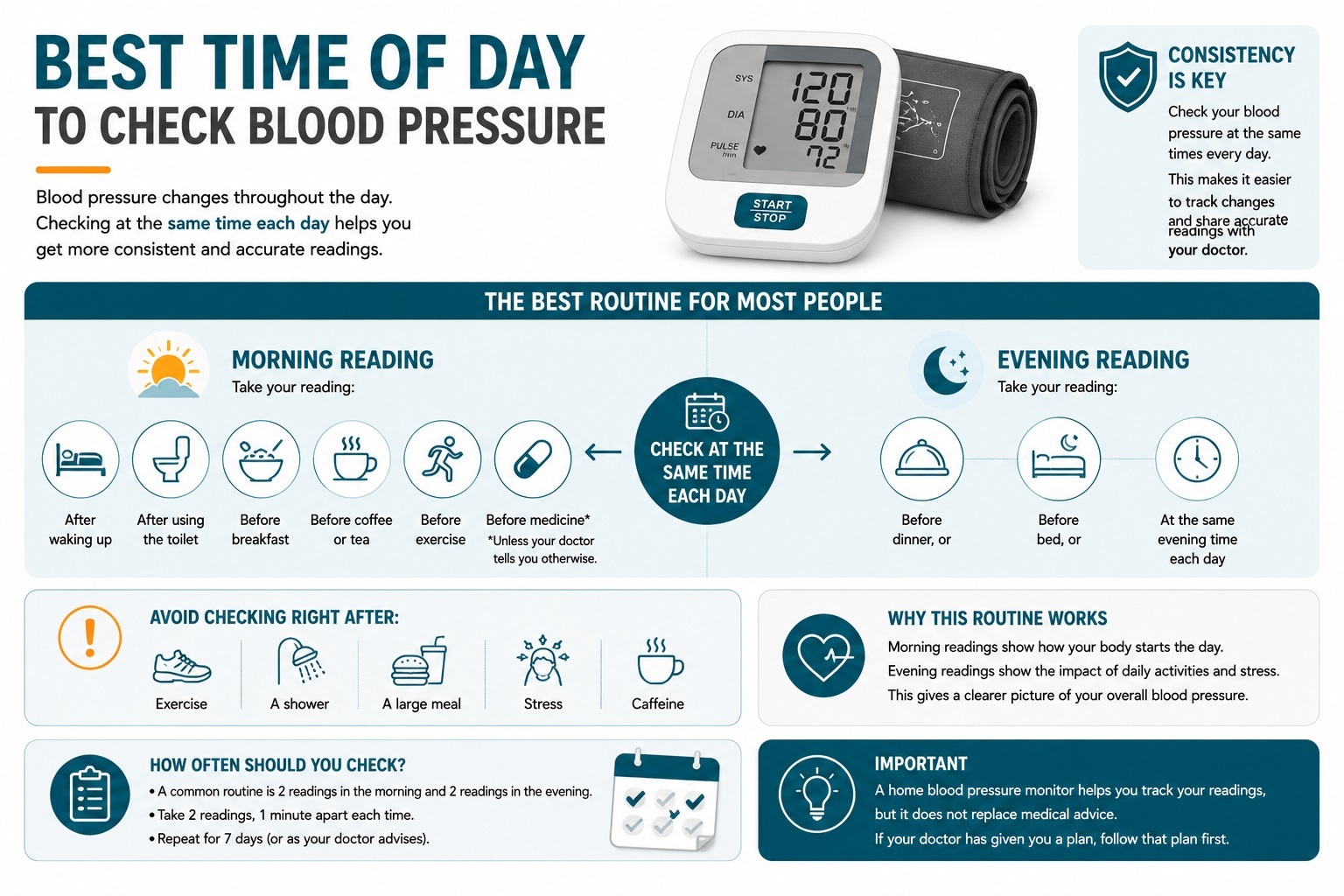
The best time to check blood pressure is usually in the morning and evening.
Many health sources suggest checking it at the same time each day. This helps you compare your readings.
A common home routine is:
- Check in the morning before food, coffee, exercise, or medicine, unless your doctor tells you otherwise.
- Check again in the evening.
- Sit quietly for 5 minutes before each reading.
- Take 2 readings, 1 minute apart.
- Write the results down.
A blood pressure monitor can help you track your readings at home. But it does not replace medical advice.
If your doctor has given you a plan, follow that plan first.
What Is Blood Pressure?
Blood pressure is the force of blood pushing against your artery walls.
It is shown as two numbers.
Example:
120/80 mmHg
The first number is called systolic blood pressure. It shows the pressure when the heart beats.
The second number is called diastolic blood pressure. It shows the pressure when the heart rests between beats.
According to healthdirect Australia, blood pressure can change during the day. It can change due to movement, stress, food, caffeine, pain, and other factors.
This is why one reading does not always tell the full story.
What Is a Blood Pressure Monitor?
A blood pressure monitor is a device used to measure blood pressure.
Most home blood pressure monitors use a cuff. The cuff wraps around your upper arm or wrist.
An upper arm blood pressure monitor is often preferred for home use. The cuff size must fit your arm correctly.
A blood pressure monitor may help you:
- Track your readings at home
- Share readings with your doctor
- Check if your readings change over time
- Follow a doctor’s monitoring plan
- Understand how time of day affects your readings
A home monitor is useful, but it should be used correctly.
Why Does Time of Day Matter?
Blood pressure naturally goes up and down during the day.
It may be lower when you are resting. It may rise after exercise, stress, caffeine, smoking, or a busy day.
This means your reading can look different depending on when you check it.
Checking at the same time each day helps make your readings more consistent.
The American Heart Association says to measure blood pressure at the same time every day.
The Heart Foundation Australia also says your doctor may ask you to take readings at around the same time in the morning or evening.
Best Time to Check Blood Pressure at Home
For many people, the best routine is:
Morning Reading
Take your morning reading:
- After waking
- After using the toilet
- Before breakfast
- Before coffee or tea
- Before exercise
- Before medicine, unless your doctor says otherwise
Mayo Clinic says morning readings are often taken before eating or taking medicine.
If your doctor has told you to take medicine first, follow your doctor’s advice.
Evening Reading
Take your evening reading:
- Before dinner, or
- Before bed, or
- At the same evening time each day
Try not to check right after exercise, a shower, a large meal, stress, or caffeine.
Choose a calm time when you can sit quietly.
How Many Times Should You Check BP?
Your doctor may give you a schedule.
A common home blood pressure routine is:
- Morning: 2 readings
- Evening: 2 readings
- Repeat for 7 days, or as advised
Healthdirect Australia says your doctor may ask you to monitor your blood pressure at home twice a day for 7 days.
The Heart Foundation Australia says readings are often taken for 7 days, with a minimum of 5 days, around the same time in the morning or evening.
Do not check too often unless your doctor asks you to. Checking too much may cause stress.
Should You Check BP Before or After Medicine?
Many guides suggest checking blood pressure before medicine in the morning.
However, this may not be right for everyone.
Some people may be told to check after medicine. Some may be told to check at another time.
If you take blood pressure medicine, ask your doctor or pharmacist when you should check.
Do not stop or change medicine based only on a home reading.
How to Use a Blood Pressure Monitor Correctly
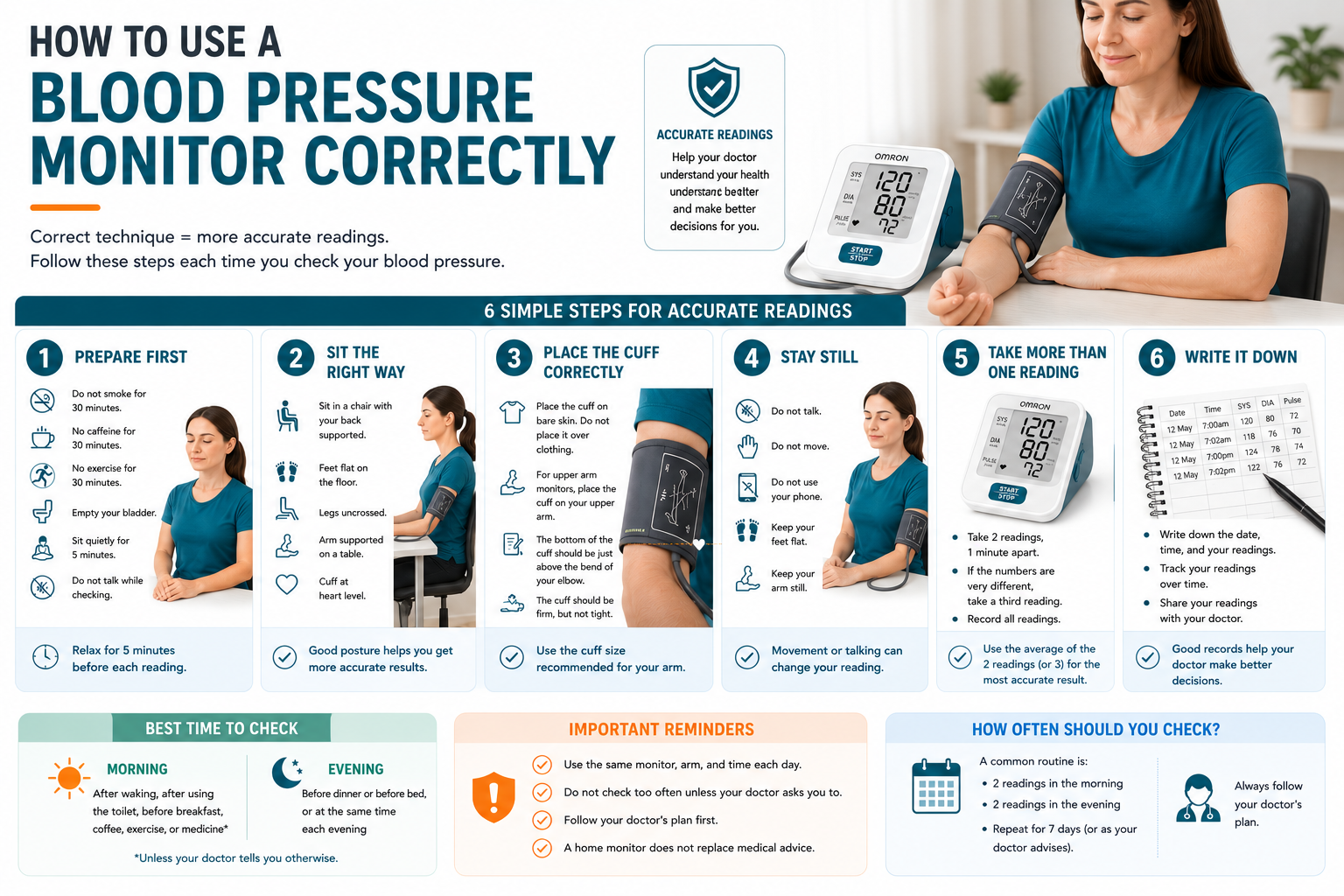
A blood pressure monitor works best when you use it the right way.
Step 1: Prepare First
Before checking your blood pressure:
- Do not smoke for 30 minutes.
- Do not drink coffee or caffeine for 30 minutes.
- Do not exercise for 30 minutes.
- Empty your bladder.
- Sit quietly for 5 minutes.
- Do not talk while checking.
The American Heart Association says to avoid smoking, caffeine, and exercise 30 minutes before taking a reading.
Step 2: Sit the Right Way
Sit in a chair with your back supported.
Keep your:
- Feet flat on the floor
- Legs uncrossed
- Back supported
- Arm supported
- Cuff at heart level
Healthdirect Australia says you should sit relaxed for 5 minutes with your legs uncrossed, feet on the floor, and back and arm supported.
Step 3: Place the Cuff Correctly
Place the cuff on bare skin.
Do not place it over clothing.
For an upper arm monitor, the cuff should sit on your upper arm. The bottom of the cuff is usually just above the bend of your elbow.
The cuff should feel firm, but not painful.
Use the cuff size recommended for your arm.
Step 4: Stay Still
While the monitor is reading:
- Do not talk
- Do not move
- Do not use your phone
- Keep your feet flat
- Keep your arm still
The CDC says correct measurement includes no talking, back supported, feet flat, and the cuff on bare skin.
Step 5: Take More Than One Reading
Take 2 readings, about 1 minute apart.
Write both readings down.
Some people may be asked to take 3 readings. Follow your doctor’s advice.
Step 6: Write It Down
Record each reading with the date, time, and blood pressure result. Keeping a log helps you track changes over time and share accurate readings with your doctor.
Morning vs Evening Blood Pressure
Morning and evening readings can both be useful.
Morning Readings May Show
Morning readings may help show your blood pressure before the day starts.
They may be affected by sleep, morning stress, caffeine, food, or medicine timing.
Evening Readings May Show
Evening readings may show your blood pressure after a full day.
They may be affected by work, stress, exercise, meals, or activity.
Both times can help show a pattern.
This is why many home monitoring plans include both morning and evening checks.
Should You Check Blood Pressure Every Day?
Not everyone needs to check blood pressure every day.
Your doctor may ask you to check daily for a short time. This may help confirm a pattern.
Some people may check less often after that.
A doctor may ask for home monitoring if:
- Your clinic readings are high
- You are starting or changing medicine
- You have a history of high blood pressure
- You need to track treatment
- You may have white coat hypertension
- You may have masked hypertension
White coat hypertension means blood pressure is higher in a clinic but lower at home.
Masked hypertension means blood pressure is normal in a clinic but higher at home.
Your doctor can explain what your readings mean.
What Is a Normal Blood Pressure Reading?
Blood pressure targets can vary by person.
Healthdirect Australia says a healthy or normal blood pressure for most people is under 130/85 mmHg.
It also says high blood pressure is usually 140/90 mmHg or more.
But your personal target may be different.
Your doctor will tell you what range is right for you based on your health history.
What Can Affect Your Blood Pressure Reading?
Many things can change your reading.
These include:
- Caffeine
- Smoking
- Exercise
- Stress
- Pain
- Talking
- Full bladder
- Cold temperature
- Recent meal
- Alcohol
- Some medicines
- Poor sleep
- Wrong cuff size
- Moving during the test
- Measuring over clothing
This is why you should prepare the same way each time.
Common Blood Pressure Monitor Mistakes
Mistake 1: Measuring Too Soon After Coffee
Coffee and caffeine can affect readings.
Wait at least 30 minutes before checking.
Mistake 2: Talking During the Reading
Talking can change your result.
Stay quiet until the reading is done.
Mistake 3: Crossing Your Legs
Crossed legs can affect the reading.
Keep both feet flat on the floor.
Mistake 4: Using the Wrong Cuff Size
A cuff that is too small or too large can give wrong readings.
Check the cuff size before buying a blood pressure monitor.
Mistake 5: Placing the Cuff Over Clothing
The cuff should go on bare skin.
Do not measure over a sleeve.
Mistake 6: Checking When Stressed
If you are stressed, in pain, or upset, your reading may be higher.
Rest first and try again later, unless you feel very unwell.
How to Keep a Blood Pressure Diary
A blood pressure diary helps you and your doctor see patterns.
Write down:
- Date
- Time
- Systolic number
- Diastolic number
- Pulse, if shown
- Notes, such as coffee, stress, exercise, or medicine
Example:
Monday, 8:00 AM — 128/82 mmHg, pulse 72 — before breakfast
Bring your diary to your next appointment.
Some blood pressure monitors can store readings. Some can connect to an app. But a written diary also works well.
What Type of Blood Pressure Monitor Should You Buy?
When choosing a blood pressure monitor, check these points.
1. Upper Arm Monitor
Upper arm monitors are commonly used for home checks.
They may be easier to position at heart level than wrist monitors.
2. Correct Cuff Size
The cuff must fit your arm.
A wrong cuff size can give wrong readings.
Check the arm size range before buying.
3. Easy-to-Read Screen
Choose a monitor with a clear screen.
Large numbers can help older adults or people with low vision.
4. Memory Storage
Some monitors store past readings.
This can help you track changes over time.
5. Irregular Heartbeat Indicator
Some monitors show an alert if they detect an irregular pulse.
This is not a diagnosis. It means you may need to ask a doctor if the alert keeps appearing.
6. Battery or Power Option
Check if the monitor uses batteries, a power adapter, or both.
7. Simple Controls
Choose a device that is easy to use.
A one-button monitor may be best for many homes.
Upper Arm vs Wrist Blood Pressure Monitor
Upper Arm Monitor
An upper arm monitor is often the preferred home option.
It is placed on the upper arm and should sit at heart level.
Wrist Monitor
A wrist monitor may be smaller and easier to carry.
But wrist position matters a lot. If the wrist is not at heart level, the reading may be less accurate.
If you are unsure, ask your doctor or pharmacist which type is best for you.
When Should You Not Check Blood Pressure?
Do not check right after:
- Exercise
- Smoking
- Coffee
- Alcohol
- A large meal
- Showering
- Feeling very stressed
- Walking up stairs
- Doing housework
Rest first.
If you feel very unwell, have chest pain, severe shortness of breath, fainting, weakness, or confusion, seek urgent medical help.
What If Your Reading Is High?
One high reading does not always mean there is a problem.
Rest for 5 minutes and check again.
If your readings stay high, write them down and contact your doctor.
If you have a very high reading and feel unwell, seek urgent medical help.
Do not change your medicine without medical advice.
What If Your Reading Is Low?
A low reading may be normal for some people.
But low blood pressure can be a concern if you feel symptoms such as:
- Dizziness
- Fainting
- Weakness
- Confusion
- Blurred vision
- Feeling clammy
If you feel unwell or your readings are often low, speak with a doctor.
Can You Check Blood Pressure Too Often?
Yes, some people may check too often.
This can cause stress. Stress may then affect the reading.
Follow your doctor’s plan.
If you do not have a plan, a common option is to check at set times for a short period, such as morning and evening for several days.
Then share the results with your doctor.
Blood Pressure Monitor Buying Guide for Home Use
Before buying a blood pressure monitor, ask:
- Is it for upper arm or wrist?
- Does the cuff fit my arm?
- Is the screen easy to read?
- Does it store readings?
- Is it simple to use?
- Does it show pulse?
- Does it come with a case?
- Does it use batteries or power?
- Is it suitable for home use?
- Can I bring it to my doctor to compare readings?
You may also ask your doctor or pharmacist if your monitor is suitable.
Best Home Routine for Checking BP
Here is a simple routine:
Morning
- Use the toilet.
- Sit quietly for 5 minutes.
- Place the cuff on bare skin.
- Take 2 readings, 1 minute apart.
- Write them down.
Evening
- Choose a calm time.
- Avoid caffeine, smoking, and exercise for 30 minutes before.
- Sit quietly for 5 minutes.
- Take 2 readings, 1 minute apart.
- Write them down.
Try to use the same arm each time.
Frequently Asked Questions
What is the best time of day to check BP?
A common time is morning and evening. Try to check at the same time each day. Follow your doctor’s advice if they give you a different plan.
Should I check BP before or after breakfast?
Many guides suggest checking in the morning before breakfast. This helps reduce the effect of food, caffeine, and activity.
Should I check BP before or after medicine?
Many guides suggest checking before medicine, but this may not apply to everyone. Ask your doctor or pharmacist what is right for you.
How long should I rest before checking BP?
Sit quietly for about 5 minutes before taking a reading.
Can I talk during a blood pressure reading?
No. Stay quiet while the monitor is taking the reading.
Which arm should I use?
Use the arm your doctor recommends. If you are not sure, ask your doctor. Once you choose an arm, try to use the same arm each time.
How many readings should I take?
A common method is to take 2 readings, 1 minute apart. Your doctor may suggest a different plan.
Is a home blood pressure monitor accurate?
A home blood pressure monitor can be useful when used correctly. The cuff size, body position, and timing can affect the result.
Can coffee affect blood pressure readings?
Yes. Caffeine can affect readings. Avoid caffeine for at least 30 minutes before checking.
Can stress affect blood pressure readings?
Yes. Stress, pain, and worry can affect readings. Try to measure when you are calm and rested.
Simple Summary
The best time to check BP is often in the morning and evening.
Use your blood pressure monitor at the same time each day.
Before checking:
- Rest for 5 minutes.
- Sit with feet flat.
- Keep your back supported.
- Place the cuff on bare skin.
- Keep your arm supported at heart level.
- Do not talk.
- Take 2 readings.
Write your readings down and share them with your doctor.
A blood pressure monitor is a helpful home tool, but it does not replace medical advice.
Where to Buy Blood Pressure Monitors
If you are looking for a blood pressure monitor for home, clinic, aged care, or workplace use, you can browse blood pressure monitoring products at MedCart Australia.
Shop blood pressure monitoring products here: Blood Pressure Monitor
MedCart Australia offers a wide range of healthcare, monitoring, testing, medical, and personal care products for Australian customers.
Visit MedCart Australia here: MedCart Australia
References
This article used information from reliable sources, including:
- healthdirect Australia: Blood pressure monitoring at home
- healthdirect Australia: What is a healthy blood pressure?
- Heart Foundation Australia: Blood pressure and your heart
- Royal Australian College of General Practitioners: Home blood pressure measurement recommendations
- American Heart Association: Home blood pressure monitoring
- Centers for Disease Control and Prevention: Measuring your blood pressure
- Mayo Clinic: Home blood pressure monitoring guidance